Uakpaeva M.M.
Kostanai State University of A.Baitursynov, the
Republic of Kazakhstan
Factoring is a key factor for
business development
In
today's business environment the purveyors are often forced to provide
customers deferment of payment. Depending on the degree of the sold good's
liquidity, the average credit period varies from 20-45 days. Advantages of
trade credit to the buyer are obvious: there is no need to take out of
significant amounts of money, as in the case of advance payment or payment upon,
the buyer can schedule debt repayment schedule, as well as to minimize the risk
of law-quality goods. However, the agreement of suppliers to provide trade
credit leads to a reduction in current assets and the decline of the current
liquidity of these companies, cash shortages and reduce financial stability,
which ultimately has a negative impact on the profitability of the business and
the volume of profits. The burden of debt is exacerbated if the buyer does not
comply with terms specified in the contract. However, the increase in the
provision or deferred payment is a major competitive advantage in the market,
and sometimes the only argument that attracts buyers.
In an
effort to prevent the occurrence of delinquent or bad debt providers conduct
daily monitoring of accounts receivable. The most effective management of
accounts receivable is possible with independent control, for example, by the
factoring company. Factoring company checks payment discipline and reputation
of buyers, monitors the timeliness of payment for the supply debtors, manages
risks to and helps to build up limit and tariff policy [1].
The
main task of factoring is providing a system of customer relationships, in
which the supplier can provide competitive payment delay their clients without
experiencing shortage of working capital. This is possible through early
financing the supply of a deferred payment to factor in a convenient mode for
the provider.
Funding
is provided on the day when the airbill is invoiced for the shipped consignment.
Size of prepayment makes up to 90% of the total supply. Cash balances minus the
factor's commission returns after payment of delivery by the buyer. Thus, the
supplier is able to plan their cash flow, regardless of the payment discipline
of customers.
Factoring
scheme is shown below [2].
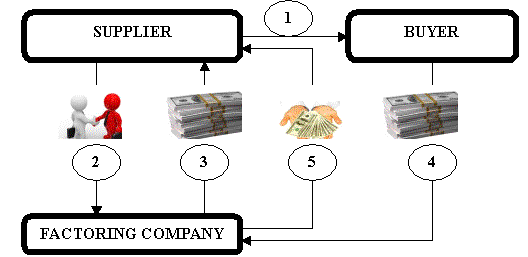

Figure 1. Factoring
scheme
There is a scheme
of a factoring:
1.
Delivery of goods on deferred payment.
2.
Assignment of the debt claim to deliver to the Bank (or factors).
3.
Financing (up to 90% of the delivered goods) immediately after delivery.
4.
Payment for the delivered goods
5.
Payment of the supply's residue less of commissions to factor.
Factoring
is often compared to a bank loan, although these financial products designed to
meet the different needs of suppliers. So, prepayments received under factoring
services company, usually used to finance current operations and loans - as
investment or innovative means.
Comparison
factoring and bank loan is presented in table 1 [3].
As we can
see factoring has advantages over credit. Under factoring, along with
financing, the Bank managing receivables provider frees him from the analytical
and practical work. Receiving from the bank exhaustive information employees
can concentrate their efforts on the development of production, sales, market
research, solving economic, organizational and other issues. It is important to
note that when factoring bank covers the main risks supplier arising in
shipments with a deferred payment - the risk of non-payment or delayed payment
of delivery by the buyer.
Table 1. Comparison
of banking products
|
Factoring |
Bank loan |
|
Factoring financing is
repaid from the money received from client's debtors |
Bank credit is paid back by
the borrower |
|
Factoring financing is paid
for a period of actual delay of payment (up to 90 calendar days) |
Loan is given for a fixed
period, usually up to 1 year |
|
Factoring financing is paid
on the day of delivery |
The loan is paid on the day
specified in the contract |
|
Factoring company's transition
to cash and settlement services to the Bank is not required |
The loan provides the
borrower transition to cash and settlement services to the Bank |
|
For factoring financing no
collateral is required |
The loan usually requires
collateral |
|
Size of the actual funding
is not limited and can infinitely increase as sales customer |
The loan is issued for an
agreed amount |
|
Factoring financing is
repaid on the day of actual payment delivered goods by the debtor |
The loan is repayable in
advance due to the day |
|
Factoring financing is paid
automatically when available invoices |
To obtain a loan you must
draw a huge amount of documents. |
|
Factoring financing
continues indefinitely |
Repayment of the loan does
not guarantee a new loan |
|
Factoring financing is
accompanied by a service that includes: accounts receivable management,
covering the risks associated with the supply on credit terms, consulting and
so on |
The Bank does not provide
any additional services to the borrower when lending in addition to providing
customer funds and cash management services |
Using
factoring allows companies to:
- increase the
liquidity of receivables;
- eliminate cash
gaps;
- insure risks
associated with providing customers deferred payment;
- develop
relationships with existing customers and attract new ones;
- expand its market
share.
In more detail the advantages
of factoring for the seller and buyer are presented in table 2 [3].
Table 2. Advantages
of factoring
|
For the seller |
For the buyer |
|
1.Additional unsecured funding |
1. More favorable payment terms that do not require the diversion of
significant funds from the turnover in the case of prepaid or postpaid |
|
2.Accelerated turnover of accounts receivable |
2. Planning for debt repayment schedule |
|
3.Reducing losses in the event of
late payment by the buyer |
3. Increase in purchasing power. |
|
4.Simplify planning money circulation |
|
|
5.Increase in turnover |
|
|
6.Gain control over the payment of current liabilities |
|
|
7.Ability to offer customers flexible payment terms |
|
|
8.Timely payment of taxes |
Estimation the efficiency of the use of
factoring in companies shows all the advantages of this financial instrument. It
is sufficient to analyze the growth in sales of goods when almost unlimited
funding. Of course, bank fees for factoring reduces the amount of revenue from
each particular delivery, but growth in the number of shipments increases the
overall amount of revenue, and therefore have a positive effect on the absolute
and relative performance of the company.
To
date, factoring is used very successfully in the delivery of food, cosmetics
and alcoholic products, stationery goods, consumer goods, medicines, household
chemicals, etc. All these branches combine high liquidity products, as the
demand for them is constant and high. However, it should be noted that
factoring can be applied in all areas where there are constants trade
connections and practiced delay of payment, clearing and settlement.
Literature:
1. Zverev V.A. Why the suppliers
of products is needed factoring // Economist's Directory, № 10, 2007, p.121-127
2.
Usolceva A.G. Development of factoring in modern conditions // STEZH, № 8, 2009, p.41-44
3. Web-site
// www.1factoring.kz