Bryakotnin Nikolay
Aleksandrovich
Irkutsk national research technical university, Russia
Overall physical
condition of student’s youth
Relevance of the
research. In recent years the problem of public healthhas
escalated in Russia. According to statistics the health of more than 50% of
children became more impaired: the majority of children under the age of 14
years suffer from chronic diseases, only 10% of children who have graduated
from school, can be classified as normal [1]. The incidence rate for children
under the age of 14 years increased at 16 % and at 18% for children aged 15 to
17 years. In this context level of physical fitness of students became reduced [2].
This situation increases the urgency of the work to implement the monitoring
studies of the physical fitness of young people in order to increase the
effectiveness of physical training [3].
Monitoring of physical growth of children, adolescents, young people is
a complex information and analytical process, involving monitoring of the
condition of physical health of each individual and social group issuing
results of the evaluation and prediction of physical health in the future, both
for the person and for a group of people combined a territorial basis or the
business occupation– the process of the observation of the object, the analysis
of his health condition, of current events, warning of negative consequences.
Physical training is one of the most important components of human
health. Scientists have observedit for a long time. Among the main physical
indicators of monitoringstand out speed, endurance, strength, flexibility and
agility.
The goal of the research is upgrading of management of physical training and improvementof quality
based on the results of monitoring studies of the physical health of 70
students of 1-4 courses of the Popov Institute of Cybernetics of the National
Research Irkutsk State Technical University in the period from 2010 to 2014
years.
Materials and methods. The results of monitoring observations of students in 2010-2014years
were analyzed. The monitoring based on such physical parameters as agility,
speed, endurance, strength, dynamic strength of muscles of the lower
extremities and flexibility.
Key findings. The results of the level of overall physical condition of students are
presented in Diagram 1-7.
It has been established that the parameter of speed and agility (shuttle
run 10 * 5) has a different index over the years. As seen in Diagram 1, in
2010-2011 years, the characteristics of this index is 15,9 ± 0,1 sec. The
dynamics of the data marked deterioration of results in this test. Thus, in the
2011-2012 academic year index decreased to 16,1 ± 0,1 sec., in 2012-2013 to
16,6 ± 0,2 sec., up to 16,7 ± 0,2 with. in 2013-2014.
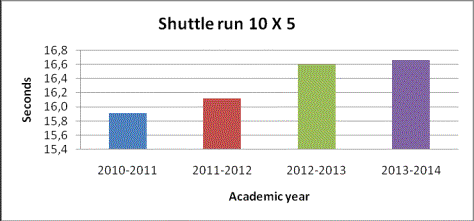
Diagram1.Shuttlerun
As seen in Diagram 2, in 2010-2011 year, in the run 100m characteristic
of this index is 14,3 ± 0,1 sec. In the 2011-2012 academic year index improved
to 13,9 ± 0,1 sec.The following characteristics show deterioration of index in
this test. Thus, in 2012-2013 and 2013-2014 academic years indicator
deteriorated by 1.1 times and amounted to 14,1 ± 0,1 sec.
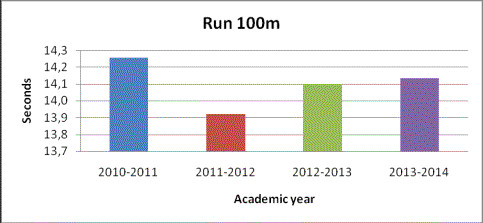
Diagram2.Run100m
The endurance index (run 1000m) has various characteristics over the
years. In 2010-2011 years (Diagram 3) the characteristics of this index is
04:02,4 ± 0:0.35. The data dynamics noted that the indicator improved in the
2011-2012 academic year and was 03:57.0 ± 0:0.32, and then deteriorated. So in
the 2012-2013 academic year, it was 04:01.7 ± 0:0.37, and in 2013-2014 04:03.4
± 0:0.03.
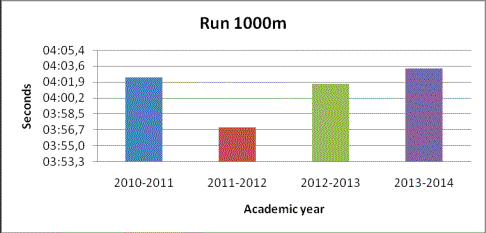
Diagram3.Run1000m.
The force index (hang / pull-up) has different characteristics over the
years. As seen in Diagram 4, in 2010-2011, the characteristics of this index is
9,4 ± 0,5 times. The dynamics of the data showed improvement in the 2011-2012
academic year to 10,5 ± 0,6 times, and in 2012-2013 to 10,9 ± 0,7 times. In the
2013-2014 academic year, noted the deterioration rate to 9,6 ± 0,6 times.

Diagram4.Hang/pull-up
The force index (situp) has approximately the same characteristics from
year to year. As seen in Diagram 5, in 2010-2011, the characteristics of this
index is 29,4 ± 0,2 times. The dynamics of the data indicated that the index
remained at the same level as in the 2011-2012 academic year, it is 30,0 ± 0,5 times, in the 2012-2013 academic year, 29,9 ± 0,5 times,
and in 2013- 2014 year- 29,4 ± 0,7 times.
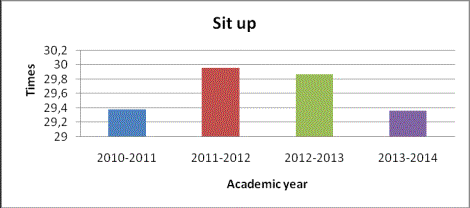
Diagram5.Situp
The indicator of the dynamic forces of the lower limbs (standing jump)
has different characteristics over the years. As seen in Diagram 6, in
2010-2011, the characteristic of this indicator was 233.0 ± 2 cm. The dynamics
of the data showed improvement in the 2011-2012 academic year to 237.5 ± 2
cm.The following characteristics show deterioration of index in this test. So
in the 2012-2013 academic year decreased to 234,0 ± 2,2 cm., and in 2013-2014 to
231,5 ± 2,7 cm.
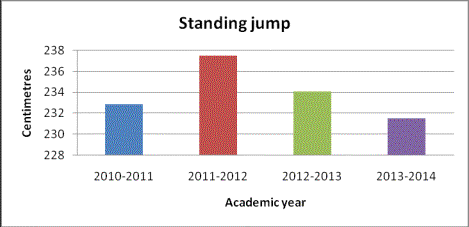
Diagram6.Standing jump
The flexibility index (bending body / flexibility) has different
characteristics over the years. As seen in Diagram 7, in 2010-2011, the
property value of this indicator was 9.3 ± 1 cm. The dynamics of the data indicated
that the rate remained at the same level. In the 2011-2012 academic year,
accounting for 10,2 ± 0,9 cm, and in the 2012-2013 academic year, accounting
for 10,1 ± 1,1 cm. In the 2013-2014 academic year has significantly declined to
3,5 ± 1 3 cm.
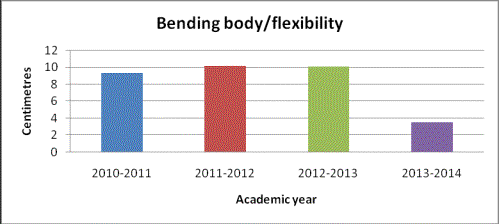
Diagram7.Bending body/flexibility
Conclusion. The important point is the constant attention to the use of modern
information technology, specially developed author's programs of physical
education to improve the health of young people by means of physical culture,
as well as a variety of physical activity.Especially important is to master the
technique of monitoring health outcomes for tests of physical development,
physical and functional training with the further conclusion of the
effectiveness of innovative solutions used in the educational process.
The graphs shows that in 2010-2011 had an average result for endurance index,
strength and flexibility. The best result was achieved in the 2011-2012
academic year, and by the 2013-2014 school year rates declined. The index of
speed and agility was the best in the 2010-2011 academicyear, and then
gradually deteriorated. This indicates deterioration in the efficiency of
physical training of students.
References:
1.
Yurchenko O.V. Physical development and physical fitness of the system of monitoring
the state of physical health //Fundamentalnyeisledovaniya. – 2012. – № 3 (2). – Pp. 324-327;
2.
URL:www.rae.ru/section=content&op=show_article&article_id=982162
3.
Izaak S.I. С.И. Monitoring of physical development and physical fitness of the theory
and practice // Monograph. — M.:
Sovetskii sport, 2005. — 196 p.
4.
Gusev Y.A.Monitoring of physical development of students // Fundamentalnyenaukaipraktika. – 2010 - №1 – Pp.
9-11.