Candidate Biol.
Sci. Slepchenko N.A.,
Candidate Biol.
Sci. Malyarovskaya V.I.
The State Research Institution All–Russian
Scientific and Research Institute of Floriculture and Subtropical Crops of the
Russian Academy of Agricultural Sciences, c. Sochi, Russia, e-mail: lab-bfbr@vniisubtrop.ru
VARIATIONS IN ANATOMICAL INDICATORS
OF GALANTHUS WORONOWII LOSINSK DEPENDING ON ENVIRONMENTAL CONDITIONS
Abstract. The aim of our
study was to investigate the influence of abiotic factors (in the first place -
light) on the anatomical structure of Galanthus
woronowii leaf blades. It is istablished that G. woronowii plants react to changes in light regime conditions.
Thus, in shading, typical changes occur in the epidermis, characterized by decreasing
the number and length of stomata per 1 mm2 in both the upper and the
lower epidermis. In contrast, plants that grow in lighting conditions in open
sunny areas, had an increasing number and size of stomata (mostly in length).
Thus, G. woronowii plants can be used
in landscaping of both shaded and open sunny areas.
Key
words: Galanthus woronowii Losinsk, endemic species, guard cells of
stomata, lighting, environmental conditions.
Introduction
Variation
in anatomical structure of plants vegetative organs, depending on the
environment is widely known and described by many researchers [1, 2, 3]. At the
same time, some authors established strong dependence of the change in leaves
anatomical features on environmental factors [4, 5]. Adaptability of plants to
various environmental factors may be reflected by leaf mesostructure,
therefore, information on its structure will complement the environmental
characteristics of the species. That is why, the study of plants life,
depending on abiotic conditions, as well as their response to changes in these
conditions is, of course, the scientific and practical interest.
In
this regard, the aim of our study was to investigate the influence of abiotic
factors (in the first place - light) on the anatomical structure of Galanthus woronowii leaf blades.
Voronov's snowdrop plants
(Galanthus woronowii Losinsk) served
as a research object. This species
is included in the Convention on International Trade in Endangered Species of
Wild Fauna and Flora (CITES, Appendix II).
This
species belongs to the category of rarity "Vulnerable". It is a rare
sporadically distributed Colchic-lazistansky endemic species with decreasing
population. It is a perennial herbaceous plant belonging to the early-spring
bulbous ephemeroids. Flowering period is January-March. Factors limiting the
spread of G. woronowii are an intense
gathering for bouquets, development of Sochi foothill zone, bulbs digging for
introduction, preparation as a medicinal plant [6].
Research Methods.
Laboratory
studies were carried out on the basis of the Laboratory of Biotechnology,
Physiology and Biochemistry of Plants in the State Research Institution
All–Russian Scientific and Research Institute of Floriculture and Subtropical
Crops of the Russian Academy of Agricultural Sciences (c. Sochi).
Plant
leaves of different ecotypes were studied in the experiment: growing in a
well-lit area and under the shading. Coeval model plants (5-7 plants from
different habitats) were chosen. Preparation of time preparations was carried
out by standard methods [7]. Preparations were viewed under the light
microscope Axio Imager M2 (Carl Zeiss Jena, Germany) with the
software at different magnification lens. The study determined the number and
size of stomata, with an increase of 10 x 10; 10 x 20; 10 x 40. In each option,
five samples were measured in 25 fields of view.
Results and Discussion
The
observations showed that the leaves in this species are dense, leathery, with a
well-developed cuticle. The venation is arcuate; the midrib forms a
well-defined keel.
Leaves
are amphistomatic (stomatal apparatus is available on both
sides of leaf), the stomata are oval and have an elongated-oval shape. Galanthus woronowii leaf epidermis
consists of elongated cells of a rectangular shape, among which there are
stomatal apparatuses. The study found that different environmental conditions
affect the change in the number, length and width of stomata.
So,
in Galanthus woronowii number of
stomata in 1 mm2 leaf area was significantly higher on the abaxial
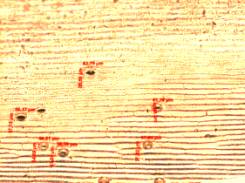
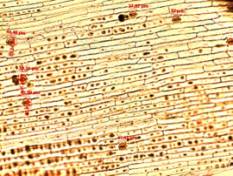
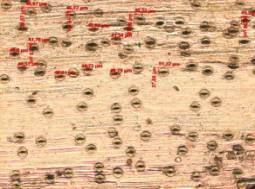
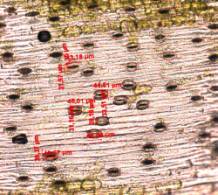
(lower) epidermis (in 5-7 times) than on the adaxial (upper) (Fig. 1.).
|
a |
c |
|
b |
d |
|
Fig.1. Change in the number and size of Galanthus woronowii stomata depending
on growing conditions: a;b).
adaxial and abaxial leaf sides (in lighting); c;d). adaxial and abaxial leaf sides (in shading). (Enlargement 10x10). |
|
Also
it is revealed that the lighting conditions in test sites significantly
affected the studied indicator, while, the number of stomata on the top and
underside of leaves was more in the plants growing in the lighted areas: 15,33
± 0,58 and 77,33 ± 1,15 , respectively, than that in the plants growing in the
shade (Table 1). The same results were obtained for other biometric indicators
(length of stomata). The plants from the lighted parts had a length of the
stomata with both adaxial and abaxial side which was more in 13,93 micrometers
and 19,11 micrometers, respectively; the differences in this indicator were
significant (НСR05 – 2,72 and 3,05). As for the width of the stomata, significant
differences between the options were not observed.
Table
1: Changes in the quantitative and qualitative characteristics of the guard
cells of stomata of Galanthus woronowii
depending on growing conditions
|
The surface of epidermis |
Growing conditions |
The number of stomata, pcs. |
Length, micrometers |
Width, micrometers |
|
Adaxial side |
Lighted area |
15,33±0,58 |
54,15±1,49 |
38,60±2,03 |
|
|
Area in shade |
9,33±0,58 |
40,22±0,82 |
38,74±3,06 |
|
|
НСР05 |
1,31 |
2,72 |
5,89 |
|
Abaxial side |
Lighted area |
77,33±1,15 |
49,00±1,50 |
30,24±1,06 |
|
|
Area in shade |
68,00±1,00 |
29,89±1,22 |
32,21±1,93 |
|
|
НСР05 |
2,45 |
3,05 |
2,56 |
We
have found out that depending on the light level in an area on which G. woronowii plants grow, the shape of
stomatal apparatus was also changing. In light conditions the stomatal
apparatus had an elongated in length - oblong-oval shape, and in shaded
conditions - oval-round. Changes in the shape of G. woronowii stomatal apparatus, according to the different growth
conditions may indicate a sufficiently high ecological flexibility of this
species.
Conclusion.
It
is shown that G. woronowii plants
react to changes in light regime conditions. Thus, in shading, typical changes
occur in the epidermis, characterized by decreasing the number and length of
stomata per 1 mm2 in both the upper and the lower epidermis. In
contrast, plants that grow in lighting conditions in open sunny areas, had an
increasing number and size of stomata (mostly in length). Thus, G. woronowii plants can be used in
landscaping of both shaded and open sunny areas.
REFERENCES
1. Kutas, Ye.N. Effect of light regime on plants
anatomical structure / Ye.N. Kutas // Bull. Main. Bot. Gard. - 1991 - Iss. 161
- P. 67-71.
2. Samelik Ye.G.
Changing of the length of hydrangea guard cells / Ye.G. Samelik, L.V.
Tsatsenko, V.I. Malyarovskaya // Scientific support of agro-industrial complex.
Materials from the third All-Russian scientific-practical conference of young
scientists. - Krasnodar, 2009 - P. 692-693.
3. Malyarovskaya V.I. Variability of
morphological and anatomical indicators of H.
macrophylla leaves, depending on the habitat/ V.I. Malyarovskaya /
Subtropical and ornamental horticulture. The State Research Institution
All–Russian Scientific and Research Institute of Floriculture and Subtropical
Crops of the Russian Academy of Agricultural Sciences, Sochi, 2011. Iss. 45 -
P. 225-229.
4. Goryshina T.K., Antonova I.S. Samoilov Yu.I.
Workshop on plant ecology. SPb.: publ. off. of SPb University, 1992. 140 p.4.
5. Djachenko A.P. Comparative analysis of
structural and functional features of the photosynthetic apparatus in different
ecological groups of higher plants // Mesostructure and functional activity of
photosynthetic apparatus. Sverdlovsk, 1978. P. 93-102.
6. Red Data Book of Krasnodar region. (Plants
and Fungi) / resp.ed.. S.A. Litvinskaya. - 2nd ed. - Krasnodar: LLC
"Design Bureau №1", 2007. – 640 p.
7. Pausheva Z.P. Workshop on plants cytology.
4th ed., Rev. and ext. - M .: Agropromizdat, 1988 - 271 p.