Doctor of Economics Simonyan T.V., KnyazevaU.S.
Don State Technical University
Management of social organization through the
mechanism of scholarship provision
Growing relevance of studying the problems of
education and learning motivation is the result of the close connection of
these problems with the socio- economic development of society, as education
provides feedback to all spheres of public life. Feeling the social pressure of
these subsystems, it, by ordering
random effects within its borders, transforms them into stable forms of
knowledge about the world as repetitive behaviors of students and forms the
traditional system of values of the younger generation, which
ultimately creates the possibility of further development of society. In today's
rapidly changing and globalizing world, filled by large-scale with information,
requiring a constant flow of new knowledge, the role of students is growing. This
understanding gives rise to a new
attitude to the students as an important resource of the modern Russian state.
The transition to a market economy has caused not only
positive but also negative changes in educational services. One of the most
serious consequences is reduced
motivation to quality knowledge.
The factors forming quality of education
include:
¾
external - state management education;
¾
internal - the teaching
staff and students, the logistics of the educational process, technology of education
and educational work
One of the most important factors in the success of
building of the information society in Russia is to develop in students a
positive motivation for education. It is necessary to search for new mechanisms
of socialization of students, creating the motivation that determines interest
and desire to learn. It is important to
note that the values, motives, attitudes of students personality should be
considered through the prism of their inherent lifestyle and environmental
features, with its numerous processes of social and economic changes that
affect students as a large social group.
Powerful
incentive to successful mastering of an educational program is scholarship. Unfortunately, at the moment
the size of the state academic scholarships is such that students have to get a
job while studying, which leads to
weakening of motivation towards learning. State Academic Scholarship
ceased to fulfill its once conceived social purpose - to provide a normal life to
a student. Scholarship becomes an element of the incentive scheme as an
external way of influence on human motivation.
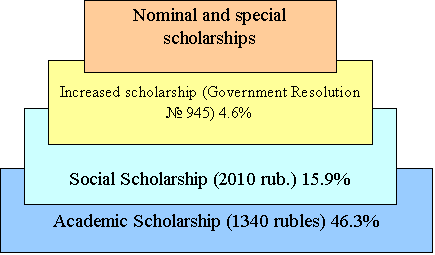

Figure 1 - Types of
scholarship and students coverage getting it (the total number of full-time
students, according to MES)
There is a need for understanding the degree of influence of the size of
material rewards to motivate student learning; allocation of factors and
conditions that underpin learning motivation.

Figure 2 - Formation of the scholarship fund
Figure 2 shows the procedure for forming the scholarship fund of the
university, its main tasks include:
1. Motivating students for successful
assimilation of basic educational programs.
2. Promoting well-performing NPO pupils, students and doctoral candidates.
3. Protection of socio-economic rights and interests of the NPO pupils,
students, graduate and doctoral students.
4. Encourage active participation in educational, scientific, social,
artistic and sporting life of the university.
5. Social support NPO pupils,
students, graduate and doctoral students in need.
The
main objective of the educational institution is to promote the interest to learning so that students aim will
become not just getting a diploma but a diploma, which confirms strong and
stable knowledge. It is important to avoid a situation of reassessment of priorities, as shown in
Figure 3.


Figure 3 — changing of priorities in learning among
students
Goals of the students' motivation:
1.
Upgrading the system of providing a sholarship.
2.
Modernization of the system of extracurricular
activities.
3.
Introducing the practice of providing mini-grants to
implement student projects.
The state's interest "in the creation of"
highly qualified specialists are confirmed by the increasing number of the scholarship funds of Russian
universities.
In November 2011 the government issued a decree of the
Russian Federation № 945 on improving provision of sholarship in public
institutions of vocational education, according to which universities received the
right to appoint and pay an increased scholarship for achievement in teaching,
research, social, cultural, artistic and sports activities (one or more areas),
and for achievement in the educational activity is not more than 20 per cent of
the increased scholarship fund. The decision on the amount of the scholarship is
made by the Academic Council of the
university. Existing restrictions (number of receiving a scholarship may not
exceed 10 percent of total state receiving an academic scholarship and in case
of academic debt or retake the exam (pass) due to valid reason for two
consecutive semesters prior to appointment of scholarships, increased shcolarship is not assigned ) allow
to get such a scholarships that it can be an incentive for " excellence
." Figure 4 shows the percentage of students receiving a higher state
academic scholarship (PGAS) in different directions and the average size
according to the criteria in rubles. *
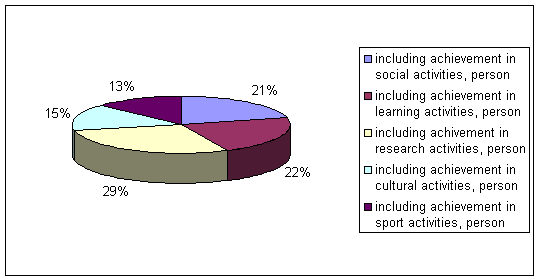
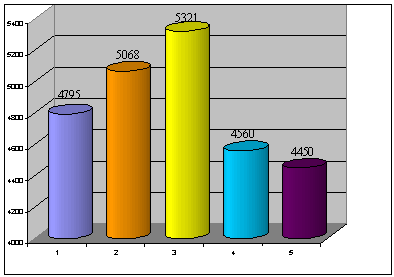
Figure 4 -
Structure destination elevated scholarships
Efficient allocation of the scholarship fund is as
follows :
- Implementation of the budget for the scholarship
fund ;
- Even distribution of the scholarship fund by month ;
- Maximizing the achievement of the stimulating effect
- namely, the appointment of the optimum size of scholarships of state academic
scholarships , state social grants, etc. , in accordance with regulatory
requirements with the largest standard , size and period of appointment of
scholarships ;
- improving the quality of education in terms of
increasing the number of students receiving the results of the intermediate
attestations "good" or "excellent."
Optimization of scholarship is necessary to avoid
falling into a situation of " antistimulation " when talking about
the relationship between the results and incentives is used an " anticipatory " stimulation.
Growth of state academic scholarship motivates
students to improve estimates of intermediate certification .
The sharp increase in the number of students leads to
reduction in the size of these scholarships, which in turn dramatically reduces
the incentives for the development of educational programs.
Thus, there is a hypothesis that the nature of the
scholarship payments are one of the key motivators of self-identification by
students themselves as students, which leads to the disclosure of their
motivational attitudes and creative opportunities, which leads to higher
quality of education.