Master Zhalelkanova N
East Kazakhstan State
University S.Amanzholov
Biological assets in fishing industry
Nowadays there is reformation of accounting in
Republic of Kazakhstan in accordance with generally accepted principles,
assumptions and rules, set out in the International Financial Reporting
Standards (IFRS).
In this regard a promising way to improve
the accounting of expenses for fish farming production are the practical
application of the provisions of IAS 41 "Agriculture" in the fish
farms. In particular IAS 41 Agriculture synthesized as the management of the
biological transformation. In fish farming biotransformation consists of the
processes of growth, degeneration, reproduction fish seed production and fish
farming, which resulted qualitative or quantitative changes in a biological asset.
Biological asset
One can get products in fish
farming by separation from the biological asset (production of eggs from
fish-producing) or by stopping the further biotransformation of a biological
asset, ie end of its life and existence as an object of production (catch of
grown market fish ).
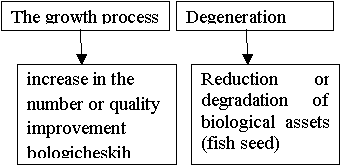


Pattern 1. The
nature and results of biotransformation in fish farming
During
the practical use of IAS 41 there is a need for a theoretical justification of
biological assets and agricultural production in fish farming, as well as the
development of methods of their fair value, which will provide the conditions
for a meaningful analysis of the resource potential and production management by fishery products.
In accordance with IAS 41
"Agriculture", fish stocks are biological assets in fish farming
(bot-spawn, fry, one year old fry) and marketable fish, commercial products
include fingerlings and marketable fish. This approach does not fully reflect
the organizational and technological features of the fishery and does not allow
an economically sound reflection in the accounting of biological assets and
received commodity products in fish farming.
It is proposed, based on the organizational and
technological features of fish farming to highlight biological assets and
commercial products listed in table 1.
Table 1. Biological assets in fish and their
products
|
Biological assets |
Commercial products |
|
Uterine |
Caviar |
|
Fish producers |
|
|
Larvae |
fingerlings |
|
fry |
|
|
yearlings |
|
|
yearlings |
commercial fish |
|
Two-years |
|
|
Fish in the fattening |
Allocation of these biological assets in fish farming
will economically sound reflection in accounting resulting from their
biotransformation products.
For effective management of biological assets
and processes of these assets` changes are of particular importance to
substantiate their assessment, accounting and income, expenditures and
financial results from the biotransformation of these objects. All this
requires a science-based classification and identification of biological assets
in the system of management of agriculture according to certain criteria
grouping.
In the account of biological assets grouping of
biological assets in fish farming involves at the following classification
criteria:
-
duration
of the use of and getting agricultural products and / or additional biological
assets (short-term or current and non-current). Biological assets which
can produce agricultural products and /
or additional biological assets, bringing in another way economic benefits over
a period exceeding 12 months are long-term, all other is short-term;
-
maturity
(mature and immature). Mature are the biological biological assets, which are
able to produce agricultural products regularly and / or additional biological
assets;
-
the
ability to get multiple agricultural products and / or additional biological
assets ( fruiting and consumed ) . Bearer biological assets are able to produce
agricultural products repeatedly and / or additional biological assets(fruiting
and consumed). Consumable biological assets are capable to produce agricultural
products once, then they cease to exist.
Management of the biological transformation , that is contributing the quantitative and qualitative changes of
biological assets , means the creation of the necessary institutional ,
technical and other conditions for its implementation. From the standpoint of
accounting, management , in this case involves the measurement, evaluation and
control of qualitative and quantitative indicators of biotransformation
consumed fruit-bearing fruiting consumed consumed fruit-bearing fruiting Mature
( fish producers) Immature ( repairmen young) Mature ( fingerlings , fish
fattening ) immature (larvae , fry , yearlings , two-year- ) Biolo giches Kieu
assets Short (larvae , fry fingerlings , yearlings , fish fattening ) Long-term
( fish - producers) , Heifer consumed