УДК 37’072
O. V. Volchanskyy, assosiate
professor, PhD in Physics
Kirovohrad
State Volodymyr Vynnychenko Pedagogical University,
Kirovohrad,
Ukraine
UNITED STATES CORPORATE RESEARCH:
History of University-Industry Linkages
The paper examines the process of emergence and
development of the university corporate research in the United States of
America.
Keywords : corporate research, employee training, university-industry
corporate linkages.
Among the factors
contributing to the success of the U.S. economy over the past decade – as
reflected in the doubling of productivity growth compared to the preceding two
decades – is the continued transformation of the U.S. economy toward a more
entrepreneurial form of capitalism. University research developed in corporate
linkages with industries through the Federal, State and philanthropic support
sets quite an important place in this process and as numerous studies show is
gathering momentum.
University-Industry Corporate Research is the interdependent research relationships
between universities and companies, under which universities, sponsored by
businesses, develop a technology or any other innovation which becomes the
company property. The goal of
the article is to survey the origin of the university-industry linkages in the
USA and the transformation of the former into corporate research interaction.
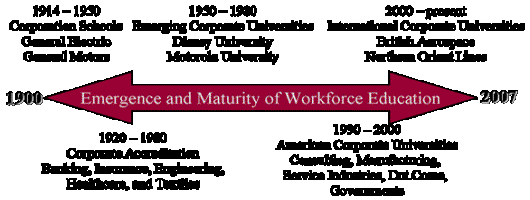
In the United States, university-industry research
relationships began with the industrial revolution [9]. Traditionally, it
was the industry that sought partnerships with universities as a means to
identify and train future employees. But very often big business and industry
created training and development departments or corporate universities of their
own to provide employees, both rookie and veteran, with the skills necessary to
perform their duties with precision and efficiency [8].
Table 1
Growth of Corporate
Universities [6]
 .
.
Alongside, the relationships of industries and existing classical
universities developed. Before the mid-20-th century those relations were
random, narrow and not systemic. But closer to the present, as industrialization
increased, more universities became directly involved in the development of
technology for commercial purposes.
Universities and corporations first entered into agreements allowing
corporations to exploit intellectual property rights arising from university
research in the 1920s, when scientists from the University of Wisconsin founded
the Wisconsin Alumni Research Foundation (WARF). This foundation sought to
protect university inventions through patent protection and to introduce
discoveries to the public through the use of licensing arrangements with
industry. Though WARF achieved early successes, the practice of patenting and
licensing inventions to industry did not reach widespread use until the 1940s,
when several other major
universities began following the technology licensing methods developed by WARF
[5].
Universities were a valuable source of scientific knowledge and
expertise for the nascent chemical and pharmaceutical industries from the late
19th century onward [7]. Those, in turn, stimulated research in universities. Biomedical and
biological research began to flourish at the University of Pennsylvania, the
University of Delaware, and Rutgers, thus inducing the simultaneous growth and
collocation of corporate research labs of companies such as Sterling, Merck,
DuPont, and Eli Lilly.
World War II was a boon for technology development. The programs
launched during the war and the scale of the funding provided by the
government, made large-scale scientific research an integrated part of the
activities of several leading American universities. Under this approach,
Harvard entered into a long-term, large-investment contract to develop a
particular technology. This type of university-corporate agreement provided an
additional model for commercializing university
inventions by concentrating on a particular objective for a collaborative
arrangement [5]. Later, when the
Cold War escalated, research for the purpose of technology development became
more firmly entrenched.
Massive Federal support for research became institutionalized in the
United States, along with equally massive spending on research and development
(R&D) by the corporate sector. A portion of this money was funneled to the
universities and helped formalize and cement university-industry links that had
begun multiplying in the 1940s.
The end of the 20-th century and the beginning of the
21-st century have been enduring a thunderstorm of changes so fundamental that some say the very idea of
the university is being challenged. Universities are experimenting with new
ways of funding, forging partnerships with private companies and engaging in
mergers and acquisitions.
Development
of University-Industry Corporate Relations becomes an objective, and therefore,
inevitable process for a number of reasons:
1. Democratization of higher
education—“massification”: the proportion of adults with higher educational
qualifications almost doubled between 1975 and 2000, from 22% to 41%.
2. The
rise of the knowledge economy. The best companies are now devoting at least a
third of their investment to knowledge-intensive intangibles such as R&D, licensing and marketing.
3. Globalisation.
US universities are opening campuses all around the world; and higher education
is turning into an export industry.
Competition. The traditional universities are being forced to compete
for students and research grants, and private companies are trying to break
into a sector which they regard as “the new health” [10].
4. The
demand for innovation. Ceaseless innovation that permits companies to
continuously refresh their product lines is becoming a necessity for many [8].
5. The
mounting cost and complexity of technologies [2] encourage firms to adopt “open”
innovation systems that favor partnerships, alliances, consortia, and
coordination of research effort with universities [1].
6. Necessity
for company researchers to deepen scientific knowledge for further
technological advance; to rely more on university-based researchers in emerging
fields where interdisciplinary expertise is required, such as nanotechnology
and biotechnology.
7. The conduct of cutting-edge research now requires teamwork—sometimes
straddling several disciplines—and expensive equipment for conducting
experiments and measuring results [4].
For those reasons now every industrial country is moving to make
university-industry links a centerpiece of its innovation systems, and the
notion of a triple helix –representing
the symbiotic relations yoking together the government, the universities, and
the business community – has acquired wide currency [3]. The path to the triple helix begins from two
opposing standpoints: a statist model of government controlling academia and
industry (Figure 1) and a laissez-faire model with industry, academia, and
government separate and apart from each other, interacting only modestly across
strong boundaries (Figure 2). New organizational innovations especially arise from interactions among the three helices (Figure 3).
The common triple helix format supersedes variation in national innovation
systems.
Table 2
Triple helix models
of university corporate relations
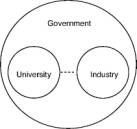
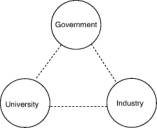

Fig. 1 Statistic model Fig. 2
Laissez-faire model Fig.3
Interactive model
Presently, Triple Helix intersection of relatively independent
institutional spheres generates hybrid organizations such as technology transfer offices in universities,
firms, and government research labs and business and financial support
institutions such as angel networks
and venture capital for new technology-based firms that are increasingly
developing around the world [3].
Thus, industry-university linkages originated as cooperation between
businesses and educational establishments, when the latter were training
companies’ future employees, and further transformed into current form of
interdependent research, when a new technology, profitable for a financing
company, is elaborated by university researchers.
REFERENCES
1. Chesbrough,
Henry William. Open Innovation: The New Imperative for Creating and Profiting
from Technology.– Boston : Harvard Business Review Press, 2003. – 226
p.
2. David,
Paul A., Dominique Foray, W. Edward
Steinmueller. The Research Network and the Economics of Science: From Metaphors
to Organizational Behaviours // In The Organization of Economic Innovation in
Europe / Ed. Gambardella A., Malerba F. –
Cambridge : Cambridge University
Press, 1999. – P. 303–342.
3. Etzkowitz,
Henry. The Triple Helix: University–Industry–Government. Innovation in Action.
– NY, London : Taylor & Francis
Group, 2008. – 164 p.
4.
Galison, Peter L. , Hevly B. Big Science: The Growth of Large-Scale Research. –
Stanford : Stanford University Press, 1994. – 408 p.
5. Hill D. Corporate Sponsored Research and
Development at Universities in the United States / David W. Hill // AIPPI
Journal. – 2002. – June // http://www.finnegan. com/resources/articles/articlesdetail.aspx?news=4447f1c1-c2fe-422a-9863-cd36a97158f9.
6. History
of Corporate Universities [article] // http://www.cuenterprise.com/ 777about/
cuhistory.php.
7. Mowery
D., Rosenberg N. 1998. Paths of
Innovation: Technological Change in 20th-century. – Cambridge : Cambridge
University Press. – 214 p.
8. Shahid,
Yusuf. University-Industry Links: Policy Dimensions. How Universities Promote
Economic Growth / Edit. Yusuf Sh., Nabeshlma K. – Washington : The World
Bank, 2007.– P.1–21.
9. University-Industry Linkages and UK Science
and Innovation Policy / Hughes, Alan [paper] // http://docs.google.com/viewer?a=v&q=cache:ayfm
9Lv4Kv0J:citeseerx. ist.psu.edu/viewdoc/download.
10. Wooldridge, Adrian. The brains
business. The Economist [article] // http://www.economist.com /node/4339960.