Магистрант Юлдашева М.
Региональный социально-инновационный университет
The Effect of IWB when Using in the Classroom
There
have been numerous studies carried out on the use of information and
communications technologies for educational purposes. One of them was done in
2003 by The British Educational Communications and Technology Agency (Becta),
which is the Government's lead agency for information and communications
technology. In addition, there are seminars and conferences dedicated to the
use and affectivity of IWB. According to research, there are three key
benefits:
·
" encourages more varied, creative and seamless use of teaching
materials
·
engages students to a greater extent than conventional whole-class
teaching, increasing enjoyment and motivation"
·
facilitates students participation through the ability to interact with
materials on the board"
The
paper also quotes a teacher, who has been using IWB for a variety of students
including those with learning difficulties or other disabilities. He identifies
and states that "the power of images and the capacity for collaboration is
very significant in whiteboards' impact on learning." [1]
It has
been found out that the positive effect of IWBs does not mean only to own them
but it is a combination of teachers' skills and the variety of approaches they
use. On the other hand some problems have also been indicated. These may be as
follows:
·
teachers should be well trained in order to use the most of what IWBs
offer
·
teachers' preparation time may increase
·
some prepared materials may use only limited students' interaction
·
the possibility of IWBs losing their attraction and teachers resorting
to conventional methods
Derek
Glover and David Miller, members of the department of Education at University
of Keele in the United Kingdom, have been interested in IWB for the last couple
of years and have published numerous interesting articles and other
publications. According to their research and having taken the previous facts
about the problems of ITW into consideration, they found that there are three
types of teachers in connection to IWB. They refer to them as:
"Missioners"
- those who are really interested in new technologies, use them all the time in
their teaching and try to convince others to use them too
"Tentatives"
- those who underwent some training, have access to the rooms with IWB but are
somehow afraid of them
"Luddites"
- those who underwent training, but are afraid of everything new and do not
want to use their time and energy. [2, p.267].
Table
1. “The use of interactive whiteboards". (Derek Glover and David Miller)
|
|
% ranking as most important |
||
|
|
Missioners |
Tentatives |
Luddites |
|
Advantages |
|
||
|
Enhanced pupil interest |
83 |
80 |
63 |
|
Motivation |
49 |
28 |
27 |
|
Use of multimedia approaches |
45 |
33 |
18 |
|
Flexibility of teaching method |
16 |
19 |
32 |
|
Effective learning |
29 |
46 |
0 |
|
Improved teacher presentation |
64 |
58 |
53 |
|
Improved structure of lessons |
58 |
27 |
23 |
|
Flexibility
of teacher response to individual need |
33 |
56 |
40 |
|
Availability of lesson print-offs |
0 |
0 |
0 |
|
Problems |
|||
|
Problems of access |
0 |
0 |
18 |
|
Siting problems in rooms |
13 |
7 |
0 |
|
Preparation time |
87 |
47 |
78 |
|
Technological ineptitude |
53 |
40 |
50 |
|
Pedagogic problems |
25 |
13 |
32 |
The
above table shows how these three types of teachers see and rank advantages and
problems in the use of interactive whiteboards. It is necessary to stress that
Luddites are very sceptical about IWBs, so they do not see any affectivity in
using them although they believe that they enhance pupils' interest and their
motivation in learning. According to the Becta research, Glover and Miller also
identify three levels of IWB use:
·
"to increase efficiency, enabling teachers to draw upon a variety
of ICT - based resources without disruption or loss of pace
·
to extend learning, using more engaging materials to explain concepts
·
to transform
learning, creating new learning styles stimulated by interaction with the
whiteboard". [1]

 schools with
IWB schools without IWB
schools with
IWB schools without IWB
Another
research has been done in the Czech Republic by a publishing House Fraus which
was the organizer of The European Educational Publishers Group (EEPG)
conference. It took place in April 2008 in Prague and different publishers from
14 European countries were presenting their products and discussing the
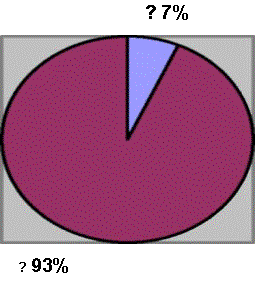
situation with IWB at their schools. The research shows that out of 60 000
schools in the Czech Republic only 4 000 schools have at least one IWB which is
unfortunately a very small number. The best situation is in Great Britain where
there are IWB in almost all the classrooms. (Fraus)
The
following graph clearly shows the situation in the Czech Republic.
MirandaNet
Fellowship is an E-community dealing with information technologies which are
offered on the market and used in teaching and learning (MirandaNet). In 2000 a
research interested in IWB evaluation and its integration in schools was done
in UK. Some interesting facts were shown. All the information is based on the
previously mentioned research.
How
valuable the IWB is within a lesson? 56% respondents claim that it is very
useful and 11% cannot imagine their teaching without using it. About 33%
teachers see at least some use in IWB.
The use
of IWB on regular bases. 67% use IWB in every lesson and the rest of the
respondents use it occasionally.
IWB and
motivation. Most of the teachers, 78% of all of them, also agreed on the fact
that IWB played a very important role in the terms of motivation.
At this
point the last research which should be presented was done by Milan Hausner4
and his colleagues who are interested in new information technologies at schools,
especially IWB. The research was done in 2005 and although only a small number
of teachers participated it still has at least an informational value. Teachers
were asked to complete a questionnaire presented on the Internet, to be
specific on "Portal na podporu interaktivni vyuky" www.veskole.cz. We can learn that
the first impression of an IWB is quite high, 74% but a general impression
after using IWBs for some time the number is even higher - 80%. Possible problems
might appear when it comes to the preparation time. 62% of the respondents
spend about 2 hours for preparing a lesson with the use of IWB and for 12%
teachers it takes even more than 2 hours. When it comes to pupils'motivation,
it might be complicated to measure it, but from a research we can see that 65%
of the teachers think that pupils' motivation increased significantly and 22%
cannot say or prove the changes. We can see that most of the teachers have the
impression of increased motivation.
Literature:
1. Becta. (2007). Harnessing technology review 2007: Progress
and impact of technology in education: Summary report. Retrieved July 16, 2008,
from http://publications.becta.org.uk/display.cfm?resID=33980.
2. Glover, D. &
Miller, D. (2001). Running with technology: The pedagogic impact of the
large-scale introduction of interactive whiteboards in one secondary school.
Journal of Information Technology for Teacher Education, 10(3), 257-275.