V. Shybetskij, V.
Povodzinskij
National Technical
University of Ukraine
"Kyiv Polytechnic
Institute"
HYDRODYNAMICS MODELING OF ROLLER FERMENTER FOR CELL CULTURES
Cultivation
of cell cultures is used in biotechnology for the active pharmaceutical
ingredient, a biologically-active substances and in the production of vaccines.
Biotechnology of antiviral vaccines almost entirely focused on obtaining full
viral antigens using cell lines. In high-volume industrial production cells
become damaged by air bubbles and flows of medium.
Creation of
fermenters with variable intensity of the culture fluid flows is a critical
task of biotechnology.
Roller
fermenters often used for cell cultivation. But their design has a number of
disadvantages, the main one of which is the low specific capacity (due to the
small surface area of immobilization).
To solve
this problem, we propose a new fermenter, taking catalytic reactors by the
prototype.
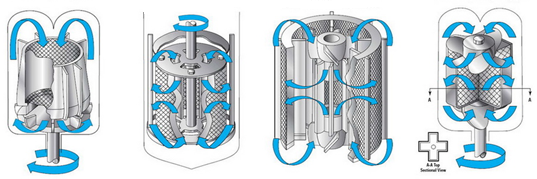
a b c d
Pic. 1. Catalic reactors
a – Berti reactor; b - Robinson-Mahoney reactor
with a movable basket;
c - Robinson-Mahoney reactor with a fixed
basket; d – Karberry reactor
The
fermenter is as follows
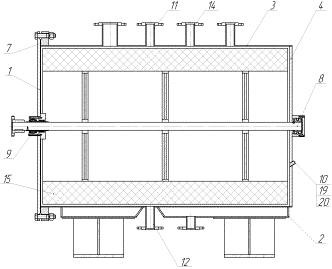
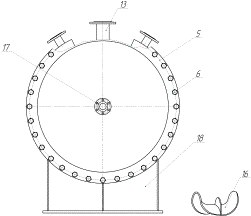
Pic. 2. New Reactor
Its main elements are the body, cassette,
process fitting, heat shirt. The head with a large surface area is used for
immobilization.
The same conditions as in the Roller must be
created in the fermenter for optimal hydrodynamic situation. This is ensured by
the speed of rotation and the shear intension. For their determination we
should create a mathematical model.
This model based on the Navier-Stokes equation,
which is:
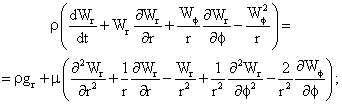 (1)
(1)
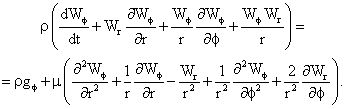 (2)
(2)
After all simplification we have the equation
in the canonical form:
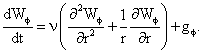 (3)
(3)
To solve the equation
we write the derivative as a difference of velocity values
 , (4)
, (4)
and rewrite the
equation in form:
 . (5)
. (5)
The value of the shear intension is given by:
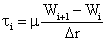 . (6)
. (6)
For numerical values the program was developed
in MathCad, and the graphs were drawn.
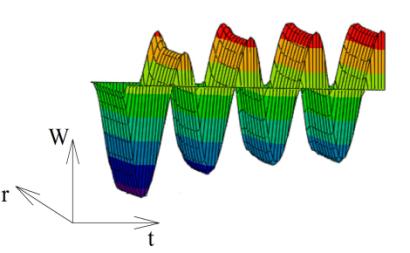
Pic. 3. Graph of speed
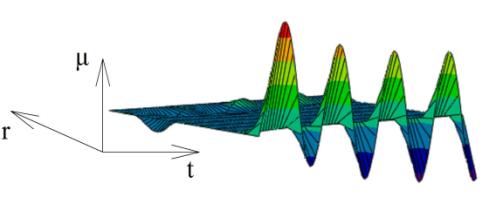
Pic. 4. Graph of shear intension
Upon receipt of the limiting values of shear
stress, it is possible to realize them on the new fermenter.