ТЕХНИЧЕСКИЕ НАУКИ/ 6.Электротехника и радиоэлектроника
C.t.s. Hovhannisyan A.T., D.t.s Grigoryan A.Kh.,
Sargsyan V.G., Khachatryan V.H.
STATE ENGINEERING UNIVERSITY OF
ARMENIA (POLYTECHNIC)
The Applications of the trapezoid
control coil in electromechanics
The control coils of the
electromechanical systems, as a rule, have a rectangular section. However, in
some particular cases, especially in electromagnets for optical researches, in
order to obtain a powerful electromagnetic field a coil with a trapezoidal
section is used [1]:
In order to increase the sensitivity
of electromechanical systems with open magnetic circuits, to improve dynamic
characteristics, to increase the distance of the possible movement of the
moving body (anchor, core) and, ultimately, in order to decrease the sizes and
the weight of the system we have made an attempt to replace the rectangular
coil by the one with a trapezoidal section [2...4].
Below we will discuss the application features
of the mentioned above coils in two different electromechanical systems.
1. Linear solenoid electromagnet
By use of linear electromechanical
systems various transmitters are being created which are being used in several
industrial fields, especially in control and monitoring processes.
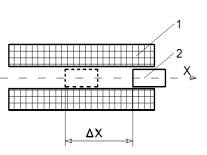
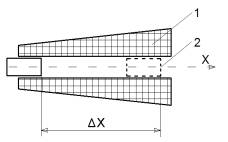
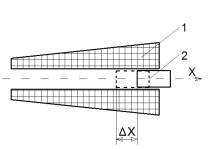
The observed solenoid electromagnet which
ensures the linear movement consists of (1) control coil, and (2) ferromagnetic
core (pic.1). In the first, traditional, case (pic.1, a) the coil has a
rectangular section and symmetrically distributed over longitudinal axis. In
the next two pictures (pic.1. b, c) are our proposed systems with trapezoidal
section coil.
We will introduce below the research
results of solenoid electromagnets, which ensures linear movement, with rectangular
and trapezoidal section control coils, where the coils had the following
parameters: the number of the windings – 3500, the diameter of the wire – 0.17
mm, the active impedance – 154 Ohms, the length – 58 mm, the internal diameter
– 11.2 mm.
a) b) c)
Pic.1. The
studied linear electromagnets
a) with rectangular section coil, b) with trapezoidal section coil, the core is set
at the smaller base of trapezoidal, c) with
trapezoidal section coil, the core is set at the longer base of trapezoidal
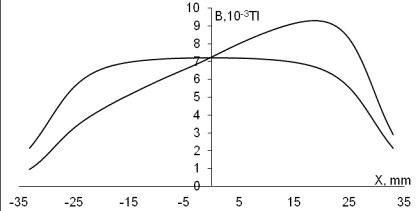
Experimentally and theoretically, through
calculations, the distribution of magnetic induction over longitudinal axis of
two types coils (without presence of core) for magnetomotive force value of
350A. The graphical images of the obtained results are shown in Pic.2.
Pic.
2. Magnetic field induction distribution by coil longitudinal axis
As shown in the graph, the maximum value
of the magnetic induction inside rectangular symmetrical coil turns out at the
center of the coil, while in case of trapezoidal one the coordinate of the
maximum value shifted from the center to longer base side. Thereby, in rectangular coil at X=29 mm coordinate the induction value
is Bmax=7,52×10⁻³ Tl, but in trapezoidal case at
coordinate X=50 mm the induction is Bmax=10,2×10⁻³ Tl. This means that in coil with
trapezoidal section the maximum value of the induction is 1,35 times higher
than in rectangular one. Moreover, the magnetic field changes over the length
unit have a greater change.
The influence of the external magnet wire
of the coil on the magnetic field distribution nature and values is also
studied (in the Pic.1 the external magnet wire
doesn’t exist). The research results showed that in the two different coils
systems the proportion between maximum values of magnetic induction and
coordinates of maximum induction remain the same toward the systems without an
external magnet wire.
The influence of the electromagnetic
attractive force on the core was studied when in the coils the ferromagnetic
core was placed at the different positions. There were two cores with the same
diameters d=8 mm but with different lengths; the length of the core 1 - l1=23 mm, core 2 - l1=42 mm. The measurement of
the electromagnetic attractive force performed by the developed and
manufactured by us scientific-experimental device which have provided the
necessary accuracy and application usability.
The
graphical dependencies of attractive force from core position coordinates for
systems with and without external magnetic wire are brought in Pic. 3. Moreover
in trapezoidal coil system the ferromagnetic core is located at smaller base of
the trapezoid.


a)
b)
Նկ. 3. The dependencies of attractive force from
core position coordinates
a) rectangular coil, b) trapezoidal coil
1,2-
core 1, 3,4- core 2, 1,3- system
without magnetic wire, 2,4- system with magnetic wire
Research results show that, regardless of
type of coil, the value of the derived force is higher in case of core 2. Thus,
in case of core 1 in rectangular coil the maximum power were 9 g at X=41 mm, and in trapezoidal coil 10 g at
X=9 mm. In case of core 2 the power
was as follow: in rectangular coil 24 g at X=31
mm, and in trapezoidal coil 32 g at X=9
mm. The presented data of force show that in trapezoidal coil (10 g, 32 g) it
is higher than values obtained in rectangular coil (9 g, 24 g). It was also studied in electromagnets with
both types of coils the ferromagnetic core DX movement
size, where symmetry axes of the above cores were matched: for rectangular coil
with the edge of the coil (Pic. 1, a), and for trapezoidal coil with the
smaller base. It was turned out that
the core movement size in the trapezoidal section coil (from smaller base)
exceeds the core movement in rectangular coil system, thus in case of core 1 in
rectangular coil system that movement is DX=12 mm, and
in trapezoidal coil system DX=39 mm.
Beside that the movement of the same core in trapezoidal section coil from the
longer base is DX=21 mm.
For the
research purpose as an example of linear electromagnet application with
trapezoidal coil the having of various uses electromagnetic valve were chosen.
In such valves the closing clapper is moving due to linear electromagnet, which
coil powered from alternating or direct voltage source. The coils of these type
electromagnets are usually being with a rectangular section. During our
experiment the rectangular coil were replaced with the same length of
trapezoidal section coil. The researches results one more time revealed the
features and advantages of the trapezoidal coil which were discovered during
the researches represented above.
Moreover, due to these advantages, by replacing of the rectangular coil
with trapezoidal one and by maintaining the characteristics of the
electromagnetic valve, it became possible, by preserving the characteristics of
electromagnet, to reduce the cooper weight of the control coil from 150 g to 83
g, means to cut down for about 45%; and the valve clapper, due to increasing of
movement size, to extend for nearly 15 mm (Pic. 4).

Pic. 4. Electromagnetic valve with trapezoidal section
control coil
2. Asymmetric reed relay
As is well
known, the asymmetric red relays are consisting from asymmetric reed switch and
control coil which placed on the glass tube of the reed (equally distributed
over the tube length) and have a rectangular cross section. In case of direct
current passing through the control coil the magnetomotive force occures which
created magnetic flux passes through reed’s contact gap and creates
electromagnetic attractive force. If the value of magnetomotive force is enough
the reed’s contacts are closing with influence of attractive force – the relay
is operating. The power starting value of the coil determines the sensitivity
of the relay.
The
disadvantage of such system comparing to symmetric reed relay (where the
contact gap symmetry axe matches with the coil symmetry axe) is that the relay
has a smaller sensitivity, means higher starting power. This is due to the
deviation of the reed’s contact gap from the zone of maximum magnetic field
created by coil.
During our
researches the rectangular coil was replaced by trapezoidal coil, and the
asymmetric reed was placed in the coil in a way that the reed’s contact gap to
be near to the longer base, means in the zone of the maximum value of magnetic
field induction (Pic. 5). In the Pic. 5
1 is a reed, 2 is a control coil, and 3 is a coil frame.
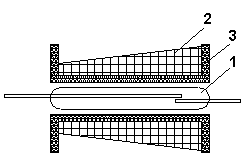
Pic. 5. Asymmetric reed relay with trapezoidal coil
The
experimental studies of asymmetric reed relay were accomplished on reed’s
phisical model. The control of the same reed were performed with both
rectungular and trapezoidal sections coils. The following results are obtained:
the current and the power of the relay’s coil at the starting point in
rectungular section coil were accordingly 27,4 mA and 88 mWatt, and releasing
parameters are 22,6 mA and 60 mWatt. The same parameters of the reed relay with
trapezoidal coil were 20,4 mA and 66 mWatt at starting point; and 17,2 mA with
47 mWatt at releasing point. From the obtained results is following that when
replacing the rectangular coil with trapezoidal one the relay’s starting and
releasing functional parameters are decreasing for about 22% – 25 %, due to
which the relay acquires comparatively high sensitivity and requires comparatively
small control power.
Conclusion
1. In
trapezoidal section coil the coordinate of the magnetic field induction maxumum
value can be changed, by changing the nature of windings distribution over the
coil’s length (the ratio of the smaller and longer bases of the trapezoid).
2. Comparing
with rectangular coil the linear electromagmet with trapezoidal coil is
two-coordinate system, since it provides the bigger movement of the core from
the smaller base side and short movement from the longer base side of trapezoid;
on the other hand, provides comparatively longer movement of the core, bigger
electromagnetic attractive force; and due to rapid changes of the value of
magnetic field coordinate it provides the stability of the core position
against external vibration factors.
3. The
trapezoidal section coil can be used to control the reed as observed the above,
as well as the toggle type symmetric reeds, and to simultaneous control of
multiple asymmetric reeds.
4. The use of
trapezoidal section control coil in open magnetic circuit electromechanical
systems creates opportunities to increase the sensitivity of the system and to
decrease the sizes and the weight.
1.
Карасик В.Р. Физика
и техника сильных магнитных полей. Наука,
М.: – 1964 – 347 с.
2.
Patent of RA 2349A, Reed
Relay: / A.T. Hovhannisyan, A.Kh. Grigoryan, V.G Sargsyan, 25.01.2010.
3.
Patent of RA 2572A. The Linear
Electromagnet / A.T. Hovhannisyan,
25.11.2011.
4.
Patent of RA 2609A.
Electromagnet / A.T. Hovhannisyan,
2012.
5.
Patent of RA 2708. The
Electromagnetic Linear Accelerator. / A.T.
Hovhannisyan, 2013.
This work was supported by
State Committee of Science MES RA, in scope of the research project № SCS 13-2B059.
Hovhannisyan Andranik - Candidat of technical
sciences, SEUA associate professor, Armenia,
Erevan-0017, Sari Tax, Rue 6, Flat 36.
Tel.: (+37410) 57-77-27,
(+37493) 32-12-60. E-mail: andranik.hovhannisyan@yandex.ru
Grigoryan Areg Khachiki
- Doctor of technical sciences, professor.
Tel.: (+37410) 52-17-92,
E-mail: Grigoryan@seua.am
Sargsyan V.G. –
Engineer, valeri@sas-se com
Khachatryan V.H. -
Engineer, (+37493) 69-37-09, vaharpa@mail.ru