Economics sciences/12.
Agricultural economics.
The Senior Teacher Orlova
Ludmila Dmitrievna
Dimitrovgrad Technical
Institute of Economics, Management and Design
(A branch of Ulyanovsk State
Technical University), Russia
Management
of Integration Processes of the Region as the Development of the Science of
Agroindustrial Management
Standard-legislative documents in the field of
development of Education and agricultural economics define basic reference
points of increasing professional competence; state social, economic and
information-consulting conditions for attracting young people to villages; but the directions in the development of
education and the quality of preparation of experts in Agrarian Complex are not
developed. One shouldn’t forget that the efficiency of work of Agrarian Complex
enterprises is entirely defined by the level of professional competence of the
experts.
One of the most important constituents of
anti-crisis management and creativeness of management is the development of
traditional management in the field of management of Integration processes of
the region in the agrarian sector of Economics. The problem of this kind of
management is formation of professional competence of the experts, whose
function is development and ordering of objective knowledge of the essence of
Management of Integration processes on the basis of corporative and cooperative
principles of development of Agrarian Region and their influence on
social-economic processes of the region.
An expert, who deals with different managing
social-economic aspects of radical transformations от an enterprise and generally in the region, can be
defined as a manager of Integration processes.
It is necessary to ascribe the following items
to the prime directions of the forming professional competence of the experts
in the field of management of Integration processes of the region in Agrarian
Complex:
·
Organization in training of the experts, who are able to use the basic
rules of Integrity Management;
·
Training of well-skilled Integrity managers;
·
Realization of management creativeness and heuristics directly into the
objects of managing;
·
State regulation of the
conditions of the regional educational systems, the level of their equipment
and quality of education accordingly.
Integrity management is understood as a process
of management of organizations including functions and methods of traditional
managing, but also as a process prompting the changes of the recourses,
technological processes, organizational-legal structure of managing and
interaction with external and internal environment on the basis of corporative
and cooperative principles of enterprise functioning.
The management of Integration processes is
connected with strategic management and corporative management and is to improve
financial conditions of Agrarian Complex. In this way the knowledge of managing
of Integration processes will increase the professional competence of the
experts in after-crisis period (Picture 1).
The job of an integration manager should
provide cutting-down of irrational expenses of Agricultural enterprises at all
the levels of managing Integration processes and reaching some social effect in
the whole region, promoting creativeness and Intellectual Technologies.
However, such experts are not trained in Russian Higher Institutions nowadays.
Meanwhile the absence of such kinds of experts is badly felt at all levels
within the process of structural transformations in Agrarian Complex.
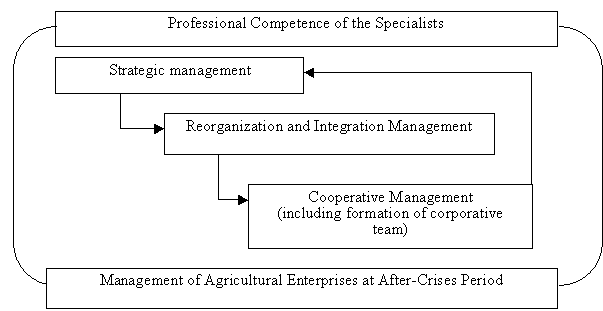

Picture 1. Management
maintenance integration processes.
The research of the quality of knowledge in
management in the conditions of after-crisis period let us make the following
conclusions:
1)
The cycle of the disciplines in accordance with State Educational
Standards of Higher Vocational Training doesn’t contain the questions of
studying the management of Integration processes on enterprises, and moreover
students give quite low appreciation to special disciplines studying managing.
2)
The future experts have no idea about their future managing career or
taking part in managing on the enterprises and their significance in
effectiveness of the productivity of the enterprise. And in the questionnaires
students, with a great frequency of repetition pointing at such specific types
of activity of experts in marketing, managers, economists and the
technologists, don’t differentiate as basic organizational and managing
activity of each expert, speaking about absence of influence of a technologist,
an economist and an expert in marketing on the process of managing of an
enterprise.
3)
Theoretical base of disciplines in managing is not seen in the examples
of the mechanisms of solving branches problem of enterprises in the region and
in the most problematic branch of the definite region. However, the theme of integration
of commercial enterprises and municipalities on the region level as the
example of a separate branch is interesting for the students in the limits of
their existing courses of managing; and only 5% of students flatly refused from
studying Integrity, not having thought that it is one of the most essential
mechanisms of managing an enterprise;
4)
Because of absence of motivation to improve training skills and getting
further knowledge about economics interaction within a definite group of young
people in Agrarian Complex it is necessary to interest and develop the
students’ creative and heuristic potential while studying in professional
educational institutions. So, 21% of students consider it important to apply
great efforts for increasing social-economic indexes of development of the
agrarian enterprise and the region, without discussing neither the size of a
salary, nor promotion possibility.
Thus, the given conclusions confirm a hypothesis about
necessity of introduction for educational institutions of knowledge of
integration management by introduction in subject matters on economy and theme
management “Integration processes in economy branches (integration
management)”. As a result of its study the future expert will receive necessary
fundamental knowledge about integration of subsystems and organization
elements, interaction within counterparts, reorganization of existing
structures of management for forthcoming professional work.
References:
1.
Sidoruk A. Innovative Business as the Factor of Effective Development of
Agrarian and Industrial Complex. // Agrarian Complex: Economy, Management/ #9,
2009. – pp. 25 – 30.
2.
Khachaturov A.E. Integration Management: Problems Necessary to Solve. //
Management in Russia and Abroad #2, 2004.
3.
Alexeev V.V., Agaev B.V., Sagdeev V.A. Agricultural Management – Open
Company Moscow Publishing Consultant Enterprise “DeKa”, 2003. – p.432.