Педагогические
науки/2. Проблемы
подготовки
специалистов
PhD Sorokina
A.I.
Belarusian National
Technical University, Republic of Belarus
Methodological
condition
for development of professional competences of managers
There
exist a lot of interpretations of the term “competence”. Firstly it was
proposed by N. Homsky [6, p.117] in 1957 for transformation grammar and
language teaching theory. Experts in a business sphere gave a great number of
definitions of the term “competence” [27; 4; 16; 9; 12; 20; 14; 11; 26; 15; 7;
18; 23]. The author holds
the following interpretation of the term: professional competence of managers
is an integral characteristic of business and personal qualities that reflect
the level of knowledge, skills, experience, and abilities which are sufficient
for the decision of theoretical and practical problems in professional activity
[11].
The development of professional competences of
managers, that are necessary for solving business,
scientific and applied problems for sustainable development of a country,
requires innovative approaches for education of managers [19; 21; 2; 1; 25; 28],
approaches, which help graduates to be “knowledgeable across disciplines” with
the ability to “examine critically, synthesise and evaluate knowledge across a
broad range of disciplines” (the Attributes of the Melbourne Graduate 2009). Therefore,
interdisciplinary integration [10; 3; 5; 24; 17; 13; 22] in managers’ education
can be an important methodological condition for developing competencies established
by the University curriculum.
The development of competences is not localized
within a single discipline. Simultaneously, all disciplines planned in a
curriculum get involved in this process. All the
competences are classified in 3 groups (Figure 1): academic, personal - social
and professional competences [11].

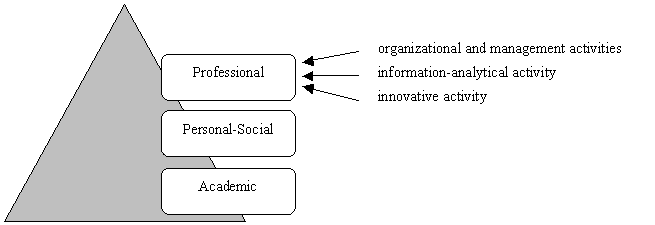

Figure 1. Three groups of competences
These competences are generated by interdisciplinary professional
activities tasks for future managers when they study at the University (Figure
2).

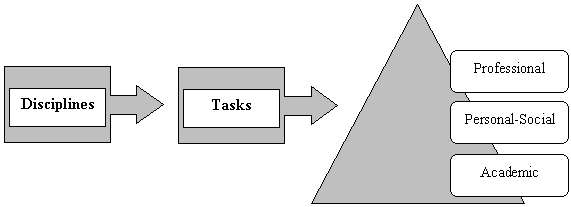
Figure 2. The connection between disciplines, tasks and competences
The correspondence of competences to tasks can be presented in Table 1.
Table 1. Correspondence of competences to tasks
|
№ |
Professional tasks |
Competences |
Disciplines involved in
developing and improving competences |
|||||||
|
1. |
|
|
|
|
|
|
|
|
|
|
|
2. |
|
|
|
|
|
|
|
|
|
|
· Every
interdisciplinary professional task can be applied for the development and
improvement of various competences.
· A competence can
be developed and improved in the process of any task solution.
· A competence can
be developed and improved in learning various disciplines.
There are a lot of benefits from interdisciplinary technique.
· Integration of
all disciplines helps students to form system thinking, integral vision of
scientific, social and professional problems, and scientific world outlook.
· Thanks to interdisciplinary integration
students are enriched by lifelong learning habits and developed universial
competences.
· Interdisciplinary technique improves team –
work skills and enhances communication skills (Jones 2009).
· Integration of
all disciplines allows students to participate as active creaters and competent
decision – makers.
Interdisciplinary ideas
should be shared with all professors and lectures of the faculty so that they
can have the occasion to contribute their knowledge and skills to offer
students the opportunity to see connections and relevance between disciplines and understand a variety of
perspectives for their competency after the graduation of the University.
References
1.
Basinskaya,
I.V. 2013. Competence-based approach in
the human resources management, Humanitarian-Economic Bulletin: Scientific and Theoretical Journal, 3:
81-87
2.
Balkienė, K.
2013. Sustainable innovativeness: issues and public policy, Journal of Security
and Sustainability Issues 3 (2): 53-76. DOI: http://dx.doi.org/10.9770/jesi.2013.3.2(5)
3.
Boix
Mansilla, V., Duraising, E. 2007.
Targeted Assessment of Students’ Interdisciplinary Work: An Empiriccally
Grounded Framework Proposal. Journal of Higher Education 78(2): 215-237
4.
Boyatzis,
R.E. 1982. The competent manager: a
model for effective performance. London: Wiley.
5.
Brew, A.
2008. Disciplinary and interdisciplinary affiliations of experienced
researchers. Journal of Higher Education 56(4): 423 - 438
6.
Chomsky, N. 1957. Syntactic Structures. Mouton & Co. p.117.
7.
Chekmarev,
V.V. 2014. Thinking of the future: an interdisciplinary education as a
condition for competitiveness, Theoretical Economics 3: 36 -42
8.
Competence
and competency Frameworks: factsheets. CIPD. 2015. Available on the Internet:
˂http://www.cipd.co.uk/hr-resources/factsheets/competence-competency-frameworks.aspx.˃.
9.
David Long,
L. 2009. Human Resource Management in the value of a knowledge-based society,
Business: Theory and Practice 10 (3): 233-246
10. Davies, M., Devlin, M. 2007.
Interdisciplinary Higher Education:
Implications for Teaching and Learning. Melbourne: Centre for the Study
of Higher Education.
11. Educational Standard of Republic of
Belarus. Higher Education. First Stage. Speciality 1 – 26 02 01 – 2013
Business – Administration. Republic Institute of Higher School. 2013.
12. Esteves, M. 2009. Construction and
development of the professional competences of teachers, Educational sciences
journal 8: 33-44
13. Golding, Clinton. 2009. Integrating the
disciplines: Successful interdisciplinary subjects. Center of the Study of
Higher Education. Available on the Internet <http:// www.cshe.unimelb.edu.au/>
14. Hunger, J.; Wheelen, T.L. 2011. Essentials
of strategic management. Fifth edition. Upper Saddle River (N.J.): Prentice
Hall Publishing.
15. Išoraitė, M.; Steiblinė, L.; Mečėjienė, G.
2014. If obtained professional competences are suitable for sustainable
entrepreneurship: case of Vilnius University of Applied Sciences,
Entrepreneurship and Sustainability Issues 1(4): 239-246. DOI: http://dx.doi.org/10.9770/jesi.2014.1.4(6)
16. Ján Figeľ 2006. Recommendation
of the European parlament and of the Counci of 18 December 2006 on key
competences for lifelong learning.Official journal of the European Union L394.
http//eur-lex.europa.eu/LexUriServ/site/en/oj/2006/l_39420061230en00100018.pdf
17. Jones, Casey. 2009. Interdisciplinary
Approach – Advantages, Disadvantages, and the Future Benefits of
Interdisciplinary Studies, ESSAI: Vol. 7: 76 – 81. Available at:
http://dc.cod.edu/essai/vol7/iss1/26
18. Kon, E.L., Freyman, V. I., Yuzhakov A.A
2015. Pprocessing and decoding of testing results of constituents of component
structure of competence, Educational Resources and Technologies 1(9): 50 – 58
19. Laužikas,M.; Mokšeckienė. 2013. The role of
creativity in sustainable business, Entrepreneurship and Sustainability Issues
1 (1): 10-22. DOI: http://dx.doi.org/10.9770/jesi.2013.1.(2)
20. Mitchelmore S. and Rowley J. 2010. Entrepreneurial competencies: A
literature review and development agenda. International Journal of
Entrepreneurial Behaviour and Research 16(2): 92-111.
21. Raišienė, A.G.; Jonušauskas, S. 2013.
Silent issues of ICT era; impact of techno-stress to the work and life balance
of employees, Entrepreneurship and Sustainability Issues 1 (2): 108-115. DOI: http://dx.doi.org/10.9770/jesi.2013.1.2(5)
22. Salyakhova, G. I., Valeeva, R.A. 2015 Pedagogical Stimulation
of University Students’ Social
Competence Development by Means of Interdisciplinary Integration, Review of
European Studies 7(5): 186 – 192. http://dx.doi.org/10.5539/res.v7n5p186
23. Sirenko, С.Н. 2015. Development
of general competencies of students on the basis of interdisciplinary
integration, Bulletin of Belarusian State University: Philology. Journalism.
Pedagogics 1: 83 – 88
24. Stein, Z., Connel, M., Gardner, H. 2008.
Exercising Quality Control in Interdisciplinary Education: Toward an
Epistemologically Responsible Approach. Journal of Philosophy of Education
42(3-4): 401 – 414
25. Vasiliūnaitė, R. 2014. Sustainable development: methodological approaches toward
issues, Journal of Security and Sustainability Issues 3 (3): 69-75. DOI: http://dx.doi.org/10.9770/jesi.2014.3.3(6)
26. Wahl, M.; Prause, G. 2013. Toward
understanding resources, competences, and capabilities: business model
generation approach, Entrepreneurship and Sustainability Issues 1 (2): 67-80.
DOI: http://dx.doi.org/10.9770/jesi.2013.1.2(1)
27. White, R. 1959. Motivation reconsidered:
the concept of competence, Psychological Review 66(5): 297-333
28. Zhuk, O.L. 2014. Interdisciplinary
integration based on the principles of sustainable development as a condition
for improving the quality of vocational training of students, Bulletin of
Belarusian State University: Philology. Journalism. Pedagogics 3: 64 – 70