Биологические науки/8.Физиология человека
и животных
S.B.Semenenko, N.I.Voytkevich, V.V.Semenenko, N.Yu.Semenenko
Bukovinian State Medical University, Chernivtsi
SPECIFIC FEATURES OF CHRONORHYTHMIC CHANGES OF THE EXCRETORY RENAL
FUNCTION UNDER CONDITIONS OF HYPOFUNCTION OF THE PINEAL GLAND
Summary. The work examines specific features of chronorhythmic changes of
excretory renal function under conditions of pineal gland hypofunction.
Epiphysial hypofucntion was found to cause disorders of circadian organization
of the renal excretory function in comparison with the control group of
animals.
Key words: circadian rhythm, kidneys, pineal body/epiphysis.
Biological rhythms are periodically repeated changes
of the character and physiological processes and phenomena peculiar for
biological systems on all the levels of their organization [1, p.45]. The
universally accepted conception about circadian body system includes the
following functional links as pineal body (PB)/epiphysis and suprachiasmatic
nuclei [2, p. 21] considered as the main biorhythmic generator of the majority
of the body functions [3, p. 93]. The kidneys are also characterized by an
accurate temporal organization of their functions, but peculiarities of
circadian organization and the mechanisms of biorhythmic regulation of the
renal functions remain insufficiently learnt. The objective of our research is
to examine peculiarities of chronorhythmic changes of the renal excretory
functions in albino rats under conditions of PB hypofunction.
Experiments were conducted on 72 mature nonlinear
albino male rats with the body weight of 0,15-0,18 kg. The animals were kept in
vivarium under constant temperature and air humidity on the standard dietary
intake. The control group (n=36) was kept under conditions of usual light
regime (12.00C:12.00T) for 7 days. The examined group included animals (n=36)
kept under conditions of continuous light regime (12.00C:00T) for 7 days. On
the 8th day the animals were subjected to 5% water loading heated to
room temperature and excretory renal function under conditions of forced
diuresis was examined.
The experiment was conducted with 4 hour interval
within 24 hours. The concentration and excretion of potassium ions, creatinine,
and protein, glomerular filtration rate, relative water absorption and
endogenous creatinine were studied. The results were calculated statistically
by “Cosinor-analysis” method as well as variation statistics parameter methods.
The diagnostics of functional peculiarities was based on the analysis of
characteristic changes of mesor, amplitude, acrophase and shape of circadian
rhythm curve. Obtained individual chronograms for every animal were grouped by
the principle of maximal acrophase identity, and the traversable mesor,
amplitude and phase structure (by the time interval between acro- and
bathyphase) for every chronogram group was calculated by “Cosinor-analysis”
method.
Examinations in the control and experimental groups of
animals at night were conducted at faint red light (2 lux) which practically
does not influence upon epiphysial melatonin biosynthesis. All the stages of
the experiment were conducted according to the requirements of the European
Convention for the Protection of Animals.
Obtained experimental data were processed on personal
computers by the program package EXCEL-2003 (Microsoft Corp., USA). The value
of an average arithmetical sampling (x), its dispersion and average error (Sx)
was calculated for all the indices. To find reliable difference of the results
in the experimental and control groups Student coefficient (t) was detected,
after that the probability of sampling differences (p) and confidence average
interval by Student distribution tables were defined. The indices with
p<0,05 were considered to be reliable.
Pronounced changes of the renal excretory functions
were found in the animals under conditions of PB hypofunction.
Diuresis chronorhythm became of a two-phase structure
loosing its sinusoid rhythm character. Acrophase shift from 4 p.m. to 4 a.m.
(fig.1) was observed as compared with the indices of the intact animals.
Attention was drawn to a reliable decrease of both
urination mesor consisting of 2,5±0,34 ml/2 hours and rhythm amplitude (about
11%) concerning the indices of animals with physiologic PB function.
Considerable changes of diuresis were caused by
disorders of renal filtration ability. Glomerular filtration rate was reliably
lowered in all the periods of the day. Chronorhythm of glomerular filtration
rate became of a one-phase character with maximal value at 8 p.m. (fig. 2), and
the mesor of rhythm was 57% lower than in the intact animals.
Such changes are caused by reduction of areliable
water re-absorption during the whole period of examination. This index was
lower than that of the animals with physiologic PB function. The animals with
PB hypofunction developed a two-phase character of the basic level of water
reliable re-absorption chronorythm as compared with the control chronograms.
Acrophase period was found at 8 p.m. and bathyphase – at 4 p.m.
Low ultrafiltration level caused a reliable increase
of creatinine concentration in the blood during the day in comparison with the
control group of animals. Rhythm acrophase was found in the period from 4 a.m.
to 8 a.m. with the following peak at 4 p.m., miniphase was registered about at
8 p.m. Such circadian changes characterized instability and tension of
glomerular renal apparatus work.
Mesor and amplitude of endogenous creatinine
concentration index were reliably lower concerning the control indices, and as
a result, a considerable rhythm change of the day period with disorders of its
phase structure was registered.
PB hypofunction resulted in a reliable decrease (22%)
of potassium ions concentration in the urine and rhythm amplitude as compared
with the control group. Architectonic rhythm was of a monotonous character with
the maximal index at 4 a.m. An average daily level differed from the same one
in the animals with physiologic PB function.
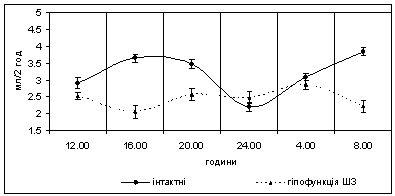
Fig.1. Chronorhythms of diuresis in rats (ml/2 hours) under conditions of epiphysial hypofunction.
Table
PB hypofunction
influence upon mesor and rhythm amplitude of the renal excretory function in
white rats ( )
)
|
Index |
Control |
Animals kept under conditions of PB hypofunction |
||
|
Mesor |
Amplitude % |
Mesor |
Amplitude % |
|
|
Diuresis, мл/2 год |
3,2±0,28 |
18,7±1,55 |
2,5±0,34
|
11,4±0,71
p<0,010 |
|
Calcium ions concentration in blood plasma, mmol/L |
5,1±0,29 |
24,8±1,41 |
3,3±0,12 p<0,001 |
5,3±1,42 p<0,001 |
|
Calcium ions concentration in urine, mmol/L |
15,9±0,62 |
35,4±1,31 |
8,1±0,81 p<0,017 |
22,4±1,21 |
|
Potassium ions excretion, mkmol/2 hours |
201,2±2,72 |
49,9±2,35 |
137,8±1,12 p<0,001 |
43,1±1,81 p<0,045 |
|
Creatinine concentration in blood plasma, mkmol/L |
49,8±1,38 |
19,9±2,11 |
55,4±2,62 |
13,4±0,61 p<0,024 |
|
Creatinine excretion, mkmol/2 hours |
3,5±0,44 |
16,9±1,91 |
1,7±0,22 p<0,004 |
17,8±1,32 |
|
Glomerular filtration rate, mkl/min/100 g |
623,5±2,24 |
22,0±1,52 |
269,7± 2,32 p<0,001 |
66,6±1,01 p<0,001 |
|
Relative water re-absorption, % |
95,1±0,56 |
1,6±0,41 |
91,9±0,59 p<0,003 |
1,8±0,31 |
|
Endogenous creatinine concentration index, UN |
24,6±1,81 |
40,7±1,01 |
13,2±0,92 p<0,003 |
21,1±1,92 p<0,001 |
|
Protein concentration in urine, g/L |
0,1±0,01 |
23,8±1,91 |
0,1±0,01 |
26,5±1,63 p<0,001 |
|
Protein excretion, mg/2 hours |
0,2±0,03 |
29,1±1,22 |
0,1±0,02 p<0,028 |
32,5±1,39 |
|
Protein excretion, mg/100mkl of glomerula filtrate |
0,1±0,01 |
31,4±1,62 |
0,1±0,01 |
140,8±1,86 p<0,001 |
Note: p – probability of difference between the indices of
the control and experimental animals; n-number of animals.
During the period
of examination the dynamics of potassium ions excretion became of a one-phase
structure. Mesor and amplitude of the rhythm were reliably less from the
control group. Acrophase was observed at 4 a.m., bathyphase from 4 p.m. to 8
p.m.
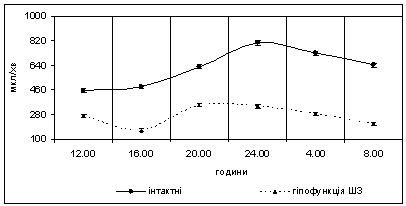
Fig. 2. Chronorhythms
of glomerular filtration rate (mkl/min) in rats with PB hypofunction
Increased level of protein excretion was found at 4
a.m., minimal level of the rhythm was at 8 a.m. in the animals kept under
conditions of continuous lightening.
Thus, PB hypofunction resulted in considerable
disorders of chronorhythmic organization of the renal excretory function as
compared with the control group of animals. The main signs of the detected
changes are:
· architechtonics of urination rhythm became two-phase in structure
loosing sinusoidal rhythm character concerning chronograms of the control rats
with decrease of its mesor and amplitude;
· ultrafiltration rate decreased reliably in all the periods of the
experiment, and the rhythm amplitude increased three times;
· the daily rate and rhythm amplitude of potassium ions excretion
decreased.
Further research is directed to find the role of PB
hypofunction in circadian organization of acid-regulating renal function.
References:
1. Skene D.J. Melatonin rhythmicity: effect of
age and Alzheimer’s disease / D.J. Skene, D.F. Swaab // Exp.'wifa Gerontol. -
2003. – V. 38, N 1-2. - P. 199-206.
2. Turek F.W. “Melatonin sleep and circadian
rhythms: rationale for development of specific melatonin agonists” / F.W. Turek,
M.U. Cillette // Sleep Med. – 2004. – Vol. 8. - P. 523-532. 438.
3. Особливості хроноритмічних змін функцій нирок за умов гіперфункції
шишкоподібної залози / [Шумко
Н.М., Черновська Н.В., Вепрюк Ю.М., Ломакіна Ю.В.] // Бук. мед. вісник. - 2006. - Т. 10, N 4. – С. 196-199.