Doctor (PhD) Tovma Nataliya
Kazak National University named al-Farabi
Standards of Internal Audit
Abstract. Internal audit is
an independent management function, which involves a continuous and critical
appraisal of the functioning of an entity with a view to suggest improvements
thereto and add value to and strengthen the overall governance mechanism of the
entity, including the entity’s strategic risk management and internal control
system.
Key words internal audit,
reporting, development, intra firm standards.
Introduction. The internal audit charter is a formal document that
defines the internal audit activity’s purpose, authority, and responsibility.
The internal audit charter establishes the internal audit activity’s position
within the organization, including the nature of the chief audit executive’s
functional reporting relationship with the board;
access to records, personnel, and physical properties relevant to the
performance of engagements; and defines the scope of internal audit activities.
Final approval of the internal audit charter resides with the board.
The
internal audit function contributes to the improvement of the institution's
operations by providing objective and relevant assurance regarding risk
management, control and governance processes to management and the
Board. Management is responsible for evaluating the institution's risks
and establishing and maintaining adequate controls and processes. To
provide relevant information, the internal audit activity will consider the
goals of the institution, management's risk assessments and other input from
management in determining its risk-based audit activities. This policy
addresses staffing, responsibilities of the internal audit function, audit
planning and reporting on internal audit activities. In addition to this
policy, the Office of System-wide Internal Audit maintains an audit manual. The
purpose of the audit manual is to provide for consistency, continuity, and
standards of acceptable performance.
The high scientific and practical demand of in-depth study of problems
of intra firm standardization of auditor activity predetermined a choice of a
subject of research [1, page 56].
Reviewing the literature. Problems of
development of intra firm standards, their essence and classification are
investigated by domestic scientists: A.M. Bogomolov, A.M. Kovalyova, N.T. Labyntsevym,
L.G .Makarova, C.B. Pankova, V.I. Podolskim, E.A. Sirotenko, L.V. Sotnikova, S.
P. Suvorova.
Stating the purpose. The purpose of
work consists in theoretical justification of intra firm standardization and
development of a complex of practical recommendations about development of
intra firm standards. For achievement
of a goal in the thesis the following tasks are set:
- to investigate essence and the main directions of development of
standardization of auditor activity;
- to develop recommendations about modeling of system of intra firm
standards of auditor activity and to offer model of hierarchical system of
intra firm standards in audit organizations on the basis of synthesis of
approaches to their classification;
- to specify methodical approaches to formation of intra firm standards
by means of development and justification of their standard structure;
- to prove the main directions of standardization of services
accompanying audit taking into account features of the standard and legal base
regulating process of rendering services accompanying audit;
- to develop the intra firm standard used at carrying out survey check;
- to offer methodical approach to development of the standard,
regulating carrying out compilation of the reporting in the form of
transformation forms of accounting reports in reporting forms on IFRS.
Results of research
1. To define a role
and value of intra firm standards of auditor activity. The standard – official
state or normative technical documentation of branch, the enterprise, the form,
establishing necessary qualitative characteristics, requirements with which has
to satisfy this type of production of goods.
The system of standards in the generalized look includes the
international standards; national standards; intra firm standards. Finally the
goal of system of standards is reached by formation and application of a
package of intra firm standards which detail and regulate uniform requirements
to performance of audit inspections and registration of audit reports. Value of system of standards consists that
it:
• provides high quality of an
audit inspection;
• promote introduction in
auditor practice of new scientific achievements;
• helps users to understand
process of an audit inspection;
• provides communication of
separate elements of auditor process;
• creates public image of a
profession.
2. Modeling of
intra firm standards has to be carried out on the basis of the accounting of
specifics of objects of standardization and the approach used at development of
the concrete standard. Development of the concrete standard includes: choice of
object of standardization, modeling of process of rendering services taking into
account features of object of standardization, model optimization, model
standardization. When forming a package of intra firm standards it is
necessary: to observe requirements of the international standards of audit.
Methodical recommendations about formation of a complex of intra firm
standards in audit organizations on the four-level hierarchical system
including are developed:
1) the conceptual standards directed on behavior of auditors and general
provisions of audit;
2) the standards regulating responsibility of auditors and their level
of competence;
3) the standards regulating carrying out check in a section of its main
stages and rendering services other and accompanying audit;
4) the applied standards regulating carrying out an audit inspection in
relation to objects of the account, to branches and groups of managing
subjects; development of a complex of
standards provides systemacity when forming a package of intra firm standards
taking into account specifics of auditor services rendered by it.
3. The system of
intra firm standards includes standards of different types. Scientists and practicians allocate the
groups of standards differing with extent of specification of those questions
which they regulate. Methodical approaches to formation of applied
standards by means of development of structure of the intra firm standard of
the audit regulating carrying out an audit inspection in relation to concrete
object of the account and created on the basis of accounting approach are
specified.

Figure 1 – Classification of intra firm standards
. In this regard, there are three levels of the
marketing audit:
Table 1 - Levels of marketing audit
|
Level 1 3 |
Level 2 |
Level 3 |
|
Bank as a whole -
control of marketing at the bank as a whole is aimed at obtaining the
information necessary to assess the level efciency of marketing |
Marketing
department - at the level of Marketing marketing control should be carried
out on a continuous basis. |
External control
- external control is carried out, as a rule, advisory firm. |
The information obtained in the process of marketing
audit can reflect and to document the bank's policy in respect of certain areas
of marketing activities in the future a more optimal allocation of resources
for a particular purpose.
The
methods of the audit may include the following:
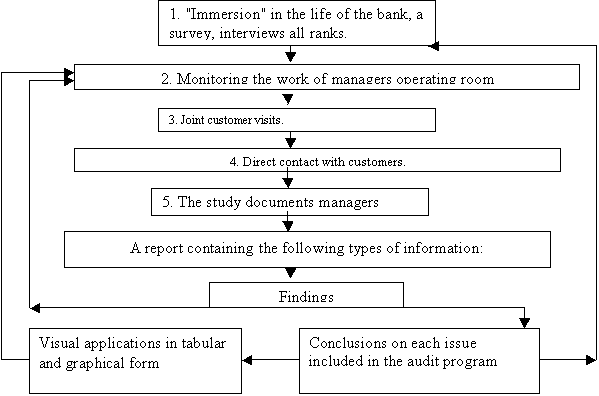
Figure 4 - Methods of conducting audits at the bank
The system of payment and incentives do not take into account the
activities of employees of adjacent units marketing purposes. The lack of
communication between departments on the basis of competent document management
across the bank. Inefficient allocation
of management authority, unwillingness of owners or senior management of the
bank to clearly define the responsibilities and rights of employees, and on
this basis to delegate the appropriate authority.
References
1.
Savin, O.P.Issledovaniye of a condition of standardization auditor P. Savin's
activity / Island//Account and statistics. - 2011.— square No. 2(18).-0,9.
2.
Soboleva N. G. Intra firm standards as condition of improvement of quality of
audit. St. Petersburg 2008 - 30 pages.