УДК 681.5.
Шадрина В.В., Сысцов К.В., Шкуркин Д.В.
Научный руководитель: д.т.н., проф. Финаев В.И.
СИСТЕМА РЕГУЛИРОВАНИЯ ТЕПЛОГО ПОЛА ЖИЛОГО ПОМЕЩЕНИЯ
В статье рассматривается задача регулирования температуры жилого помещения
путем создания системы управления параметрами теплого пола. В данной работе
разработана структура системы и получены результаты ее исследования, что
служить базовым элементом для разработки автоматизированной системы
регулирования теплого полого с применением SCADA-технологий.
UDC 681.5.
Shadrina V.V., Systcov K.V., Shkurkin D.V.
The scientific adviser: PHD, prof.
Finaev V.I.
PREMISES TEMPERATURE REGULATION SYSTEM BY USING
THE TECHNOLOGY OF A HEAT-INSULATED FLOOR
The paper considers the solve
of the premises temperature regulation task by means of design the control
system of a heat-insulated floor parameters. In this
paper developed the structure of control system and obtained the research
results to be design a heat-insulated floor automated control system by using
SCADA technologies hereafter.
Automatic equipment with application of technology of
a heat-insulated floor, first of all, is necessary for heating systems for
maintenance of the set parameters (temperature of the direct and/or return heat
carrier, air temperature or a surface) in automated and/or in automatic modes
for the purpose of economy of energy resources. In the offered automatic system
of heating control a temperature mode is carried out in limits plus (minus) one
degree Celsius. Manual control assumes reaction of the person to a temperature
mode indoors "cold" ("hot"). And if it is necessary to
change boundary value of temperature indoors, changing of temperature can be
felt [1-3]. The example of the room for which the system of regulation of
temperature of a heat-insulated floor is intended, is presented in the fig. 1.
Depending on carried-out tasks, a place of installation, a way of control and
management the following regulation systems of heating the water heat-insulated
floor can be expected: group [1-3]; individual (zone) [2, 4]; complex [5]. In
compliance with regulations about the SanPiN 2.2.4.548-96, GOST (All Union
State standard) 30494-96 Russian Federation need to fulfill the following
requirements [6]:
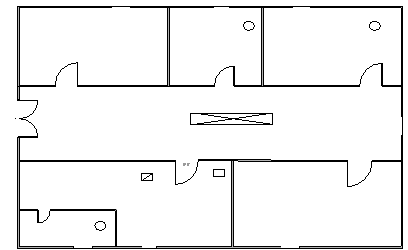
Fig. 1. Example
of the considered room
- control
of the actual air temperature in rooms has to be made on average temperature
not less than from three sensors of temperature placed in the different parties
of each building;
- the
system of regulation of temperature has to pass into a standby mode
automatically;
For
regulation of temperature of the room it is possible to choose the system which
even not isn't adaptive, even it is possible not to accept the device of the
theory of artificial intelligence because for providing complete control can be
executed obvious and certain and all types of calculation on the basis of
classical regulators. Classic control system using P-, PI, PID, it is difficult
to reconstruct due to the large amount of computation when the parameters of
the control object, but that does not make their use difficult, because the
classic control system- it is the only system, which give the exact (optimal)
results for the whole during operation of the system as a whole. On the basis
of the research of references on the solution of a problem of regulation of
temperature [1-5], it is possible to stop on a choice of traditional regulators
with application of the PI-law of management.
The
PI-regulator makes impact on regulator in proportion to a deviation and
integral from a deviation of adjustable size:
 (1)
(1)
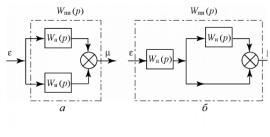
Transfer
function of the PI-regulator (according to the scheme, fig. 2, a):
 (2)
(2)
|
|
|
|
Fig.
2. Block diagram of ideal PI-regulators: a – with transfer function of
parallel connection; b – with transfer function of consecutive connection |
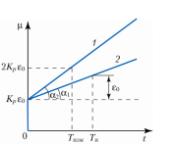
Fig.
3. Law of PI-regulation of regulators: a – with transfer function of parallel
connection; b – with transfer function of consecutive connection |
At
spasmodic change of adjustable size on value  PI-regulator with a speed
determined by speed of the drive, moves the executive mechanism at a value (
PI-regulator with a speed
determined by speed of the drive, moves the executive mechanism at a value ( ), then the executive mechanism in addition moves to the same party with
a speed
), then the executive mechanism in addition moves to the same party with
a speed  , the adjustable size proportional to a deviation. Therefore, in the
PI-regulator at a deviation of adjustable size from a preset value the
proportional (static) component of the regulator instantly works, and then the
integrated (astatic) component of the regulator gradually increases. The
transitional characteristic of the PI-regulator with transfer function is shown
in fig. 3 (a straight line 1). Parameters of tincture are coefficients of
strengthening of
, the adjustable size proportional to a deviation. Therefore, in the
PI-regulator at a deviation of adjustable size from a preset value the
proportional (static) component of the regulator instantly works, and then the
integrated (astatic) component of the regulator gradually increases. The
transitional characteristic of the PI-regulator with transfer function is shown
in fig. 3 (a straight line 1). Parameters of tincture are coefficients of
strengthening of  independent from each other and
a constant of time of integration
independent from each other and
a constant of time of integration .
.
The
scheme in fig. 2 b, realize the law of control.
 (3)
(3)
where  - time constant of the integral action.
Transfer
function of the PI-regulator according to fig. 2b scheme:
(4)
As
a result, the PI-regulator with the block diagram is given on fig. 2, has the
interrelated tincture of static and static parts on  coefficient. In this way, at
control of coefficient of strengthening of
coefficient. In this way, at
control of coefficient of strengthening of  the constant of time of
integration will change also:
the constant of time of
integration will change also:
 (5)
(5)
In
system of heating it is necessary to support demanded hydraulic characteristics
of system, for this purpose the key controlled parameters of the lamellar heat
exchanger are: expense, pressure, heat carrier pressure in giving and return
pipelines, heat carrier temperature on entry of heating and after heating
system. For temperature regulation indoors there are two ways, first of which consists
in system development based on use of three in parallel switched-on
PI-regulators from identical transfer function (fig. 4), each of which is
responsible for regulation in due time "D1- air temperature, D2- air
Speed, D3 - relative air humidity ". The second way consists in
development of the system of management consisting of three independent
entrances and one exit, such approach is applied in the classical theory of
management, but, it is undesirable, because of three blocks transfer functions
connection on an entrance (rice 5), each of which describes part of object of
management "D- air temperature, D2- air Speed, D3- relative air humidity
". The selection of the control system structure of all parameters of the
control object (control action) of one parameter (controlled exposure), or
control all the parameters of the control object with three parameters on the
output. The latter option is not complicated, as in the first method, the
result is a notoriously unstable. [6]
|
|
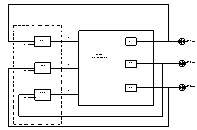
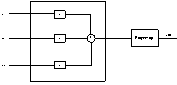
We will stop on the structure shown
in fig. 5.
References
1. H.
Yang , W. Sun and B. Xu "New investigation in energy regeneration of
hydraulic elevators", IEEE/ASME
Trans. Mechatronics, vol. 12, no. 5,
pp.519 -526 2007.
2. J.
Zhang , F. Zhang , M. Ren , G. Hou and F. Fang "Cascade control of
superheated steam temperature with neuron-PID controller", ISA Trans.,
vol. 51, no. 6, pp.778 -785 2012.
3. Z.
Dong , X. Huang and L. Zhang "Saturated output feedback dissipation
steam temperature control for the OTSG of MHTGRs", IEEE Trans.
Nucl. Sci., vol. 58, no. 3, pp.1177 -1190 2011.
4. P.
Setlur , J. Wagner , D. Dawson and E. Marotta
"An advanced engine thermal management system: Nonlinear control
and test", IEEE/ASME Trans. Mechatronics,
vol. 10, no. 2, pp.210 -220 2005.
5. T.
Xu , X. Pu and Z. Yuan
"Application of PID parameter setting based on a genetic algorithm
in a high-temperature multiphase flow wind tunnel", J. Eng. Thermal Energy Power, vol. 25,
no. 4, pp.414 -417 2010
6. Reference
book on state standard specifications of the Russian Federation http://www.opengost.ru/