Kh.B.
Asadova
Doctor of philosophy,Technics «Department of
Development Oil and Gas fields»,Tashkent State Technical University,Uzbekistan
A.A.
Sharapov
Student of «Department of Development Oil and Gas
fields», Tashkent State Technical University,Uzbekistan
ON
THE INFLUENCE OF BOTTOM-HOLE ZONE WELLS BY FLOW FLUID
Abstract: This article discusses the productive reservoir
sediment drainage, filtration properties and dynamic changes of bottomhole
formation zone. Also the explatation in the operation of wells in the wellbore. The leaking of the various
processes which adversely affect the properties of the filtration zone. As a result of those reasons
is a lack of fluids or lower rate wells during their operation. The work also contains the experimental processes are applied in the fields of oil and gas.
Keywords:
Buttom-hole zone, filtration properties, the influx of fluid
reservoir, carbonate sediments, current flow, open drainage, leachate, culling,
the productivity index.
I. As
the drainage of the productive deposits of reservoir properties of bottom-hole
formation zone dynamically changing, that is skinfactor. In cases where the
volume of recoverable hydrocarbon reserves significantly decreases, the problem
is in the forefront automatically. At the time of opening the thermodynamic
system "collector-reservoir fluids" different kinds of impact on it
is mechanical, hydrodynamic, thermal, chemical and other lead to deformation or
breakage of the skeleton productive deposits.
II. As a result of those reasons is a lack of
flow of fluid or decrease rate of producing wells during their operation.
So, at 26 holes were drilled in the
Namangan, only four of which are tributaries of the oil. It is known that the
productivity of wells mainly depend on the reservoir filtration properties. As
an example here is the indicator well 21 curve of Namangan. ( pic.1)
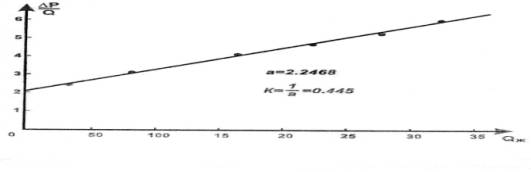
Picture - 1. Indicator 21 wells curve of Namangan.
The filtration capacity of the
reservoir, in turn, changes the value of the depression (∆P) .
Of 13 wells drilled at the deposit Garmiston are only 3, with ongoing
discharges of oil of about 50 t/d. The
deposit amount only two wells Feruza six
drilled. The current flow of oil wells from 9 t/d, up to 11 tons/day, if
necessary, this list can be continued. One thing is clear-oil production,
ceteris paribus, are generally dependent on the condition of bottom-hole
formation zone wells, reservoir properties which were deteriorating, due to
infiltration of filtrate formation and mechanical impurities during drilling,
as well as deposits asphaltic and paraffin-cerezonic components of the produced oil products and
the destruction of productive deposits.
Lisenko V.D. counts [1], the bottom zone
accounts for more than 90% of the total filtration of the resistance. During
the drainage of oil at a pressure below the saturation pressure, some
previously dissolved in oil and gas, standing out is part of the cross section
of a stream, and, in turn, increases the filtration resistance for oil.
The degree of loss of productivity of oil
wells extracting petroleum is [1]:
η=η
where: η – the current rate of productivity;
η₀
– initial productivity index at initial
reservoir pressure of saturation pressure
Р₀ – pressure saturation;
Рс
– current
reservoir pressure;
a -
productivity decline in the known values of η and Rs in time (η’, η’’, Рс’’ и Рс’)
а=1
 · ln
· ln
One of the most
important components of the mechanism of degradation of filtration properties
of manifolds is their deformation by compression of skeleton rock due to
depression in the near wellbore zone producing wells. The fact of the
destruction of the collector during long operation is supported by core samples
from several wells drilled at the deposit double Romashkino [2].
III.
Calculations showed that the thickness of the bottom zone with sharply
degraded collection properties can reach in the wells of Northern Urtabulak 0.5
-0.93 m, and North Shurtan field wells perhaps exceeding it to over 2 m. The results indicate that the currently used
hammers may not provide the desired bond formation with the slaughter of mining
hole, i.e. the inflow may not be.
This,
in a simplified form are:
-productive
oil deposits;
-deterioration of the filtration properties
of bottom-hole formation zone for quite sizeable distance from bottom of
well;
IV.
To ensure stable oil filter to wells as appropriate:
-on opening the productive deposits using
the drilling fluids with possibly a small watergive and content of mechanical impurities;
-ensure
the minimum possible period between the end of the process of drilling and
testing of the productive interval;
-in
cases where it is possible, check out the well "open face";
-to restore the reservoir properties during
well operations, when appropriate, the use of saltacids processing-moderated
reactions to ensure a deeper penetration of acid into the reservoir.
List of references:
1.
Lisenko
V.D. A decline in productivity on oil // Neftepromislovoe delo, 2005. №
12. 5-12.
2. Vladimir I. Sarvaretdinov, Galimov R.Kh., etc. Some of the causes of the destruction of the reservoir during of operating of wells //
Neftepromislovoe delo, 2002. № 9. 20-25.