УДК 619:636.7:619.9
Sickness Rate and
Treatment of the Chlamydia Infection of Dogs in the City of Kostanay
Annotation
Kulakova L. S.– associate professor of the
department of veterinary Kostanai State University. A.Baitursynov
Tokareva К.– 5th year student the department of veterinary medicine faculty of
veterinary medicine and animal breeding technology
Annotation
The statistical data of the
chlamydia infection sickness rate of dogs depending on sex, age, and the time
of the year from 2010 through 2013 are provided in the article. Also, an
effective therapeutic program in treating this disease is proposed in the
article.
Among numerous quadrupedal friends of humans, domestic dogs and cats are
considered the most faithful and loyal in their own right that amount,
nowadays, to more than a billion. And today, there are pets in almost every
single house [1, 2, and 3]. Animals tend to be down by many diseases, including
the chlamydia infection, which has infected about 18-38 % of dogs [4].
The
chlamydia infection is an acute or chronically passing zoonotic disease,
characterized by an infection of the genitourinary system, a development of
keratoconjunctivitis, rhinitis, and pneumonia [5].
Telling
that the chlamydia infection of dogs and cats is rarely seen is quite
premature, because in recent years, with the improvement of the laboratory
diagnostics methods, chlamydiae are found more often. Nowadays, some of the
leading foreign producers of vaccines, for instance, in France, include an
anti-chlamydia infection component in a vaccine for cats [6]. Thus, the
research on the chlamydia infection sickness rate and treatment of carnivores
is of current interest.
The
goal of our research was to find an effective therapeutic program in
treating the chlamydia infection of dogs.
Proceeding
from the goal we have put the following objectives:
1. Study the chlamydia infection sickness rate of dogs depending on sex,
age, breed, and the time of the year.
2.
Test the therapeutic program of the chlamydia infection of dogs which consists
of a Polioxidonium immunomodulator and antibacterial complex based on a Dorinum
antibiotics.
The research was being carried out at
the KSU Veterinary Clinic, 99/1 Mayakovskiy Street, Kostanay. The material of
the research was based on the animals diagnosed with the chlamydia infection,
verified at the RGP "RVL" laboratory, 43 Naberezhnaya Street,
Kostanay. The statistical processing of the sickness rate data have been done
with the help of ambulatory journals.
In
the KSU Veterinary Clinic from 2010 to 2013 years, 476 animals were
ambulatorily accepted with the diseases of the reproductive system. Different
diseases had been discovered both males and females: andrologic (phimosis,
inflammation of testicles, inflammation of prepuce, venereal sarcoma,
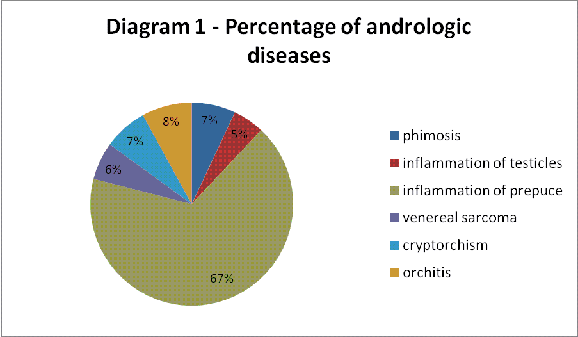
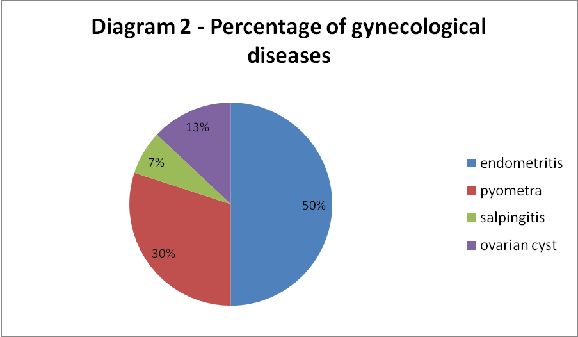
cryptorchism, orchitis) - 210 animals (diagram 1); gynecological (endometritis,
pyometra, salpingitis, ovarian cyst). - 266 animals (diagram 2).
Carrying
out the data analysis of the diagram 1 we see that phimosis makes up 7%,
inflammation of testicles 5%, inflammation of prepuce 67%, venereal sarcoma 6%,
cryptorchism 7%, and orchitis 8%. Among the andrologic diseases the
inflammation of prepuce takes the first place which was found in 140 dogs,
among which, there were 50 animals with the chlamydia infection.
Carrying
out the diagram 2 analysis we see that endometritis makes up 50%, pyometra 30%,
salpingitis 7%, ovarian cyst 13%. The diseases accompanied by the chlamydia
infection were found in 117 animals, which amounted to 44%.
The
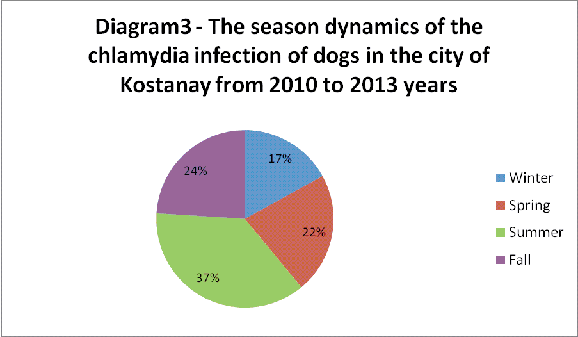
season dynamics of the chlamydia infection of dogs is shown in the (diagram 3),
which points out that the chlamydia infection occurs in all the times of the
year. In summer - 37%, in fall - 24%, in winter - 17%, in spring - 22%. Most of
the percentage of the diseases is noted in summer (37%), which is, in our
opinion, connected to exogenous and endogenous factors. In spring and fall with
a drop of animal resistance in these times of the year.
The dependence of the chlamydia
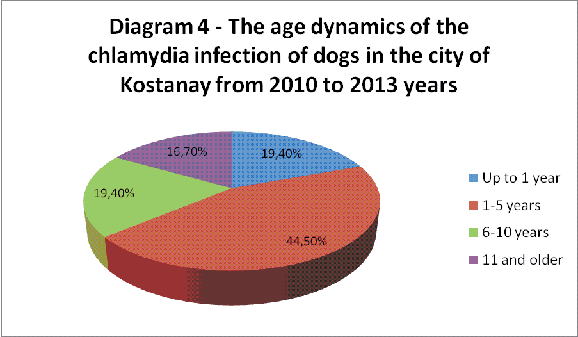
infection sickness rate based on animals' age (diagram 4), has been distributed
the following way: up to 1 year - 19,4%, 1-5 years - 44,5%, 6-10 years - 19,4%,
11 years and older - 16,7%. Most of the percentage of the sickness rate in the
age group 1-5 years is connected to the sexual activity of this age group.
As for the
interconnection of the chlamydia infection and the breed composition of dogs,
we see that it occurs among all breeds and crossbreeds of dogs, but usually
this disease is immanent in such breeds as German Shepherd, Dachshund, and
Boxer.
All
the animals with the prepuce inflammation were clinically examined as well as
have gone through a mandatory laboratory examination in order to find the cause
of the chlamydia infection, in the Regional Veterinary Bacteriological
Laboratory of the city of Kostanay. Among 140 males with the prepuce
inflammation, there were only 50 dogs with the chlamydia infection which was
confirmed at the laboratory, and these animals, subsequently, have become the
material for our research. All the animals have been divided into two
experimental groups based on the principle of analogues with 25 animals in each
group.
The
animals of the first group have got the treatment that is used in city clinics.
1. The antibiotic Ceftriaxone with
a dose of 20-100 mg/kg, intramuscularly, once a day, a course of 10 injections.
2.
An antibacterial medicine Metronidazole, 25 mg/kg, twice a day, inside,
a course of 10 days.
The
animals of the second group have got the treatment made by us:
1. Dorinum with a dose of 5 mg/kg based on the physiological
solution, intravenously, once a day, a course of 3 injections starting on the 5th
day of treatment.
2.
For the stimulation of the immune system – the immunomodulator Polioxydonium
with a dose of 0.2 mg/kg, intramuscularly, once in 24 hours, a course of 11
injections.
3.
Locally developing trays with 0.02 dose of furacilin solution
The
difference in the treatment programs was in using of the antibiotics and the
antibacterial medicine from different groups and our inclusion of the
immunomodulator Polioxydonium in our treatment program.
Polioxydonium
was used the following course: the first week, intramuscularly, once a day,
with an interruption on the 3rd day, and the next 10 days, the
injections were done in 24 hours with the same dose.
As
a result of the conducted treatment all the animals of the experimental (the
second) group have gotten completely healthy (confirmed in a laboratory),
relapses of the disease and the complications by the staphylococcus infection
have not been observed in any of the 25 animals. Among the 19 animals of the
first group, the relapses of the disease have appeared after a week of the
treatment course. After a repeated laboratory examination there were 6 animals
only with no chlamydia infection which amounted to 24%.
Our
experiments were carried out in industrial conditions and it lets us make a
following conclusion
1. The chlamydia infection has a widespread occurrence in
the city of Kostanay and amounts to 36% in males, and 44% in females.
2. The most quantity of the animals with the chlamydia
infection occurs in the summer period, 37%.
3. Most of the time, the animals from 1 year to 5 years
are affected by the chlamydia infection.
4. The chlamydia infection treatment program which
includes the immunomodulator Polioxydonium in its composition, 4.2 times more
effective than traditional therapeutic programs.
Practical
propositions
For the treatment of the chlamydia infection among dogs,
we recommend for practicing veterinary doctors to include in their treatment
program – Polioxydonium. Scheme of use: in the first week
intramuscularly once a day, with an interruption on the 3rd day, and
the next 10 days, the injections were done in 24 hours with the same dose.
Literature
1. Baranov
A.B. The Health of Your Dog. – RIMEKS. – 1992. p. 432 – ISBN: 5-86452007-1
2. Belov A.D.,
Danilov E.P., Dukur I.I., and others. Diseases of Dogs. – M. Kolos, 1995 – p.
272.
3. Bratyukha
S.I., Nagorny I.S., Revenko I.P., Shevtsov A.A., Ptitsyn A.K. Diseases of Dogs
and Cats. – Kiev: Publisher “Vishcha Shkola”, 1979. – p. 232.
4. [http://www.kfrt.ru/ru/lib/issue/f16/o157/]
5. [http://vetclinic.com.ua/news/2009-12-30-17]
6. [http://www.puppy-dog.ru/vet/209.shtml.htm]