Современные
информационные технологии/ 3.Программное обеспечение
Monchak M., Bilas O.
Lviv Polytechnic National
University, Ukraine
Project documentation
metrics adaptation for Scrum development methodology
Abstract
- Indicators and metrics of quality documentation in the lifecycle model of
Scrum development process are considered. Adaptation of the project
documentation quality metrics for agile development methodologies are carried
out to improve the quality of the software.
Metrics
of software quality should not be considered absolutely, the overall result of
this assessment should be regarded as information for analysis. Process
improvement and application of relevant metrics are recommended as results.
I.
Introduction
During
requirements for the software system determining external characteristics and
attributes that define various aspects of the behavior of the product in a
specific environment are relevant. To assess the characteristics of the quality
of the software system mentioned in the requirements determined by the
appropriate metrics, models of their estimation and range of measures for
measuring individual quality attributes are used [1].
Working
and quality product is the main metric of widely used agile development
methodology [2]. Preferring direct communication, agile reduce the amount of
written documentation in comparison with other methodologies. In Scrum
methodology documentations are in the form of user stories, tasks, and
retrospectives.
Scrum
documentation is updated after the end of the iteration and reflects the degree
of implementation of tasks and testing [2]. Analyzing of design documentation
metrics and documentation of Scrum methodology identified the need in
sophisticated set of metrics for a more complete assessment of the design
documentation in Scrum projects. Adaptation of existing classic quality metrics
for Scrum methodology is purposed to carry out.
II.
Model of quality
metrics for Scrum development methodology
Software
quality metrics is a function of inputs which are the measured data of software
process or product, and the output is a numeric value that can be interpreted
as a degree, which possesses the attribute of the software that affect its
quality [3].
To
develop or refine a set of metrics for Scrum projects, we need to create a list
of quality factors that are needed to determine for quality of design
documentation.
Scrum
documentation is updated after the each iteration finish and reflects the
degree of tasks and testing fulfillment. The obtained data contribute to the
documentation that assesses the quality metrics of project documentation [4].
2.1
Definition and adaptation documentation metrics for Scrum projects
2.1.1
Accuracy
Defect density of the sprint. Defect density is
calculated after each new design description verification (inspection) in the
sprint or after the end of sprint.
Primitives:
D - total number of defects
Di - total number of defects detected during the
inspection of the sprint
I - total number of inspections
DS - number of source lines of the sprint design
goals, expressed in thousands
Defects
density can be calculated as:
 (1)
(1)
Defect
density of the sprint can also be measured as
 (2)
(2)
Accounted
for every defect in the later stages, which is a defect of the sprint. The
result can be shown as a histogram of the defects density of sprints.

Fig. 1 Histogram of the defects density
2.1.2
Modularity
-
Metric integrity to sprint. Integrity or “strength” features associated with
sprint points out the relation between elements of features. Values integrity
for sprint’s assigned using a standard appraisal chart. The highest level of
integrity is a functional level, and the worst is occasional.
Sprint
with high strength (functional) performs a single function. Sprint with low
strength (random) includes several unrelated functions. Analysis has shown that
sprints with high strength, tend to have lower rates of defects, and they are
cheaper to develop. According to sprints with high strength modularity is
higher.
Toughness
is a measure of integrity degree of software module elements.
Calculation
of strength:
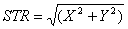 (3)
(3)
where:
X - reciprocal of the number of assignment
statements in the sprint
Y - number of unique results of function divided
by the number of unique input.
- Connectivity descriptions metric within
iterations. Connectivity is measures of the degree for which the functions are
implemented in the sprint communicate. Connectivity descriptions can be
evaluated using standard evaluation chart. The connectivity data is the best
type of connectivity, while the connectivity of the content is the worst.
The
connectivity data is data exchange through the options list, while the overall
connectivity is in communication through the global (total) area. In the
previous guidelines stated that total connectivity should be avoided. But
further research showed that error distribution does not depend on the
mechanism of connectivity. However, from the modularity point of view and
independence descriptions from external factors, value of connectivity should
be lower.
Calculation
of connectivity:
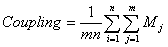 (4)
(4)
where:
Mj - total number of input and output elements
distributed between components i and j
Zi - average number of input and output elements
distributed between the m components of component i
n - number of components in the software
description.
After
examining the connectivity descriptions within iterations need to explore the
overall coherence of the sprint project.
2.1.3
Clarity
- Metrics of volume. Studding the
effect of module size on modularity (and therefore reusability) was made during
the research. Module size of itself does not affect the bounce rate. In
addition, the cost of large modules per executable statement is less than for a
smaller module. This suggests that the rows number of the project and code is
not a good indicator of modularity. However, when it’s used with other metrics
(complexity, etc) metric size can be an indication that the module should be
split on smaller modules. The following metrics can be considered as metrics of
volume:
•
Number of project sprints
•
Number of records on one sprint
•
Number of lines of code document
•
Number of functions
•
Number of inputs and outputs
•
Number of interfaces
- Complexity metrics
1.
External complexity (De) is based on information available during
the design of solution architecture, such as hierarchical data flow diagrams,
functional descriptions and interfaces.
Calculation
of external complexity:
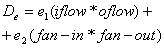 (5)
(5)
where:
iflow - number of data entities
passed to the function descriptions
oflow - number of data entities
sent from the description of the functions
fan-in - number of parental
descriptions directly related to the description
fan-out - number of child descriptions directly related to the
description
e1 and e2
weight coefficients.
2. The internal complexity of the sprint (Di)
is based on information available after detailed design descriptions, including
information that is used for external complexity plus selected algorithms and
possibly pseudo-code or view the design language.
Calculation
of internal complexity:
 (6)
(6)
where:
CC (central call - Central calls)
- number of calls to procedures or functions
DSM (data-structure manipulation
- manipulation of data structures) - the number of references to complex data
types
I/O - number of calls to external
devices
i1, i2, i3 – weights.
For the
optimal sprints planning determination of the descriptions number in the sprint
are needed and the size of descriptions depends on the objectives of the
sprint, so it can be made in a certain time and resources.
Conclusion
Examining
metrics of project documentation standards revealed that the selected metrics
can be useful for evaluating documentation according to agile development
methodologies. Design documentation metrics can be adopted for Scrum projects
after their analysis.
The
metric of sprint defects density is calculated after the finish of the sprint
and reflects the quality of software code.
The
integrity metric of the sprint points to the relationship between elements of
the functions associated with sprint. Studies have shown that the features of
high strength, tend to have lower rates of defects, and they are cheaper in the
development. Therefore, sprint with high strength modularity is better.
The
metric of connectivity in Scrum projects are useful for determining the
connectivity of the descriptions and how they communicate, as well as
connectivity descriptions between sprints. Connectivity descriptions can be
evaluated using standard evaluation chart. The connectivity data is the best
type of connectivity, while the connectivity of the content is the worst.
During
the research was identified that it is necessary to extend the set of metrics
of volume because they can be an indication that the description can be divided
into smaller.
Complexity
metrics used in Scrum projects to measure the complexity of the architecture of
the software product, represented by a set of descriptions that is useful for
analysis of the project.
References
[1] Boheme B., Brown J., Caspar H. (1981), “Characteristics of software quality”, Mir, p. 206.
[2] Agile Modeling [Electronic resource] - Mode of access:
http://www.agilemodeling.com/essays/agileDocumentation.htm/
[3] Stephen Kan (2003), “Metrics and models in software quality
assurance (2nd edition)”, Addison-Wesley Professional, p. 520.
[4] Monika Agarwal, Rana Majumdar, “Tracking Scrum projects Tools, Metrics and Myths
About Agile”, International Journal of
Emerging Technology and Advanced Engineering,рp.
97-104,
March 2012.