R.Zhumatayev
Al-Farabi Kazakh National University, Kazakhstan
Some
problems of worldview of ancient nomadic Kazakh Altay
(By Berel the burial ground materials)
Each historical era
has certain specific features, which finds its expression in different types of
material, social and spiritual culture. As is well known, the study of ancient
periods of history, especially when we do not have the written information is
based mainly on a comprehensive analysis of archaeological sources, that allows
you to restore important moments in the development of the people in specific
cultural and historical conditions.
To date, the Kazakh
Altay territory investigated a significant number of archaeological monuments
of early nomads, especially Berel burial, materials which we refer in our work.
Accumulated materials allow a closer look at the problem of religious and
mythological worldviews and people of that time.
Berel burial site is
located in the administrative territory Katonkaragayskogo district of East
Kazakhstan region, 7 km south-west of the village of the same name, on the
terrace of the third. Bukhtarma. On the east and west sides closed terrace
mountains slopes are covered with mixed forest. The absolute height above sea
level - 1120 m (Fig. 1).
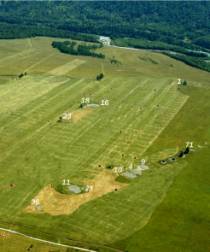
Fig. 1. Location of main group Berel barrows on the terrace of the river
Bukhtarma
Berel burial was
known in the XIX century. In 1865 V.Radloff unearthed the largest repository of calling it the "Big Berel
barrow" [1, p.9]. On the ground and in the construction of this monument
tombstone designs - no precise details and drawings and graphic documentation.
Prior studies S.Sorokin in 1959 did not found an overall picture of the
architectural appearance and design features of the monument, as they only task
was opening the burial pit with the remains of a log house and the deck, and
not a detailed analysis of the construction of ground facilities. Meaning V.Radloff excavations lies in the fact that the Altai was
first made the discovery of the phenomenon of barrows permafrost, which has
long remained unnoticed.
Since 1998, research
on the burial of the conductive members of the Institute of Archaeology named of A.Margulan
led by Z.Samashev. During this time
there have studied more than 20 sites, the vast majority of which belongs to
the era of ancient nomads, and some part of the period of the ancient Turks and
obtained very valuable materials. Preliminary results of some scientific issues
relating to the monument were presented in the book Z.Samashev [1].
The study of philosophy
of ancient societies in many cases is conducted on the basis of analysis of the
funeral rite. Type of burial structure is largely determined by the dominant
religious and mythological concept and the influence of the environment [2,
P.16].
For example, to
create a place Berel "kingly" necropolis, probably chosen priests and
the elders of the congregation. The burial ground, as was noted in a valley
bordered by mountains, limited Buhtarma tributaries, which, combined with the
amazing beauty of nature contributed to the sacralization of space. According
to the beliefs of the ancient people, the mountains were endowed with special
meaning, since their vertices inhabited by gods in the upper world of the soul
departed ancestors [1, p.9].
Based on the above
theoretical propositions acceptable to make the assumption that the funeral
rites can act as a definite philosophical system of actions. In some elements
of this system, in particular in the funerary monuments are some religious
beliefs of the ancient tribes.
To bury their
tribesmen ancient bereltsy erected, as well as their neighbors in other parts
of the Altai, stone mounds with elaborate wood and stone graves.
According to preliminary
observations Z.Samashev common to most Berel burial barrows is that laid buried
at the bottom of a deep hole in the sarcophagi-deck, enclosed in houses or in
wooden frames. Dead are laid back, heads were oriented to the east, and they
were accompanied by 1 to 17 horses, funeral food, arms and household.
Orientation and
position of dead people is an important feature of the funeral rite any
archaeological culture. In many cases, the characteristics of the orientation
of the deceased are used as one of the main indicators in the allocation of
individual cultural and historical units.
In ancient times,
people orientation entombed many people attached great importance, because it
has been associated with the idea of death as a transition a
person from one state to another, from the earthly realities of the afterlife.
To do this, to understand the body in a certain direction, the deceased pointed
the way to an otherworldly space. Orientation buried people could also be
associated with many specific indicators or targets [3].
The analysis of
the observations showed that the orientation of the buried in barrows Berel
burial ground was mostly based in the horizon at sunrise. The most common, not
only in Berel burial, but throughout the Altai Mountains in Pazyryk, the
situation of the dead head to the east, possibly reflecting the outlook of
ancient people that the soul of man after death should go to the top of the
world for life. With the same idea, probably due to cover the burial of horses
on the north side log, which also guided the skull to the east [4, P.118].
One of the most
significant and distinctive features characterizing the funeral ceremony and
culture of the population of the Altai, including the ancient tribes have left
Berel barrows a burial of a man with a horse in a burial pit. This rite, which
was formed under the influence of socio-economic relations in the society of
ancient nomads, is reflected in the systems of religious and mythological
representations of the ancient nomads of the Early Iron Age.
As previously
noted in Berel burial found from 1 to 17 horses buried in the northern part of
the burial pit. The total number of horses found in the cemetery until today
has more than 70 For full information about the horses buried in barrows is a
brief description of their location in the burial chambers mostly from tribal
leaders.
Buried under the
Big Berel barrow accompanied by a noble man, according to reports, dumping 17
horses. Beyond the northern wall of the burial chamber, in 4 rows of 4 horses
in each row was laid 16 animals. One horse was buried in a log house near the
deck. Horses were saddled and bridled. In mound №11 well as the northern wall
of the log house, under the floor of birch panels, was buried on 13 horses.
Animals were placed in two layers: the lower are 7 horses in the top - 6; on
the belly, with bent legs, heads NNE (Fig. 2).
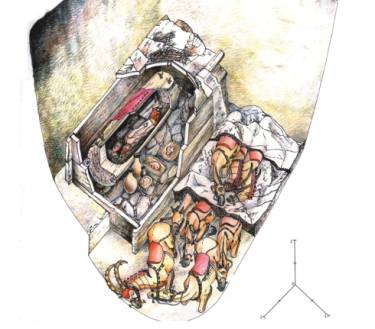
Fig.2. The burial chamber barrow №11.
Upgrade to Z.Samashev
And in a barrow under the wall №10 log were stacked
ten horses in three rows with bent under the belly down, head to the northeast.
All the horses were saddled and bridled. Straps of a harness, saddles decorated
in the traditions of the Scythian-Siberian animal style. Animalistic images are
presented as real-life animals: deer, feline predators, fish, and fictional,
fantastical creatures - griffins. Horse harness is made of wood, using
different techniques, combining technique and bas-relief sculptures. All of
these products: badges, Psalm, pendants, belt separators - decorated on the
front side, covered with gold foil and tin. [1]
In one of the small barrows under №36, which was
considered as a private burial was found buried in a special stone box. The
decoration of a riding horse consisted of more than 60 pieces made from the
horn of red deer and representing outstanding works bone carving art of the
early nomads of the Great Steppe zone. Such a number of samples of highly
carving horn, made in the Scythian-Siberian animal style, met for the first time in the
funerary complexes of the early nomads of Altai not only, but also in Eurasia. [1]
Some of the horses buried in large burial mounds were
ceremonial masks in the form of horns of a mountain goat. The image of a
mountain goat is interconnected with the rest of the front decoration horse
supreme leader. This may be linked with the idea of chosenness
deceased person. Mountain goat - inhabitant of the heavenly peaks, special
sphere of space, accessible only to the elite, interpreted as an attribute of a
leader.
Factor in the presence of various animalistic images
in the decoration of horse equipment can be explained in different ways, for
example, just as a man of his day to day, ceremonial vestments with images of
strong, agile, and other sacred animal was meant to provide eternal prosperity,
passing through the magical properties of these positive animals and his horses
must have fantastic properties of transformation in order to overcome possible
obstacles on the way to another kingdom, beginning with the date of the
"rites of passage".
On assumptions made by many scientists burial structures
"Pazyryk", including the ancient population Berel reflect on the
semantic level dwelling type, probably, a certain kind of wagon [5, p.262]. Thus,
the presence of horse burial together with the classic design of the burial
evidence of the implementation of the idea of the ancient population
of Berel burial carts to move to a distant world beyond the grave of the dead. The
room is on the north side of the horse inside the burial structure with
orientation head to the east (in the same direction and is focused deceased person)
indicates probably that man after death is sent to the upper world, which is
the attribute of the eastern side of the horizon. Thus, having a plurality of
sources, the ancient tribes of the Kazakh Altai time considered the origins of
human burial with a horse (or a few animals) in a burial chamber, and the
formation of world outlook due to the role of the horse's social and economic
life of society.
Characteristics
of the latest discoveries in the territory of the Kazakh Altai shows the
brightness and variety of monuments that characterize the high culture of the
ancient nomads, to determine the contribution and importance of the cultural
achievements of the ancient peoples of the Kazakh steppes who lived in the I
millennium BC.
Location in Berel
burial of several large barrows, the ratio of its other cemeteries Altai
containing "royal" burial suggest Berel as one of the political and
cultural centers of society, to create a local version of the so-called Pazyryk
culture, which can be called Berel.
1.
Samashev Z. Berel. – Almaty: Izdatelskiy dom «Taymas» 2011. – 236 s.
2.
Olkhovskiy V.S. Pogrebalno-pominalnaya obryadnost naseleniya stepnoy Skifii
(VII-III vv. do n.e.) – M., 1991. – 256 s.
3. Shilov
YU.A. Prarodina ariyev. Istoriya, obryady i mify. – Kiyev, 1995. – 744 s.
4. Voytov
V.Ye. Drevnetyurkskiy panteon i model mirozdaniya v kultovo-pominalnykh
pamyatnikakh Mongolii VI-VIII vv. – M., 1996. – 152 s.
5.
Tishkin A.A., Dashkovskiy P.K.Sotsialnaya struktura i sistema mirovozzreniy
naseleniya Altaya skifskoy epokhi – Barnaul: Izd-vo Alt. un-ta, 2003. – 430 s.