УДК 577.352
MATHEMATICAL MODEL OF THE
INFLUENCE OF TEMPERATURE AND CHEMICAL FACTORS ON THE FUNCTIONING OF CELLULAR
RECEPTORS.
Sukhorukova
Irina V., Doctor of Economics, Professor of the Mathematics Department of the
Russian Plekhanov University of Economics, 117997, Russian Federation, Moscow,
Stremyanniy per., 36,
e-mail:suhorukovaira@yandex.ru
Vybornova I.I., associate professor of the Mathematics Department of the Russian Plekhanov University of
Economics, 117997, Russian Federation, Moscow, Stremyanniy per., 36,
e-mail: inezvyb@rambler.ru
Vybornov A.N., Ph.D., associate
professor, Moscow State University of Information Technologies, Radio Engineering and Electronics,
119454 Moscow, Vernadsky prospect, house 78,
e-mail : a_vybornov@rambler.ru
Shershnev
Vladimir G., Professor of the Mathematics Department of the Russian Plekhanov
University of Economics,
117997,
Russian Federation, Moscow, Stremyanniy per., 36,
e-mail: shershnev_vg@yandex.ru
By methods of
mathematical simulation study of the effect of thermal and chemical factors on
cell receptors and the dynamics of their functioning. Selected two processes that are most
sensitive to these impacts.
Biological membranes and their various
components, such as ion channels, pumps, membrane enzymes and receptors, showed
a high sensitivity to external factors.
Ambient
temperatures, chemical agents, рН affect both himself
silipigni layer and membrane components, causing the cooperative response of
the cell membrane. This
work is devoted to the theoretical study of some mechanisms of the influence of
temperature and chemical factors on the functioning of biological membranes:
the influence of external effects on the functioning of the receptors of
different classes.
The functioning of the body
cells is largely due to the ability to specifically bind ligands (contained
outside the cell substance) surface receptors. The
processes of ligand binding and transporting it to the internal compartments of
the living cell are membrane receptors. Experimental data indicate changes in
the ability of receptors to bind ligand and internalional it in response to
changes in temperature, concentration of cations and рН. Ionic requirements for the binding of receptors with ligands are
important condition for the implementation of an adequate response of the cell
to the ligand. An equally important aspect of the ability of functioning
receptors look temperature conditions. The interaction of receptors with
ligands leads to cooperative effects of changing the ultimate state of the
membrane.
Cells of a multicellular organism are
constantly changing microenvironment. They are able
to maintain your metabolism and the constancy of the internal environment due
to the property selectively (specifically) "learn" with a complex of
proteins (glycoproteins) that are embedded in the cell membrane (receptors)
that are contained outside the cell substances (ligands).
It is known [1,2] that a common feature
of cellular receptors, which determines the realization of their biological
functions is the ability the ability of internalization, that is, the
displacement from the cell surface to the interior of cells.
J. Kaplan [3] receptors subdivided into two classes:
Receptors, transport molecules into the cell for further metabolic process ---
class II (for example, low-density lipoproteins (LDL), transferrin IgG).
Receptors conditioners directly alter
cellular behavior or metabolism after binding of the ligand --- class I. The class I receptors can be divided into receptors capable of
internalizing its ligand (class IA), and receptors that are not internalized
ligand (class IB).
To the class IA include insulin and epidermal growth factor (EGF), to the class IB --- IgG on basophils, acetylcholine.
The class II receptors reutilized many times in the
course of his life. Most receptors of class IA upon binding with ligand are in
the lysosomal compartment. This process is accompanied in a significant
reduction of receptors on the cell surface (“down—regulation”), which leads the
cell to loss of sensitivity to class IA molecules. The class IB receptor is not
regulated (e.g., acetylcholine receptor, there is a low density and a very fast
dissociation of the complexes the ligand-receptor).
In order to examine the changes in the functioning of cellular
receptors, their ability internalional ligand depending on the ionic
characteristics, pH conditions and temperature was constructed mathematical
model of the dynamics of internalization and recycling of cell receptors, class
I and class II.
Receptor-induced endocytosis occurs
primarily through bordered pits (pores ). They exist in almost all animal cells
and in approximately 2 % of the cell surface.
Receptors of class I to the initially randomly distributed on the
membrane and require the binding of a ligand to movements in the pores. The majority of class II receptors reclustered in bordered pits.
Bound to the
receptors of most ligands are clustered in the pores and leaves the surface of
the cells for 10-15 minutes.
The first stage of
internalization is associated with the invagination of the cell membrane
(within 1-2 minutes) and subsequent itsoriginal her dressed vesicles (i.e.
vesicles, covered latinboy shell). Then dressed
vesicle is transformed into receptosomes (smooth vesicles), losing latinova
coat, which bordered returns to the pits at the cell surface.
The second
stage is the fusion of receptosomes in the cytoplasm to lysosomes. In a weakly
acidic environment of receptosomes due to the conformational changes in the
receptor involves dissociation of the complex ligand-receptor full (class II)
or partial (class IA). The ligand in the lysosome breaks down, the receptor or avoids crushing
or subjected to limited cleavage.
The foregoing has given the
basis to build a functional scheme of the process of interaction of the ligand
with the receptor, including internalization, recycling and interaction with
the pore.
Mathematical model of
process of interaction of the ligand with the receptor is as follows:





 где
где  ,
,  ,
, 


 — the concentration of ligand-free
receptors, ligand-receptor complexes, pore complexes in the pore, complexes in
the vesicle, internalized ligand, internalized receptors, respectively;
— the concentration of ligand-free
receptors, ligand-receptor complexes, pore complexes in the pore, complexes in
the vesicle, internalized ligand, internalized receptors, respectively;


 — the speed of synthesis and catabolism of ligand and
receptor, respectively;
— the speed of synthesis and catabolism of ligand and
receptor, respectively;


 — the baud rate and dissociation of ligand and receptor; complexes
ligand-receptor with at times, respectively;
— the baud rate and dissociation of ligand and receptor; complexes
ligand-receptor with at times, respectively;
 ,
,
 — the rate of
internalization and recycling, respectively;
— the rate of
internalization and recycling, respectively;
 ,
,  — the rate of destruction in the lysosomes of
internalized ligand and receptor, respectively;
— the rate of destruction in the lysosomes of
internalized ligand and receptor, respectively;
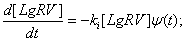
m --- the coefficient characterizing the percentage of receptors,
pregesterone to pore.


 ;
;
 — time
intussusception;
— time
intussusception;
The model reflects the process of invagination of the membrane
and threshold character falling through the pores.
The model identified receptors for
low-density lipoprotein , insulin, and epidermal growth factor. The
mathematical model shows the periodic process of falling then, the
internalization and recycling of receptors; "down-regulation" for
insulin and EGF.
For LDL receptors in normal human fibroblasts with 50-70% of LDL
receptors, reclustering in bordered pits, complexes leave the surface of the
cells for 10 minutes . For defective fibroblasts and carcinoma cells A-431— 3-4
% LDL receptors reclustered in bordered pits, here the process of
internalization of the complexes lasts much longer.
The model demonstrates for the LDL receptor, the importance of
the number of receptors, reclustering in the pores. In defective condition (3 %) time of
internalization increases significantly.
Receptors of class I and II are
characterized by different speeds of lysis of internalized receptors. For class
II — .
.
For class I receptors in the lysis
within a few seconds-minutes, the concentration of free receptors decreases
rapidly, there is "down-regulation".
In a very large factor  , characterizing the rate of dissociation of the complexes
ligand-receptor, the concentration of the complexes are close to zero. This corresponds to the dynamics of binding the receptors of
class IB, for the realization of biological effects which are not necessary in
the internalization of ligand.
, characterizing the rate of dissociation of the complexes
ligand-receptor, the concentration of the complexes are close to zero. This corresponds to the dynamics of binding the receptors of
class IB, for the realization of biological effects which are not necessary in
the internalization of ligand.
The mathematical model adequately
reflects the dynamics of the process of binding the ligand with all other
classes of receptors, class II, class IA, class IB.
As noted in [4], for class
II receptors unlike receptor class I binding of ligand to the receptor is
typically sensitive to the concentration of cations and pH. The majority of class II receptors shows a lower affinity to the
ligand at low pH (with the exception of transferrin).
The ability to bind the ligand for the receptor, accumulating
external ligand without the depletion of receptors on the cell surface, or
depends on the concentration divalent cations or pH. Receptors, transporting
ligand to various intracellular compartments, such as mannose-6-phosphate
receptor, sensitive to low pH, but not low concentration divalent cations.
Receptors low-density lipoprotein and receptor -macroglobulin protease is
sensitive to low concentrations of cations and reduced pH. At pH=5,0 binding
receptors with ligand does not occur.
Thus it is clear that the concentration of cations and pH affect
the rate of binding of the ligand to the receptor  . In the study of the mathematical model was obtained with reducing the
  four times is
observed for increasing absorption of the ligand is almost twice the number of
complexes decreases approximately in 1.6 times. When you decrease
four times is
observed for increasing absorption of the ligand is almost twice the number of
complexes decreases approximately in 1.6 times. When you decrease  an order of magnitude the
concentration of complexes of the Lg R is reduced about three times. When
increasing
an order of magnitude the
concentration of complexes of the Lg R is reduced about three times. When
increasing  the order of the response time
of the cell to the ligand decreases 1.8 times, while lower order of magnitude
response time is increased four times. Thus the reduction value
the order of the response time
of the cell to the ligand decreases 1.8 times, while lower order of magnitude
response time is increased four times. Thus the reduction value  greater effect than an increase.
Experimental studies indicate the sensitivity of membrane
Receptors not only reduce pH and concentration of cations, but also to
temperature change. In [9] provides data about the lack of internalization of
LDL within 4-5 hours at a temperature of C. In [10] it is noted that at a
temperature of C for three hours internalizes only 20% EGF, at a temperature of
C for thirty minutes - 73%, at a temperature C — 77% EGF. There are also data
on the temperature dependence of the functioning of insulin receptors.
All this allows to conclude that the
temperature affects the rate of internalization of the complexes of ligand
receptors  and(or) on the rate of binding
of the complexes with sometimes
and(or) on the rate of binding
of the complexes with sometimes  . . In the study model, it was found that when reducing
  the order time absorption of the
ligand in the cell increases 2.5 times, two orders of magnitude - more than
five times and the concentration of free receptors on the cell surface tends to
zero. For receptor class IA (e.g., insulin
receptor), an abrupt increase in the rate of internalization leads to
"down-regulation" and the rapid loss of cell sensitivity to class IA
molecules. The increase in the mathematical model of the rate of
internalization
the order time absorption of the
ligand in the cell increases 2.5 times, two orders of magnitude - more than
five times and the concentration of free receptors on the cell surface tends to
zero. For receptor class IA (e.g., insulin
receptor), an abrupt increase in the rate of internalization leads to
"down-regulation" and the rapid loss of cell sensitivity to class IA
molecules. The increase in the mathematical model of the rate of
internalization  of ten times
leads to the reduction of drilling down then three times and a quick,
"down-regulation".
of ten times
leads to the reduction of drilling down then three times and a quick,
"down-regulation".
Because the class II receptors for the performance of its
functions is to transport molecules into the cell, they need to form a complex
of the ligand-receptor contact-lined pit. Change the speed of binding of the
receptor and its complexes with sometimes certainly will affect the performance
of the transport functions of the receptor. In the study model, it was found that
the decrease  in the rate of binding of the
ligand-receptor bonds with sometimes twice leads to an increase of 1.6 times
the absorption of the ligand to the cell and higher concentrations of unbound
complexes sometimes several times. When
in the rate of binding of the
ligand-receptor bonds with sometimes twice leads to an increase of 1.6 times
the absorption of the ligand to the cell and higher concentrations of unbound
complexes sometimes several times. When
 reduced in 4 times the
absorption of the ligand takes longer more than 3 times, the membrane is a
large number of complexes unrelated to sometimes. When
reduced in 4 times the
absorption of the ligand takes longer more than 3 times, the membrane is a
large number of complexes unrelated to sometimes. When  you decrease on the order of almost all complexes the ligand-receptor
located on the membrane surface without contacting bordered pits.
Eternalization ligand, effect of small amounts of complexes in the pore, hardly
occurs.
you decrease on the order of almost all complexes the ligand-receptor
located on the membrane surface without contacting bordered pits.
Eternalization ligand, effect of small amounts of complexes in the pore, hardly
occurs.
In the study model, it was found that the decreased rate of
binding of the ligand with the receptor  in two times the model demonstrates the increasing
absorption of the ligand about 1.3 times and reduce the concentration of
complexes Lg-R about one and a half times.
in two times the model demonstrates the increasing
absorption of the ligand about 1.3 times and reduce the concentration of
complexes Lg-R about one and a half times.
On the basis of
experimental data (e.g. [11]) we can assume that under the influence of
temperature and pH may change the real number of cellular receptors located on
the membrane. Given the function of receptors of class I, sostoyanie receptors
with membrane becomes a barrier to perform their metabolic functions. In the
study model identified receptors for class I, the following results were
obtained. The initial decrease in the number of receptors on the membrane by
30% leads to a decrease in ligand-receptor complexes on the cell surface
approximately in half. While "down-regulation" (DR), i.e. the
depletion of receptors on the membrane, occurs five times faster than normal,
resulting in the number of ligand, a total of proteinopathies with receptors
decreases more than three times. When reducing the initial number of receptors
by 50 % the number of ligand-receptor complexes is reduced more than twice, DR
comes in 10 times faster, which leads to a reduction of the captured ligand 4
times. Reducing the number of receptors on the membrane on the right leads to
the fact that they are virtually unable to perform its functions. Rapid
depletion of receptors, a low concentration of ligand-receptor complexes and
the unbound ligand, remaining almost the same amount outside the cell,
characterize this situation.
Thus, when considering the processes of interaction of the
ligand with the receptor and internalization of the ligand-receptor complexes
as a stage that is most sensitive to changes in ionic state of the membrane and
pH, we can distinguish, first of all, the stage of ligand binding to class II
receptors on the cell membrane. The sensitivity can be achieved by changing the
ability of receptors to bind. The latter may occur due to changes in the ionic
properties of the membrane in the vicinity of the receptor.
Temperature change
affects the stage of binding of the receptor with the ligand and to the stage
of internalization of free receptors and the resulting ligand-receptor
complexes. Sensitivity may
occur here due to the conformational changes to the receptor and (or) by
changing the viscosity of the bordered pits.
This is consistent with the results of numerical experiments
conducted with the presented mathematical model.
Thus, considering the influence of the ionic state of the
membrane and pH and temperature on cell receptors and the dynamics of their
functioning, we can distinguish two processes that are most sensitive to this
effect. First, the binding of ligand to receptors on the cell membrane. The
sensitivity in this case may be provided the actual decrease in the number of
receptors on the cell surface (their sostoyanie) or(and) change the ability of
receptors to bind. The latter may occur either through conformational changes
in the receptors themselves, or by changes in the ionic properties of the
membrane in the vicinity of the receptor. Secondly, the process of
internalization of free receptors and the resulting ligand-receptor complexes.
Sensitivity may occur here due to the change in viscosity of bordered pits.
Bibliography:
1.Chernikov
M. V.Cell receptors: a modern approach to classification and architecture
.Volgograd scientific medical journal. 2009. No. 1 (21). S. 13-16.
2. Savin A.V., Gendelman O.V. Mechanical
control of heat conductivity in
molecular chains Physical
Review E - Statistical, Nonlinear, and Soft Matter Physics. 2014.
Т. 89. № 1.
С. 012134..
3. Kaplan J. Polypeptide-binding
membrane receptors: Analysis and classification //Science. 1981. V. 212. P. 14.
4. Sukhorukova I.V., Vybornov A.N.,
Vybornova I.I Economic-mathematical
model for analysis of the effects of pollution areas. — Interuniversity Collection of papers :
"Information technologies in education, science, technology and
Humanities" , vol.5, 2014. p. 21-29