P.h.D. Kryuchin O.V.,
Kryuchina E.I.
Tambov State University named after G.R. Derzhavin
Parallel algorithms training
artificial neural networks for exchange rates forecasting
The aim of this paper is to predict exchange rates between Euro and US
dollar using an artificial neural network. To achieve this aim, several tasks
have to be solved. These tasks are the training of artificial neural networks (ANN)
structure witch consider time series of currency pair quotations; the check of ANN-model adequacy based on this
structure; the forecasting result of technical and neural networks analysis
comparison; to formulate a corollary about the possibility to use ANN for
predication [1].
We will
use two networks. First of these it a multilayer perceptron (MLP) which is a
structure in which each neuron in each layer (except output layer) is connected
to all neurons of the next layer. Weight coefficients is are calculated by
formula 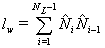 where NL is
layers count,
where NL is
layers count,  is the number of neurons in i-th
layer [2-3]. The second structure is a Volterra network which is a dynamic
network for the nonlinear adaptation of array of signals belated for each
other. The vector
is the number of neurons in i-th
layer [2-3]. The second structure is a Volterra network which is a dynamic
network for the nonlinear adaptation of array of signals belated for each
other. The vector  from equation
  activates the network at moment m.
Here
activates the network at moment m.
Here  is the vector of currency values at
moments
is the vector of currency values at
moments  , L is the Volterry level and w
is the weight coefficients vector. This polynomial degree is called the
Volterra series degree [4].
, L is the Volterry level and w
is the weight coefficients vector. This polynomial degree is called the
Volterra series degree [4].
The
predication and its checking consist of several steps:
1.
the algorithm starts at time t=t0, and sets the test
index to k=0;
2.
the pattern is formed [5];
3.
weight coefficients are trained by a gradient algorithm of steepest
descent [5];
4.
the ANN input vector  is formed and the ANN calculates
the output output value yN+1 ;
is formed and the ANN calculates
the output output value yN+1 ;
5.
the quotation change 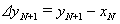 is calculated and used for
calculation of value
is calculated and used for
calculation of value 
where  is the swap value.
6.
the time t is changed (t = t + c) and the test index is
incremented (k = k + 1);
7.
the algorithm goes to step 2.
These tests show the probability of obtaining the correct direction of
the quotation change. For multilayer perceptron it is 72% and for a Volterra
network it is 76%. The technical analysis [5] allows to forecast the direction
of change with probability value of about 65%. So the neural network analysis
using a Volterra network is efficient.
Table 1
shows values of sufficiency coefficient for ANN-models (calculated by formula  using a multilayer perceptron (
 ) and a Volterra network (
 ) where IT is the number of experiments.
Figure
1 shows series of currency pair quotations, both empirical and forecast (by the
multilayer perceptron and the Volterra network).
Tab.1. Values of sufficiency
of ANN-model.
|
|
ANN-model sufficiency |
|||||||
|
Coefficient of discharging
c |
15 min |
30 min |
60 min |
120 min |
||||
|
Predication rating L |
|
|
|
|
|
|
|
|
|
8 |
69 |
73 |
69 |
71 |
67 |
70 |
65 |
65 |
|
9 |
70 |
73 |
70 |
72 |
69 |
71 |
65 |
67 |
|
10 |
71 |
73 |
71 |
73 |
71 |
72 |
65 |
69 |
|
11 |
72 |
75 |
72 |
73 |
69 |
73 |
66 |
69 |
|
12 |
72 |
76 |
72 |
75 |
70 |
73 |
66 |
70 |
|
13 |
72 |
75 |
72 |
75 |
70 |
71 |
67 |
72 |
|
14 |
72 |
75 |
71 |
74 |
70 |
70 |
67 |
73 |
|
15 |
70 |
75 |
70 |
73 |
70 |
72 |
66 |
72 |
|
16 |
69 |
74 |
69 |
73 |
70 |
72 |
67 |
70 |


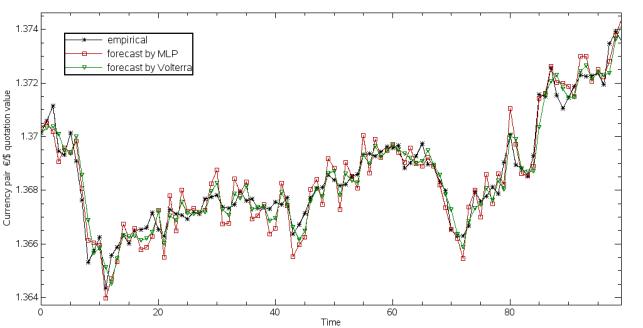 Pic.
1. Empirical exchange rates, exchange rates forecast by multilayer perceptron
Pic.
1. Empirical exchange rates, exchange rates forecast by multilayer perceptron
and by Volterra.
It
follows from the experimented results that a Volterra ANN with four layers and
twelve inputs allows to predict the correct direction of the quotation change
with a probability of 76%. So such a structure can be used for forecasting of
exchange rates.
Literature
1.
Крючин О.В.
Использование технологии искусственных нейронных сетей для прогнозирования
временных рядов на примере валютных пар // Вестн. Тамб. ун-та. Сер. Естеств. и
техн. науки. – Тамбов, 2010, Т. 15, Вып. 1, С. 312.
2. Rosenblatt,
Frank. x. Principles of Neurodynamics: Perceptrons and the Theory of Brain
Mechanisms. Spartan Books, Washington DC, 1961
3. Rumelhart,
David E., Geoffrey E. Hinton, and R. J. Williams. “Learning Internal Representations
by Error Propagation”. David E. Rumelhart, James L. McClelland, and the PDP
research group. (editors), Parallel distributed processing: Explorations in the
microstructure of cognition, Volume 1: Foundations. MIT Press, 1986.
4. Osowsky S.
Sieci neuronowe w ujeciu algorytmicznym // Warszawa. 1996.
5. Kryuchin
O.V., Arzamastsev A.A., Troitzsch K.G. The prediction of currency exchange
rates using artificial neural networks [Электронный ресурс] — Электрон. дан. //
Arbeitsberichte aus dem Fachbereich Informatik Nr. 4/2011. Koblenz. 2011. 12 p.
— http://www.uni-koblenz.de/%7Efb4reports/2011/2011_04_Arbeitsberichte.pdf