Cubesat miniature
satellites of the planet Earth
Proshin
A. A., Goryacheva E. P., Goryachev N. V., Yurkov N.K.
Penza
State University.
Satellite
technologies are an essential component in the study of outer space, as well as
for many other tasks. Along with serious big-machines, there are small,
so-called nanosatellites. On one of them is being discussed in this article
about nanosatellite standard CubeSat.
Keywords.
Space, satellite, nano-satellite, orbit, the ISS, CubeSat, platform,
standardization, microelectronics.
"The heavenly bodies revolve all on the same
orbit, but every time under other laws."
Stanislaw Jerzy Lec (poet, writer, philosopher)
Running
into space artificial satellite is quite expensive pleasure. One reason for
this is that the satellites are designed to address specific scientific
purposes. Of course, this approach allows you to create superior devices, which
have the maximum possible efficiency and carrying on board the most advanced
equipment. Such satellites can easily perform any task, but their cost is often
a stumbling block and an insurmountable obstacle for a variety of scientific
communities.
Comes
to the aid, the so-called satellite formation (formation flying), which allows
to share the load between multiple devices. Not to be confused with the concept
of the group of satellites. In contrast, where all satellites, though moving in
relative proximity to each other, but operate independently, in the formation
of satellites all devices work together, sharing each other tasks. For example,
all members of the formation but one of the collected information. The task of
the latter includes only receiving data from all of them and transfer it to the
operator. In other words, the use of satellite formation can solve the same
problems as the big expensive machines, but their reliability is several times
higher, since there is the possibility of replacing the failed module. The cost
and development time are also the indisputable advantage. However, the bad one
who is content available. Standardization satellite platforms can further
reduce the cost and development time. In the space sector, this approach,
unfortunately, for a long time was impossible, because of the specificity of
tasks, but now, when many of them have become routine, and the development of
science in the field of micro- and nano-electronics has reached a higher level
of standardization began to raise his head. This method is very widely used in
the use of small (nano and pico) satellites as well as equipment failure will
result in the loss of only a small cheap device that can easily be replaced.
Currently, one of the most successful and is actively developing projects in
this area is nanosatellite platform CubeSat (Fig. 1).
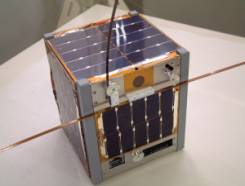
Fig.
1. Satellite standard CubeSat, created by the University of Tokyo
As
you can guess from the name, all the satellites that are created under this
standard are required to have a cubic shape size mm 100x100x113.5 with an error
of not more than 0.1 mm (in the absence of additional solar panels) and a
weight of not more than 1 kg (there are rare exceptions).
One
of the key features of CubeSat, it stands out from the rest of nano-satellites,
is a well-defined specifications, allowing a high degree of standardization.
CubeSat must have a monolithic structure, that is, not to have separated parts.
This requirement is dictated by the struggle for the purity of space (the
smaller debris we leave after the use of their vehicles, the better). Among
other things, on CubeSat banned installation of explosive devices, containers
with explosive substances and tanks under pressure of more than 1.2 atm. And
despite the fact that such requirements significantly limit the spectrum of
possible equipment they offer the possibility of launching a satellite with the
International Space Station. Use of the ISS is an essential tool in creating
formations of satellites as well as the storage of small satellites on board
allows almost instantaneous replacement of the failed unit. Plus, ISS allows
testing directly at nano-satellites on board, because the conditions in it
coincide with orbital.
The
technical documentation CubeSat'a spelled out the possibility of his run with
the help of standardized launch platforms. For this purpose the housing
nano-satellite (Fig. 2) are provided special rails to secure the platform.
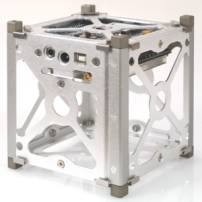
Fig.
2. Housing of CubeSat
The
main objective of this platform - is the protection of the carrier rocket from
possible disruptions CubeSat, as the latter often run in conjunction with a
large machine, breaking is due to damage young fellow would be a serious
problem, while the loss of CubeSat is not a problem. In addition, the launcher
allows you to make a launch platform with a minimum angular velocity, thus
minimizing the possibility of a clash with the launch vehicle. It must meet the
same requirements as to the most satellite, it should be easy, cheap and
standardized.
The
most widespread use CubeSat a formation of satellites in Earth orbit. Firstly,
they start to not pose any problems, especially with the support of the ISS,
and secondly the power of the transmitter mounted on the satellite are often
not very high, due to restrictions on its size. Finally, thirdly, the use of CubeSat
orbiting the Earth provides an excellent opportunity disposal through atmospheric
drag, which in turn minimizes the creation of space debris, the theme of which
was affected earlier in the article.
In
conclusion it remains to say that the potential of the CubeSat standard, and it
has still not explained fully. The number of areas in which it can be applied,
does not have the number, and relatively low cost of development and makes it
possible to start using it not only to large companies and universities, and
individuals, the modern world never ceases to amaze.
References
1.
Grigor'ev A.V., Goryachev N.V.,
Yurkov N.K. Way of measurement of parameters of vibrations of mirror antennas.
2015 International Siberian Conference on Control and Communications (SIBCON).
Proceedings. – Omsk: Omsk State Technical University. Russia, Omsk, May
21−23, 2015. IEEE Catalog Number: CFP15794-CDR. ISBN: 978-1-4799-7102-2. DOI:10.1109/SIBCON.2015.7147031
2.
Goryachev N. V., Tanatov M. K.,
Yurkov N. K. Issledovanie i razrabotka sredstv i metodik analiza i
avtomatizirovannogo vybora sistem okhlazhdeniya radioelektronnoy apparatury
[Research and development of tools and techniques for analysis and automated
selection of cooling radioelectronic equipment]. Nadezhnost i kachestvo
slozhnykh system [Reliability and Quality of Complex Systems.], 2013, no. 3,
pp. 70–75.