Peculiarities of
process cost accounting
Abdakimova Assel
Karagandy
c.
KEU,
undergraduate, UA-21 NP group
asel_abdakimova@mail.ru, 87004954460
Madieva K.S. c.e.sc., professor
The process costing is one of the main methods of
calculating in managerial accounting. This method is used when the production
consists of a sequence of continuous or repetitive operations or processes, and
the cost of production is determined at each stage of production, operation or
process. The essence of the process system, in which costs follow the product,
is that after the completion of any operation, costs are accumulated relative
to their average level and, by mathematical calculations, come to costs per
unit of output.
Process accounting is used in those industries that
produce, as a rule, homogeneous products, such as flour, cement, screws, nuts,
pharmaceutical products, etc. The cost price of each separately taken from the mass
of other units of production will be identical to the cost of the remaining
units of production. Many simple processes fall into this category, for
example, mixing two or more raw materials to produce another type of product
(for example, one liter of paint does not differ from the other one liter of
paint obtained as a result of the same process). In addition, this method is
also used for assembly (cars, electrical appliances, etc.) [1].
Process accounting is used in cases where the finished
product of one process becomes a semi-finished product for another process. As
an example, the dairy industry, where the technological process involves the
division of milk into cream, which can later be processed into butter, and
skimmed milk, from which a number of products can also be produced, can be
cited. This method is also acceptable for complex production of various types
of products, consisting of one or more processes.
The process costing can be illustrated as follows: a
product requires several processing operations each of which occurs in a
separate department. The costs of Department One for the month of June amount
to 500 000 tenge of direct materials and 280 000 tenge of conversion costs (direct labor and manufacturing
overhead). If the number of units processed in June in Department
One is the equivalent of 1000 units, the per unit cost of the products
processed in Department One in June will be 500 tenge
for direct materials and 280 tenge for conversion
costs. These costs will then be transferred to Department Two and its
processing costs will be added to the cost of the units.
Process accounting has both a number of advantages and
certain drawbacks.
Among the advantages of this method is, as a rule, the
collection of costs. The process-based method requires less effort and is more
economical than job costing. The fact that the costs of a non-process method
are collected over a period, rather than related to a specific order, allows
you to have some time in the activities of the enumerators and provides
intermediate bases for comparing costs. The averaged units of output are more
accessible, provided, of course, that these average values are homogeneous.
Streams of expenses are easily traced in the accounts, there are more clear
boundaries between the division of responsibility. The assignment of overheads
to workshops or processes can be done on a more accurate basis than is possible
with a custom system [2].
Speaking about the shortcomings of the process
accounting, it should be noted that the averaging of costs, adopted in the
process, sometimes leads to inaccuracies in the calculations (when the product
or its constituent material components are not completely homogeneous). This
drawback can be illustrated by the example of those processes where the weight
of the raw materials of the calculated units is mixed in products of different
sizes or compositions. When an enterprise produces several types of products,
where different products are made from several materials and on different equipment,
the prorated distribution of cost elements for individual products is often a
very complicated procedure in which estimates are used. Inventories of work in
progress should be evaluated according to the degree of completeness, and this
evaluation entails inaccuracies passing through various processes to the
finished product, cost of sales and net profit. If preliminary costs are used,
periodic reports of factual data are not provided until the end of the
reporting period, which makes this shortcoming very important for the purpose
of controlling a process system, the essence of which is to divide the
enterprise into separate units.
Process accounting in one form or another provides:
- production planning in general and in the context of
the flow of costs;
- calculation of production volumes for a certain
period, including processes and operations;
- collection and distribution of costs;
- preparation of a report on the cost of production;
- maintenance of accounting accounts, journals, books
and other accounting registers that form the accounting structure and its
connection with the calculation system.
One of the main characteristics and goals of a process
accounting system is to provide data on the costs of operations or processes.
Controlling the costs of the production system as a whole is usually not very
effective, so for the purpose of presenting the necessary information, the data
must be distinctly divided and grouped. This uses division, which includes such
concepts as "process", "shop", "operation",
"unit of production".
In order to accumulate costs in the process system, it
is first and foremost necessary to dismember the manufacturing enterprise into
separate subdivisions, with special attention to the division of the
technological process into shops that reflect the characteristics of the
production activity of the enterprise and to cost centers that facilitate the
collection and accumulation of data on a uniform basis. So, for example, a
brick factory should have two production halls: one for mixing concrete and
converting it into bricks and the other for baking bricks. Production shops can
be as many as required for production and production. Some products can pass
through several production shops, while the rest can go through one or two. At the
same time, they should combine the following: first, the work done in them must
correspond to all the units of production passing through the shop, and
secondly, the production of the production shops must be homogeneous [3].
Production shops can be organized in a variety of
ways, but the two main options are associated with the sequential and parallel
calculation of the cost of production.
Production workshops for the production of such
products as, for example, bricks, can be organized according to a consistent
model, in which the units of production pass from one shop to another for
further processing. The finished product of one shop becomes the direct cost of
the materials of the next workshop (scheme 1).
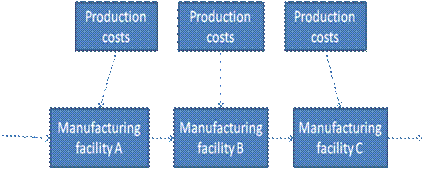
Scheme 1. Sequential calculation of the cost of
production.
Parallel production is used in cases where the
products do not undergo sequential processing in all facilities. A part of the
units of production passes through one production processes, and some through the
other (scheme 2).
For example, crude oil is used in one process, and
then refined oil is used to further manufacture several end products. Each
final product can go through several stages of further redistribution after
initial purification, with some products participating in the production of the
final product, and some not. The number of possible options in parallel
production is almost unlimited.

Scheme 2. Parallel calculation of the cost of
production.
The most important procedure in the process model is
the production plan of the enterprise, broken down by cost centers. It follows
that the process or shop usually forms the center of costs. As a rule, either
direct or indirect costs are collected from the cost centers, however, some of
the cost centers may include combined costs. This is done for the purpose of
grouping in one cost center homogeneous overhead expenses for choosing the
appropriate method for their distribution. The detailed work of the system is
determined by the existing conditions: first, division into divisions is of a
natural nature; secondly, the cost centers must be organically interconnected
with the division made; and thirdly, the accumulation of costs occurring in the
cost centers must be realizable and economically [4].
The peculiarity of accounting procedures in the
process calculation is that for each production department opens its account
"Work in progress" (in the domestic account, the account "Main
Production"), and not one single account "Work in Progress" for
the entire company. The finished products that have come out of the first
workshop are transformed into "Work in Progress" in the second
workshop, where it is further processed, then the same occurs in the third
shop, and so on, depending on the number of processes (redistribution). After
that, the units finished by processing become finished products. Material,
labor and overhead costs can be attributed directly to any production
department (not necessarily the first). The costs of each subsequent workshop
will consist of materials, labor and overheads attributed directly to the
process, plus costs related to semi-finished products from the previous
workshop (transferred costs).
The essence of the method lies in the fact that direct
and indirect costs are accounted for by the costing items for the entire output
of finished products. The average cost price of a unit of production is
determined by dividing the sum of all costs for the reporting period by the
quantity of finished goods produced in the period. Costs of auxiliary
production and management costs are formed by complex costing items. If there
is no work in process at the end of the period, then the total value of
production costs is the cost, otherwise the distribution of costs for finished
products and work in progress.
References:
1. Voronova E.Y. Process cost accounting: general characteristics.
– Auditor №6 , 2013
2. Ivashkevich V.B. The issues of accounting and calculating the costs of product. — М.: Finance, 2014
3. Kondrakov N.P. Managerial accounting: Tutorial. - М, 2014
4. Kukukina I.G. Managerial accounting: Tutorial, 2013