MATHEMATICS
/ 3. Theory of Probability and Mathematical Statistics
Iskakova A.S., Zhaxybayeva G.K.
L.N. Gumilev Eurasian National University, Astana,
Kazakhstan
About maximum likelihood estimates of one class of
discrete multinomial distributions
As
is
know,
maximum
likelihood
estimates,
under certain conditions
[1], have
important
properties
in
the
theory
of
estimation. In other words, they are consistent,
asymptotically normal, and asymptotically effective.
Let
us consider the case when the maximum likelihood estimates do not always exist.
Suppose that the urn contains balls, and each ball in the urn is marked by some
value of a rectangular matrix La,
where the elements of matrix
lai are
arbitrary integers from a known finite set.
Suppose that the number of possible matrices La is
d. Let’s the
elements of the vector p=(p1,
… , pd) determine the
probabilities of retrieval from the urn of a ball marked by corresponding
matrices L1, …, Ld,
moreover  .
.
There
is a successive extraction of n balls from the urn with a return, and it is not
known which balls were taken from the urn. Only the value
of the matrix u is know,
which represents the sum of the matrices on n balls taken from the urn. To
study this situation, it is necessary to construct a probability distribution
u. Let`s say,
that
Vu
represents the number of possible combinations r1vuL1,…,
rd vuLd, which
in the sum formed a matrix u,
where
r1vu,…, rd vu determine
the possible number of removed balls that are marked with the corresponding
matrices L1,…, Ld.
In other words, from work [2] follows that Vu
is the number of partitions of the matrix u into parts L1,…, Ld.
The following assertion follows from the results of [3-5]. The probability that
the random variable U will take the value of the matrix u, is
 (1)
(1)
Obviously,
in practice, the elements of the vector are not known p=(p1, …, pd). Consequently, formula (1) does
not find actual application. In this connection, it becomes necessary to
determine the probability estimate (1).
Let
Х represents
a sample of the volume k from the distribution (1) and
х there
are observed values of X, where the
elements хi represent the sum of
matrices on n balls sequentially removed from the urn with a return. For each i=1, ..., k
determine
Vi
number of partitions хi for matrices L1, … , Ld.
Let us find the maximum likelihood estimates for the parameters p1, … , pd of the distribution
(1). The log-likelihood function for the parameters p1,
… , pd of
the distribution (1) can be represented in the form where
where From
which it follows that for any Δ=1, ¼ , d we have
From
which it follows that for any Δ=1, ¼ , d we have
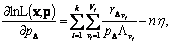 (2)
(2)
where
under
i=1,
… , k, vi=1, … , Vi
 (3)
(3)
As
is known, maximal likelihood estimate for parameters
p=(p1, … , pd) satisfy the following condition
under Δ=1,
¼
, d
 (4)
(4)
As
 then
then
 (5)
(5)
By
(3) it is obvious that Lvi³1, under i=1,
… , k, vi=1, … , Vi, moreover Lvi=1,
if Vi=1,
otherwise Lvi>1.
From which it follows that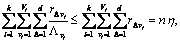 that is
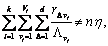 if
at some i=1, …, k Lvi>1.
Hence (6) is satisfied if Vi=1 for all i=1, …, k. Therefore, the construction of maximum likelihood estimates for
the distribution parameters of the presented model is possible only if the
elements of the sample implementation have no more than one partition into the
presented parts. In other words, if for all
i=1, …, k Vi=1, то Lvi=1,
with Δ=1, ¼, d, that is
if
at some i=1, …, k Lvi>1.
Hence (6) is satisfied if Vi=1 for all i=1, …, k. Therefore, the construction of maximum likelihood estimates for
the distribution parameters of the presented model is possible only if the
elements of the sample implementation have no more than one partition into the
presented parts. In other words, if for all
i=1, …, k Vi=1, то Lvi=1,
with Δ=1, ¼, d, that is
 (6)
(6)
Thus, the following
theorem is true.
Theorem. If all the elements of
the sample implementation х
from the distribution (1) have no more than one partition into the
presented parts, then there exist maximum likelihood estimates for the
distribution parameters (1), defined as 
Consequence.
If any element of the sample implementation х from the distribution (1) has more than one
partition into the presented parts, then there are no maximum likelihood
estimates for the distribution parameters (1).
Thus,
it is not always possible to construct maximum likelihood estimates for the distribution
parameters (1).
Reference
1.
Ibragimov I. A., Has'
Minskii R. Z. Statistical estimation: asymptotic theory. – Springer Science
\& Business Media, 2013. – Т. 16.
2.
Ayman I. Construction
of the most suitable unbiased estimate distortions of radiation processes from
remote sensing data //Journal of Physics: Conference Series. – IOP Publishing,
2014. – Т. 490. – №. 1. – P. 012113.
3.
Ayman I. Statistical
Research for Probabilistic Model of Distortions of Remote Sensing //Journal of
Physics: Conference Series. – IOP Publishing, 2016. – Т. 738. – №. 1. – P.
012004.
4.
Iskakova A. S. Determination of the most suitable
unbiased estimate for a weather forecast being correc //Sibirskii Zhurnal
Industrial'noi Matematiki. – 2002. – Т. 5. – №. 1. – P. 79-84.
5.
Maximum likelihood
estimation and inference for approximate factor models of high dimension
//Review of Economics and Statistics. – 2016. – Т. 98. – №. 2. – P. 298-309.