Zamyrbek F.Z., Zhusipova D.A., Zulpuhar A., Tastambek K.T., Karibayev E.K., Abdullayeva B.
Al-Farabi Kazakh National University,
Almaty, Kazakhstan
IN VIVO INVESTIGATION OF WOUND DRESSINGS BASED ON CARBONIZED RICE HUSK
WITH SILVER IONS
Abstract
Sorption properties of the sorbent obtained from carbonized rice husk (CRH) has an important role in the treatment of
purulent wounds. In efferent therapy, the practical importance of silver/CRH
biocomposite is great. This study
demonstrates in vitro studies of
antimicrobial activity of silver containing carbonized rice husk (CRH) obtained
by high temperature carbonization against the
total bacterial count of causative agents of purulent wound. The
results showed that the antimicrobial activity of CRH/silver biocomposite
become wider as the silver content increases. It was created wound dressings
based on complex therapeutic agents, including highly efficient sorbents with
nanostructured surface (carbonized rice husk) enriched silver ions for the
treatment of purulent wounds. In vivo studied wound-healing activities of wound
dressings on the purulent wound of laboratory rats.
Key words:
purulent wound, wound dressings, carbonized rice husk (CRH), silver, total
bacterial count.
Topical preparations for wound care have been used for
centuries. Dressings play a major role in wound management and have developed
greatly over the last 50 years from passive to more active types
[1]. Dressing selection is a vital part of the successful management of
infected wounds and those at risk of infection. The role of silvers as an
antimicrobial agent is particularly attractive, as it has a broad spectrum of
antimicrobial activity with minimal toxicity toward mammalian cells at low
concentrations and has a less likely tendency than antibiotics to induce
resistance due to its activity at multiple bacterial target sites. There are
already a large number of silver-containing dressings, and the list is growing
[2].
The properties of metallic silver is a broad
antibacterial spectrum of action, virucidal and fungicidal activity, the
complexity of generating protective mechanisms of microorganisms to it, justify
promising studies using it in terms of wound infection [3].
Treatment of purulent wound is an extremely complex
and multifaceted phenomenon. In a study of its pathogenesis make the main
contribution microbiology, biochemistry, cell biology and immunology. That is
why it is necessary to develop completely new approaches to the delivery of
silver ions to destruction of causative agents of purulent wound. The solution to this problem may be found in new
techniques in biotechnology based on the use of immobilized preparations in
which silver ions are adsorbed on the surface of a carrier.
Among these of special interest are the
carbonized sorbents with nanostructured surface that manifest not only high
affinity to bacterial cells but also detoxifying activity. It means that such
sorbent will act as carrier for silver ions and at the same time neutralizes
various toxins of purulent wound.
Several studies have shown that prospective for
practical use are carbon sorbents with a nanostructured surface based on vegetable
raw materials [4]. Carbon obtained by carbonization such materials retains its
original thinly organized structure. By varying, the conditions of
carbonization can produce complex composition of carbon, giving the final
product a variety of properties that determine their practical application.
Large quantities of plant wastes and agricultural by-products, such as grape
seeds, nutshells, corn waste, etc. are produced annually. Meanwhile, excellent
renewable raw materials for adsorbent production can be prepared. In most
cases, as raw plant materials are commonly used monocyclic crop plants, such as
wheat, rice, etc. For
instance, rice shell is considered to be excellent renewable raw material for
activated carbon production [5].
One of the ways to optimize the problem of improving
the quality of treatment of the wounded is the use of dressings [6]. For the
treatment of purulent wounds suggested a wide variety of methods and means of
the local application. The use of wound dressings on the basis of carbonized
rice husk as a sorbent which has been impregnated on its surface with silver in
wound treatment procedures have a great relevance. It is also important to
study how the exudates from the wound accumulate on the surface of the material
and these results in a large reduction in the material's capacity to effect
sterilization.
The main purpose of this work is to investigate new
wound dressings with carbonized rice husk impregnated with silver ions in vivo and antimicrobial activity of
CRH functioned with silver ions
against Escherichia coli, Staphylococcus
aureus, Pseudomonas aeruginosa and Proteus spp. in vitro.
MATERIALS AND
METHODS
As
the materials, it were taken the carbonized rice husk (CRH), AgNO3, nonwoven materials, laboratory rats, test strains from the collection of
Applied Microbiology laboratory: Escherichia
coli, Staphylococcus aureus, Pseudomonas aeruginosa and Proteus spp.
Carbonized rise husk
In Kazakhstan, the carbon materials with
nanostructured surface for the first time obtained by high-temperature
carbonization from cheap secondary vegetable raw materials. Such as stone
fruit, walnut shells and rice husks at the Institute of Combustion Problems led
by Professor Z.A.Mansurova [7]. The presence of nanostructural surface of these
materials enhances their attachment ability for microbial cells. Especially,
the diameter of formed pores in the carbonization process controlled by
carbonization temperature.
Silver. The silver ion is bioactive and in sufficient concentration readily kills bacteria in vitro. Silver exhibits low
toxicity in the human body, and minimal risk is expected due to clinical
exposure by inhalation, ingestion, dermal application. The medical uses of silver include
its incorporation into wound dressings, creams, and as an antibiotic coating on
medical devices [8].
Nonwoven materials. Nonwovens
have specific characteristics that allow them to deliver high-performance
across a wide range of applications. Specific functions include absorbency,
liquid repellency, resilience, stretch, softness, strength, flame retardancy,
washability, cushioning, filtering, bacterial barrier and sterility. Today, innovations
in nonwoven fabrics are growing as rapidly as the demand for them, with almost
unlimited possibilities for a wide variety of industries [9]. In this work, it was taken surgical robes as nonwoven materials.
METHODS
Preparation of silver/CRH biocomposite
The silver enriched CRH was synthesized by treatment
with AgNO3 at the
concentrations of 44; 22 and 0.44 µg/g.
These concentrations were chosen because according to the concentration of
Actisorb® Silver Antimicrobial Dressing 220 and preliminary experiments done by
us. This process is allowed to proceed overnight then washed thoroughly with
distilled water.
Calculation the total
bacterial count at silver and CRH effect
The pure culture of microorganisms is enlivened in
Nutrient broth for one day, and then it is carried out according to the
dilution method by Koch. In 104 dilutions in 50 ml is added CRH
enriched with silver ions. The flask contents were incubated for 15 minutes and
1 hour at 370C on a shaker at 200 rotations. After 15 minutes and 1
hour, from flask contents is taken out 0.1 ml suspension, then it is
distributed on the surface of the selective medium with a sterile spatula. The
plates are incubated for 24 hours at 370C. The next day, the total
number of grown microorganisms would calculate. Number of cells in 1 ml of the
substrate is calculated by the formula:
 (1)
(1)
where, M - amount of cells in 1 ml, a - average number
of colonies present at seeding dilutions, 10 - dilution coefficient, n - number
of serial dilutions of the seeding which was done, V - the volume of suspension
taken for seeding in ml.
Preparation wound dressings with silver/CRH
biocomposite
In the preparation of wound dressings the
concentration of CRH enriched silver were performed according to the
concentration of Actisorb® Silver Antimicrobial Dressing 220. Within the
dressing, there is 22 µg silver per 1g
CRH. As nonwoven material it was taken surgical robes. The flasks with silver
and CRH were shaken in Shaker for 15 minute at 200 rotations. Then CRH
impregnated with silver was filtered and dried under the dry box, then put into
the nonwoven material.
RESULTS AND
DISCUSSION
1.
The separate effect of silver ions on total bacterial count
It was studied the effect of Ag on
total bacterial count of test strains. It was added Ag concentrations on 104 suspensions. Initial it was taken 0.1 ml suspension from the flask contents. Taken
volume of suspension spread over the surface of the medium with a sterile
spatula. The total bacterial count after incubation for 24 hour at 370С in thermostat and the results in
the presence of 3 Ag concentrations (22µg/ml, 11µg/ml and 0.22µg/ml) were
illustrated in Table 1.
Table
1. The separate effect of silver ions on total bacterial count
|
Test strains |
Initial |
Ag exposure time (min)
and concentrations (µg/ml) |
|||||
|
22
µg/ml |
11 µg/ml |
0.22 µg/ml |
|||||
|
15 min |
60 min |
15 min |
60 min |
15 min |
60 min |
||
|
E. coli |
5.7×10⁷ |
- |
- |
- |
- |
105 |
- |
|
S. aureus |
2.3×10⁷ |
- |
- |
- |
- |
- |
- |
|
P.aeruginosa |
3.5×10⁷ |
- |
- |
- |
- |
- |
- |
|
Proteus spp. |
3.1×10⁶ |
- |
- |
- |
- |
2×10⁵ |
- |
2.
The effect of CRH enriched with silver ions on total bacterial count
It was considered the effect of CRH impregnated with silver on total bacterial count. Initial it was taken 0.1 ml suspension
from the flask contents. Taken volume of suspension spread over the surface of
the medium with a sterile spatula. The total bacterial count after incubation
for 24 hour at 370С in thermostat
and the results in the presence of 3 concentrations of CRH
enriched with silver (0.5g CRH + 22 µg Ag,
0.5g CRH + 11 µg Ag
and 0.5g CRH + 0.22 µg Ag) were demonstrated in
Table 2.
Table
2. The effect of CRH enriched with silver ions on total bacterial count
|
Test strains |
Initial |
CRH enriched Ag
exposure time (min) and concentrations (g/µg) |
|||||
|
0.5g CRH + 22 µg Ag |
0.5g CRH + 11µg Ag |
0.5g CRH + 0.22 µg Ag |
|||||
|
15 min |
60 min |
15 min |
60 min |
15 min |
60 min |
||
|
E. coli |
5.7×10⁷ |
- |
- |
4×10⁵ |
- |
6×10⁶ |
- |
|
S. aureus |
2.3×10⁷ |
- |
- |
- |
- |
4.5×10⁵ |
- |
|
P.aeruginosa |
3.5×10⁷ |
- |
- |
- |
- |
- |
- |
|
Proteus spp. |
3.1×10⁶ |
3×10⁵ |
- |
2.7×10⁵ |
- |
2×10⁷ |
- |
We found complex
silver/CRH biocomposites have
antimicrobial, anti-inflammatory, anti-toxic activities. Therefore, almost at
all concentrations of biocomposites were active against test strains. Obtained results show the highest
effects of biocomposites were against E. coli, S. aureus, P. aeruginosa even in 15 minute shaking. Definitely, after one hour
shaking the total bacterial count of all microorganisms was completely
inhibited by the effect of silver/CRH biocomposites.
3.
Wound-healing properties of
wound dressings to the purulent wound of lab rat.
The laboratory rats were
adapted on the condition during the experiment. After the adaptation, it was
made wound on the lab rat skin with surgical instruments. Injured zones of skin
were treated with causative agents of purulent wound Staphylococcus aureus. The wound of rats treated during 1-2min with the cotton impregnated
with bacterial suspension. After one day, it was conducted wound healing
procedures with wound dressings (Fig. 1).
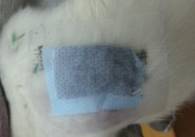
Fig. 1. Medical dressing on the rat skin
It was counted the total bacterial count of microflora of purulent wound
every second day of treatment with silver impregnated CRH dressings. In control
variant of wounds was steady decrease of colony
forming units of in 103 suspensions of microflora (Table 3). The healing of wound lasted 10
days (Fig. 2).
Control (without dressing):
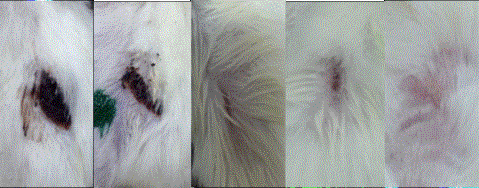
2 day 4 day 6 day 8 day
10 day
Treatment with silver impregnated CRH dressings:
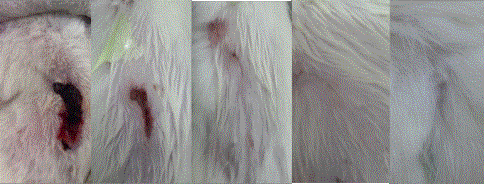
2 day
4 day 6 day 8 day 10 day
Fig. 2. The healing of wounds (in days).
However, in the case of treatment with silver impregnated CRH dressings
the healing of wound reduced for 2 days in comparison with control. The
purulent wound healed in 6-7 days. In sixth day of healing the number of colony forming units of in 103 suspensions of microflora has been completely reduced (Table 3).
Table
1. The change of number of microflora during the wound treatment
|
Wound dressings |
CFU of microflora in 103 suspension |
||||
|
2
day |
4
day |
6
day |
8 day |
10 day |
|
|
Control |
13,5×10⁵ CFU/ml |
8,5×10⁵ CFU/ml |
1,5×10⁴ CFU/ml |
5×10³ CFU/ml |
- |
|
Ag +CRH experiment |
7×10⁴ CFU/ml |
104 CFU/ml |
- |
- |
- |
CONCLUSION
The
greatest inhibitions of total bacterial count in the presence of silver ions
suggest the wide effective, antimicrobial
activities against a broad range of microorganisms. In this study, CRH
with silver ions were tested using a proposed standard in vitro method for
evaluating the antimicrobial activity of this material.
The
wound-healing properties of medical dressing, which was created by us showed
high effectiveness. In the presence of CRH/silver biocomposite the wound
treatment procedures shortened for 2-3 days in comparison with control due to
the anti-inflammatory and antimicrobial activities of CRH/silver biocomposite.
REVERENCES
1.
Leaper D. J. Silver dressings: their
role in wound management. Int Wound J. 2006; 3:282-294.
2.
Thomas S, McCubbin P. An
in vitro analysis of the antimicrobial properties of 10
silver-containing dressings. J Wound Care. 2003;12(8):305–308.
3.
Jones S. A., Bowler P. G., Walker
M., Parsons D. Controlling wound bioburden with a novel
silver-containing Hydrofiber dressing. Wound Repair Regen.
2004;12(3):288–294.
4.
Khokhlova G.P., Shishlyannikova
N.Y., Patrakov Y.F. Opportunities for carbon sorbents based on the composition
of waste wood and resin shaped coal conversion products // Chemistry for
Sustainable Development. - 2005. - №13. - P. 103-110.
5.
Chang H.Y., Yun H.P., Chong R.P.
Effects of pre-carbonization on porosity development of activated carbons from
rice straw // Carbon. - 2001. - Vol. 39, №4. - P. 559-567.
6.
Yagelsky V.P., Sugurova I.Y.,
Kilchenko I.I. Modern dressings in outpatient practice // the
Military-med.zhurn. -2003. -№ 7. P. 65-68.
7.
Z.A. Mansurov, Zhilibayeva N.K.,
Ualiyeva P.S., Mansurov R.M. Preparation and properties of sorbents herbal //
Chemistry for Sustainable Development. - 2002 - V. 10, № 4. - P. 339-346.
8.
Storm-Versloot, MN; Vos, CG; Ubbink,
DT; Vermeulen, H (Mar 17, 2010). "Topical silver for preventing wound
infection".
9.
http://www.edana.org/discover-nonwovens/what-are-nonwovens.