Математика/5. Математическое моделирование
К.ф-м.н.
Хилько А.В.
Башкирский
государственный университет, Россия
Mathematical modeling of induction period
of chemical reactions
Investigation of
mechanism of homogeneous metalcomplex catalysis is important problem of modern
chemistry. The reactions which run with complex of transitional metals are
complicated processes. Modern physical and chemical methods cannot define the
structure of all intermediates which take part in complex catalytic processes.
Therefore we have mathematical ambiguity of solution in solving the inverse
problems of searching for kinetic parameters. In science school of Dzhemilev
U.M. the fundamental catalytic reactions of hydro-, carbo- and cycloalumination
of unsaturated compounds was worked out.
In last years
investigations of mechanism of given processes was started. The aim of these
investigations is building the kinetic model of given reactions. For the
reaction of olefins hydroalumination by alkylalanes in presence of catalyst Cp2ZrCl2
the existence of induction period was shown experimentally. Induction period is
some time interval [0;Tind], such that we have a slow accumulaton of
reaction product during this time interval. Out of this interval the fast
accumulation of reaction product observed. Induction period exist in various
chemical systems, however, for the processes of homogeneous metalcomplex
catalysis, particularly, for the reaction of olefins hydroalumination the
question about induction period is not investigated.
Thus, the
mathematical modeling of induction period in reactions with metalcomplex catalysts
is important and relevant.
The main aim of
this work is investigation the mechanism of reaction of olefins
hydroalumination by alkylalanes in presence of catalyst Cp2ZrCl2,
mathematical modeling of induction period, building a kinetic model of process,
detachment the stages which define the characteristics of induction period.
Let’s consider the
system of differential equations which describe the kinetics of some chemical
reaction
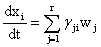 , (1)
, (1)
where  ,
,  ,
,  - a number of process members,
  - a number of
elementary stages,
- a number of
elementary stages,  -concentration of substance
  ,
,  - stoichiometric coefficients of substances,
  - velocity of jth stage.
The system (1)
solved with use a “time division” method. Firstly we made a numerical
integration of system (1) by explicit method of Runge-Kutta with variable step
(but with implicit scheme of Eiler for the “fast” variables). Then by knowing a
computational solution we divide the time interval (0; ) on a chain of subintervals. On each of these subintervals
the initial system simplified to the subsystem differential-algebraic equations
by the following rules:
) on a chain of subintervals. On each of these subintervals
the initial system simplified to the subsystem differential-algebraic equations
by the following rules:
1) If on some time
interval the absolute value of rate of change of normalized concentration of ith
substance is less then absolute value of rate of change of normalized concentration
of other substance then ith equation of initial system can be
written as  where
where  -concentration of ith substance at time t.
2) If on some time
interval the absolute value of rate of change of normalized concentration of ith
substance is less then absolute value of some items in right side, then ith
differential equation of initial system can be replaced by algebraic equation 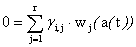 , where
  -velocity of jth stage,
  - stoichiometric
coefficients.
- stoichiometric
coefficients.
3) If on some time
interval in the right side some items exist which is less by its absolute value
in comparison with the rest items then we can ignore this items.
We know a works
which dedicated to investigation of induction period. But we don’t know any
works about modeling of induction period in catalytic processes, in particular,
in reaction of olefins hydroalumination by alkylalanes in presence of catalyst
Cp2ZrCl2.
Experimental data
was obtained in laboratory of structure chemistry in institute of oil chemistry
and catalysis of RAS.
The problem of
induction period modeling for reaction of olefins hydroalumination with
catalyst Cp2ZrCl2 is appeared. For different schemes of
given reaction we need:
1) to create a methods
and algorithms of modeling the induction period, to make a calculating
experiment which modeling an induction period.
2) to define a kinetic
parameters of reaction which describe given experimental data (for different
initial concentrations of catalyst and different temperatures of reaction) as
good as it possible.
3) Clear up the stages
of reaction which define an existence of induction period.
Main results of this
investigation.
1. Method of
mathematical modeling of induction period for reaction of hydroalumination an
olefins by alkylalanes in presence Cp2ZrCl2 was created.
2. The kinetic model
of reaction of olefins hydroalumination by alkylalanes with presence the
catalyst Cp2ZrCl2 was built.
3. The values of
kinetic parameters of reaction of olefins hydroalumination by alkylalanes in
presence Cp2ZrCl2 which describes well an experimental
data. Obtained values are allowed to describe an induction period in all
experimentally investigated area.
4. The stages of
mechanism of reaction of olefins hydroalumination by alkylalanes in presence Cp2ZrCl2
which determine an existence of induction period was found.
5. Software of
mathematical modeling of induction period which allow define a stages which
determine an existence of induction period was created. It can be used for wide
class of investigated reactions.