Physics
/ 2 Solid State Physics
Prof.
Urusova BI
Karachay-Cherkessia
State University, Russia
The
theoretical explanation of the magnetic viscosity of mining ores.
It is known that the magnetic viscosity occurs
at a slow change in the magnetization of a ferromagnet with time. Age of the
Earth's crust is approximately  years, this time is enough to
provide a noticeable effect on the magnetization mining ores.
years, this time is enough to
provide a noticeable effect on the magnetization mining ores.
Now it is proved that the mining ores, there are two
different types of magnetic aftereffect in ferromagnets - the viscosity due to
the diffusion and viscosity due to thermal fluctuations, but unfortunately not
enough reliable experimental data confirming the presence of a magnetic
viscosity due to diffusion furnaces ores.
Therefore, we consider the appearance of the magnetic
viscosity due to thermal fluctuations. Thermal fluctuations contribute to the
movement of domain walls through the energy barrier, they can overcome the
action of the weak geomagnetic field.
Neel, was supposed theory of viscosity of
single-domain grains, in which the viscosity of the effect relates to the
rotation process and then developed this theory for the case of solid
ferromagnets. In this theory, the action of thermal fluctuations on shifts
boundaries seen functioning field , additional to the current field - H.
Then , can be expressed as:
 ,
(1)
,
(1)
where Q - the constant of the
order of 50; t- the duration of the
field;  - a constant that characterizes a sample that is independent of
temperature and has the dimension of the magnetic field.
- a constant that characterizes a sample that is independent of
temperature and has the dimension of the magnetic field.
The intensity of magnetization after exposure can be expressed:
 , (2)
, (2)
where  - magnetization in a field H, when the field is no
viscosity;
- magnetization in a field H, when the field is no
viscosity;  - irreversible differential
susceptibility in point (
- irreversible differential
susceptibility in point ( hysteresis loop.
For the region Rayleigh instantaneous magnetization  is:
is:
 ,
(3)
,
(3)
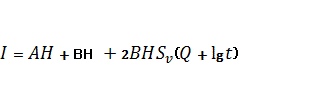
And irreversible susceptibility  at (
at ( is 2ВН, then the expression (2) can be rewritten as:
 (4)
(4)
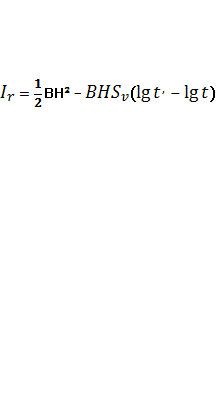
After removing the residual magnetization field H
is equal to ½ and the irreversible susceptibility - BH, so  residual magnetization at the
time
residual magnetization at the
time after the field is:
 , (5)
, (5)
where time t- field action H.
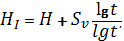
Neel theoretical calculation for the critical variable
magnetic field -  , necessary for the destruction of residual magnetization gives the
following relationship:
, necessary for the destruction of residual magnetization gives the
following relationship:
 ,
(6)
,
(6)
where H - the applied field; t -
time of relaxation.
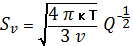
Theoretically calculate  by Neel model is:
 , (7)
, (7)
where k is the Boltzmann constant; T
- the absolute temperature; v- volume of the region
corresponding to the Barkhausen jumps.
If we consider the impact of fluctuations in the
height of the potential barrier,  is:
is:
 (8)
(8)
where  - spontaneous magnetization; v-
volume of the magnetization reversal region corresponding to the Barkhausen
jump; α- constant less than one, depending on the orientation of
the boundary with respect to the magnetic field.
- spontaneous magnetization; v-
volume of the magnetization reversal region corresponding to the Barkhausen
jump; α- constant less than one, depending on the orientation of
the boundary with respect to the magnetic field.
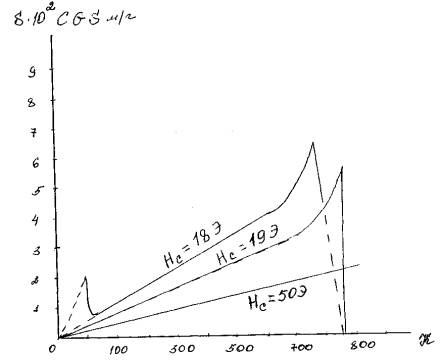 Comparing the expression (8) and (7) we see that the temperature
dependence of
Comparing the expression (8) and (7) we see that the temperature
dependence of  expressed by - differently. If v
is independent of temperature, in
expressed by - differently. If v
is independent of temperature, in  (7) changes in proportion to
  by the formula (7), but
proportional to T according to the formula (8) (see Figure 1).
by the formula (7), but
proportional to T according to the formula (8) (see Figure 1).
Figure 1. Temperature dependence of the magnetic
viscosity coefficient S.
From Fig. 1 that the coefficient of viscosity with
temperature, in the region of 2000К<Т<4000К viscosity caused no internal field
variance and fluctuation in the height of the potential barrier.
Fig. 2 shows the change in viscosity - S
depending on the magnetic field.
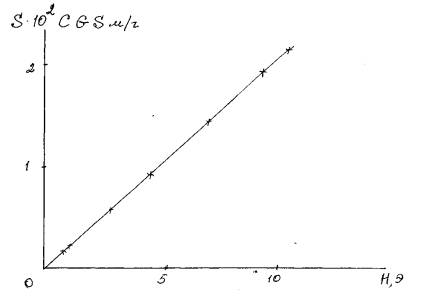
Figure
2. Changes in the magnetic viscosity coefficient S according
the
magnitude of the applied magnetic field.
From Fig. 2 shows that the magnetic viscosity
coefficient for Rayleigh field region is a linear function of the applied
magnetic field and temperature than close to the Curie temperature.