Конференция «Образование и наука ХХI века»
Строительство и архитектура/3. Современные технологии
строительства, реконструкции и реставрации.
Zaiats I.I.
State Higher Educational Establishment «Pridneprovs’ka
State Academy of Civil Engineering and Architecture»
EstimaTION OF DESIGN
DECISIONS IN THE CONSTRUCTION OF HIGH-RISE MULTIfUnctional COMPLEXES
In the
construction of high-rise buildings, which relate to features of the first
increased level of responsibility, and are correspondingly higher requirements
on their quality, namely: quality assurance in the design and execution of
construction and installation works, fabrication and construction of
structures, application of new products and materials, ensuring the stability
and security of the tall buildings and surrounding buildings and infrastructure
that are in the influence zone of new construction, timely account of possible
climatic and anthropogenic impacts and other emergencies during construction
and operation [2].
The
quality of high-rise buildings is an integral concept that combines the degree
of validity of a high-rise building to its use by functionality and customer
satisfaction. In this case, the quality of a high-rise building refers to its
rationality and comfort. Rationality is determined by a combination of such
groups of properties as cost (both in construction and in operation) and
solidity.
The
value of the efficiency factor ( ) is calculated on the basis of expert assessments.
Comfort is viewed as the totality of such groupings of
properties as ecological compatibility, functionality and security, due to the
adopted space-planning decisions, made of sanitary-hygienic requirements and
level of engineering accomplishment.
The importance of the factor of comfort ( ) of high-rise multifunctional
complex is determined by an expert according to the degree of conformity to a
given level of comfort.
) of high-rise multifunctional
complex is determined by an expert according to the degree of conformity to a
given level of comfort.
The value of factor of tightness in a generalized form
can be defined as follows:
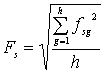 , (1)
, (1)
where  – the number of components of the tightness factor that are considered.
When calculating the value of factor of tightness,
consider the following components.
The factor of tightness of the construction site ( ) can be determined using the
following formula:
) can be determined using the
following formula:
 , (2)
, (2)
where  and
and  – accordingly, the built-up area and land area, m2.
The factor of limited zones of action mechanisms ( ):
):
 , (3)
, (3)
where  and
and  – accordingly, the number of mechanisms, limited range and the total
number of arrangements at the facility, pieces.
– accordingly, the number of mechanisms, limited range and the total
number of arrangements at the facility, pieces.
The factor of influence of existing roads and railways:
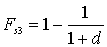 , (4)
, (4)
where  – the number of intersections of access roads to the construction site
with permanent roads and railways.
– the number of intersections of access roads to the construction site
with permanent roads and railways.
The main characteristic of the quality of design
solutions is its adaptability.
Today there is no uniform methodology for the
formation and justification of composition factors of adaptability, which
should have a functional-object character and describe the subsystem
construction project (engineering, design construction, project management).
The importance of the factor of adaptability of design
decisions [1] of construction of high-rise multifunctional complexes expert is
calculated by experts, based on the technical level and perfection of the
planned high-rise multifunctional complex, its conformity with the requirements
of construction and housing and civil purposes, that is consistent with each of
the subsystems of construction and operation.
References:
1.
Zaiats I. Estimation of the
manufacturability of the design decisions in the construction of high-rise
multifunctional complexes / I. Zaiats // News of science and education. – Sheffield: Science and education Ltd, 2015. – NR 7 (31) 2015. – P. 52-55.
2.
Zaiats I. The
system approach to the design of high-rise construction of multifunctional
complexes / I. Zaiats // Nauka i studia. – Przemysl:
Sp. z o.o. «Nauka i studia», 2015. –
NR 10 (141) 2015. – P. 12-17.