Student, Almaganov Abay,
research supervisor, Ph.D., associate Professor, Vladimir Sapa
Kostanay
State University A. Baitursynov, Kazakhstan
Factors affecting the efficiency of solar panels
Solar
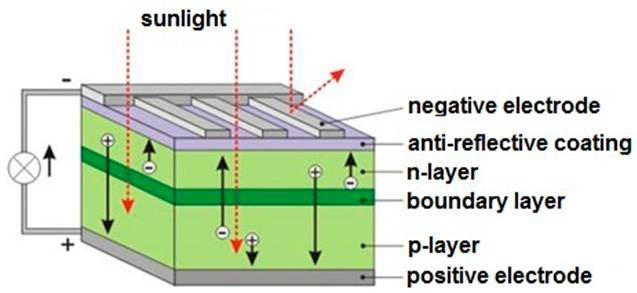
battery is a unique energy Converter of the light rays into electricity with an
unlimited external source. The growing demand for these products due to
affordability and sustainability of energy supply without coolant flow, as well
as the economic payback in 2 years with a minimum service life of panels is 25 years.

Examples are
semiconductors or film polymers, plate layers of different polarity converts
light into a directional movement of electrons is a physical phenomenon
consistently for all solar panels. However, this design limits the efficiency
of solar cells, a part of photon energy is inevitably lost at the border of the
p-n junction. In practice, the efficiency of the battery is influenced by many
factors: material, area, location, intensity of light, what is involved in the
purchase and exploitation.
The
dependence of the efficiency of solar cells.
This
indicator is defined as the ratio of electric power produced to the power of
the incident sunlight. The magnitude is affected by the cleanliness of the
plates and its structure: film, poly - or monocrystalline. The last species
belong to the most expensive and long payback period, the available solar
panels with high efficiency for home yet produced only from layers of silicon
of different polarity. Are less efficient panels made of cadmium and terrorize
CIGS, produced on the basis of film technology. Efficiency cadmium batteries is
only 11 %, but they are cheap and quite reliable in operation. Slightly higher
rate in film coated with particles of gallium, copper, indium and selenium, the
effective CIGS solar cells by 15 %.
For
comparison, the efficiency of converters monocrystalline silicon is 25 %, and
thin-film or amorphous submodules of the same material for a maximum of 10
devices based on organic polymers have a minimum value of 5 %. Much depends on
the square panel, single solar cells are limited to generating electricity.
Value of efficiency of the small solar battery allows you to use them
for full power, but enough of them to run certain types of electronics. In any
case, increasing efficiency and minimizing cost is a priority of modern energy.
Factors
affecting the efficiency of solar panels
The
efficiency depends not only on the applied material and technology, but also of
the entire complex of external conditions:
1. The
intensity of the light flux. In turn, this index is associated with
geographical coordinates located the battery, particularly with latitude.
2. The angle
of inclination of the structure. Ideally, you should install solar panels,
change it from gradient of incidence. This system is more expensive but it
allows you to accumulate an impressive amount of electricity (up to 40-60 %)
and less dependent on season and time of day.
3. The
temperature of the environment. Heat is bad for the photoelectric effect,
vented batteries have very high efficiency. Paradoxically, in cold clear
weather, they produce more energy than the heat (although the total cumulative
effect is reduced due to the short daylight hours).
4. The time
of year. In practice, the efficiency of solar panels decreases in the winter in
2-8 times, but it's not related to snow: on a dark surface it melts quickly,
besides photovoltaics perceive perfectly diffused light.
5. Dust. The
purer the outer part of the solar panels, the greater the number of photons
will be converted, so to increase the efficiency of work surfaces it is
recommended to wipe at least every two years.
6. Shadow.
It is no secret that the efficiency for solar panels in cloudy weather greatly
reduced in foggy and rainy areas it makes no sense to bet the same applies to
the shaded areas. Panel desirable to mount the shade of tall trees or
neighboring houses, in choosing the location of the priority given to the South
side.
References:
1. Yurchenko, A.V.; Savrasov F.W.; Yurchenko V. The
real cost of energy - from resources to consumer // Bulletin of the Tomsk
Polytechnic University. - 2009. - P. 43-46.
2. Stepanenko, N.I.; Gubin, V.E. Prospects for the use
of alternative and renewable-energy sources in the conditions of Siberia //
Modern Techniques and Technologies: Proceedings of IX Intern. Conf. students,
graduate students and young scientists. - Tomsk, 2003. - T. 1. - P. 47-48.
3. Lukutin, B.V.; Surzhikova O.A.; Shandarova, E.B.
Renewable energy in decentralized energy supply. - M .: Energoizdat, 2008. -
231 p.