Shapovalova O.,
Gnuchуkh L., Hozyaenova J.
Kharkov National University of civil engineering and
architecture, Ukraine
Modeling the
dynamics of the currency rate
For
Ukraine, which undergoes
the economic reforms, the issue of forecasting developments in the foreign exchange market is particularly important both at the macro and at micro levels. Almost
every citizen of the country observes the exchange rates.
Current values and leading national currencies are the first things which are reported about in any economic sector of the news today. The stabilization of exchange rates has become one of the main topics during the discussion
of issues related to the global economy
in international negotiations.
When
forecasting such integrated indicators as exchange rate,
economics identifies two basic set of methods:
fundamental and technical analysis. Fundamental
analysis involves the examination of trends in pricing, based on the basic factors of the
economy, which include, in particular, interest
rates, taxes, unemployment, state
budget, inflation, the stability
of the political system and so on.
The basis of technical analysis is the fact that the
behavior of prices has already taken
into account all the existing factors.
In general terms, technical analysis expects the accumulation of real history of price changes and conclusions’
building concerning likely future trend. Thus, the sequence of time-ordered data forms
a time series.
Works
of N.D. Kondrateva, Schumpeter, Dzh.M. Keyns, R. Harrod, Y. Domar, R. Solou are dedicated to the
problems of modeling and forecasting
of economic and financial series.
There are some Interesting approaches
proposed in the papers of Russian scientists A.N. Zinin, D.S. Lityn, L.R. Bolotov,
S.V. Smirnov.
Today
the majority of experts agree that
the most suitable method to analyze
operational daily constantly changing information under the circumstances of limited amount of time is technical analysis with
all its advantages and disadvantages. Model ARIMA, where the current value is expressed as a linear finite set of previous
values of the process, is used within the technical analysis approach to describe the time series. This model is characterized by three types of parameters: d is the number of nonseasonal
differences, p is the number of
autoregressive terms, q is the number of lagged
forecast errors in the prediction equation, and is denoted by
ARIMA (p, d, q).
In this model, the current value of the process is expressed by a linear finite set of
values of the previous process. In other words, dependent random variable regressed
on itself, id est
autoregression. Model ARIMA of p-order is as follows:
 .
.
Parameters of the model are calculated according to the method of least
squares, taking into account the complexity of the model or according to the
method of adaptive filtering.
The identification of the model, id est
determining of p, d,
q order, is carried out on the
basis of analysis of the autocorrelation function (ACF), which describes the
magnitude of the correlation dependence on the delay factor  lag, and partial autocorrelation function
(PACF), determined by the correlation coefficient between two random variables:
the first, which is determined by a series
lag, and partial autocorrelation function
(PACF), determined by the correlation coefficient between two random variables:
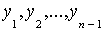
the first, which is determined by a series , and the
second by the series
, and the
second by the series
 .
.
During the analysis of statistics changes in market value of the US dollar
against the Ukrainian hryvnia in the first half of 2014 was built
autocorrelation and partial autocorrelation functions of the sample and a
series of first differences
(fig.1-2) and according to their appearance such models were identified:
ARIMA (1,1 , 0), ARIMA (0,1,2), ARIMA (1,1,2). Calculations were carried out in
MS Excel, using a macro to build ACF and PACF.
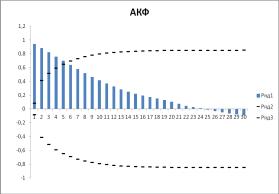
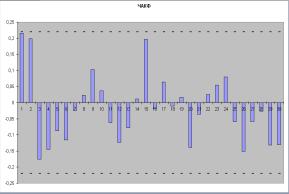
Fig. 1 – ACF and PACF.F for the initial sample.
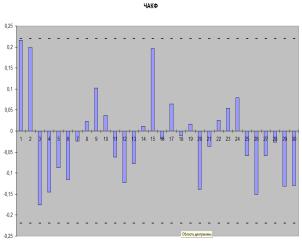
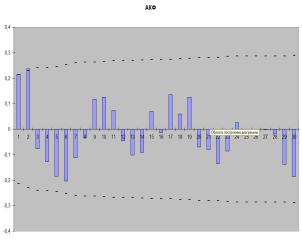
Fig. 2 – ACF and PACF. for a number of first differences.
The
calculations of the parameters
of the model ARIMA (1,1,0) were conducted
by the method of least squares using
MS Excel add-in Solver.
The model ARIMA (1,1,0) is
 .
.
The model ARIMA(0,1,2) is
 ,
,
where  model’s error for level t-1, i.e. the difference between real and model values
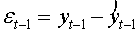 .
.
Autoregression model and integrated fluid medium ARIMA (1,1,2) combines the
properties of the above two models and has the form

Dispersions of the three discussed
models are equal to ARIMA (1,1,0) – 4,894855; ARIMA (0,1,2) – 4,110223; ARIMA
(1,1,2) – 3,968714. The model with the lowest variance – ARIMA (1,1,2) is
chosen for the prediction.
Point and interval forecast of exchange rate for the model ARIMA (1,1,2)
has been compared to the real data (tabl.1). Error forecast was 2.3%, which is
quite acceptable.
Table 1 – Comparison with the real value of the course
|
Period of forecast |
Point forecast |
The interval of the
forecast with theoretical frequency of 95 % |
Real
value of exchange rate |
|
|
27.05.2014 |
11.57711 |
11.00552 |
12.1487 |
11.4673 |
|
28.05.2014 |
11.64003 |
11.06843 |
12.21162 |
11.4635 |
|
29.05.2014 |
11.70691 |
11.13532 |
12.2785 |
11.4648 |
|
30.05.2014 |
11.77379 |
11.2022 |
12.34539 |
11.4271 |
|
31.05.2014 |
11.84068 |
11.26909 |
12.41227 |
11.3999 |
As a result of work autoregressive models were constructed and implemented
short-term forecast error of 2.3%, based on an initial sample of the dynamics
of the exchange rate of US dollar against the Ukrainian hryvnia for a fixed
period of time.
Reference
1. ARIMA Models
and the Box–Jenkins Methodology. Asteriou, Dimitros; Hall, Stephen G/ Applied Econometrics, 2011. Palgrave
MacMillan. pp. 265–286.
2. Time series techniques for economists. Terence C. Mills/ Cambridge University Press in Cambridge,
New York. 1990, 377p.
3. Spectral analysis for physical applications multitaper and conventional univariate techniques. Donald
B. Percival and Andrew T. Walden/ Cambridge University Press in Cambridge, New York, NY, USA,
1993, 583 p.
4. Time series
analysis: forecasting and control. Box, G.E.P., and G. M. Jenkins/ Holden Day,
San Francisco, CA, 1970, 652 p.
5. Brockwell,
P.J., and Davis, R. A. Introduction to time series and forecasting/ Springer,1996,
452 p.
6. Литинский Д.С.
Статистическое прогнозирование для построения эффективных торговых стратегий на
валютном рынке. Автореф. дисс. канд. экон. наук. Москва, 2003. – 23 с.