Antoniuk O.P.
Associate
Professor of National Mining University, Dnepropetrovsk
Using simultaneous equations for Modeling of the
interrelationship of basic macroeconomic indicators of Ukraine
A simplified
model of macroeconomics was proposed in [1], which was based on
the following assumptions: consumption was an increasing function of the
available income; investments
were an increasing function of national
income; national income was the sum of consumer
spending, investments and government procurement of
goods and services. A mathematical model that related the above mentioned macroeconomic indicators was built on the basis of these provisions.
Based on this, a
simplified model of the main macroeconomic indicators
of Ukraine has been proposed, which in contrast
to [1] has not considered state
regulation of the economy; has accounted
external borrowings and payments on
foreign loans. The model represents
the following system of three equations:
 ,
,  (1)
(1)
 ,
,  (2)
(2)
 ,
,  (3)
(3)
In the above equations  is consumption,
 is investment,
 is national income,
 is government purchases of goods
and services,
is government purchases of goods
and services,  – is income tax in the
  year;
year;  and
and  – are random variables with respect to which the standard assumption
is given about their centredness (expectations are zero) and noncorrelatedness
for different time periods
– are random variables with respect to which the standard assumption
is given about their centredness (expectations are zero) and noncorrelatedness
for different time periods  ,
,  .
.
Estimation of structural coefficients
has occurred in two stages. At the first stage, due to lack of information about the error variance in the regressions (1) – (3) it was
assumed that they were the same, which led to the problem of estimating
 , (4)
, (4)
where the minimization was
performed by  ,
,  ,
,  and
and  ,
,
 , (5)
, (5)
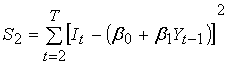 ,
(6)
,
(6)
 . (7)
. (7)
In (5)
– (7)  is the duration of
the observation period, in our case
is the duration of
the observation period, in our case  years.
As the result of solving the problem of estimating (5) – (7), estimates
of structural coefficients  =0,02;
  =0,68;
  =5,55;
  =0,21 have been obtained. They satisfy
a priori restrictions on the coefficients of the model in structural form
=0,21 have been obtained. They satisfy
a priori restrictions on the coefficients of the model in structural form  . Moreover, the relative errors
for the three regression equations are
e1=5%; e2=8%; e3=3%. These errors have
been defined as the ratio of the
average values
. Moreover, the relative errors
for the three regression equations are
e1=5%; e2=8%; e3=3%. These errors have
been defined as the ratio of the
average values  ,
,  ,
,  for the range
  to the standard deviation of the residuals in
the corresponding regressions (4) – (7).
to the standard deviation of the residuals in
the corresponding regressions (4) – (7).
The residues have been
determined by the formulas
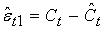 ,
, 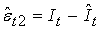 ,
,  ,
,  . (8)
. (8)
In the paper, the estimates parameters of the
model for determining the national income as the sum of consumer spending,
investment and government procurement of goods and services were determined.
The direction of future research is
to test the quality of the
resulting model, to make the statistical analysis of the
accuracy of the constructed model and to identify ways to improve it.
References.
1.
Johnston J., DiNardo J. Econometric Methods. – McGraw-Hill, Inc. 1997. – 514 р.
2.
Statistical Yearbook of Ukraine for 2012 / Ed. O.H.
Osaulenko. / State
Statistics Service. – K.: 2013.
– 552 p. (in Ukraine).
3. Statistical
Yearbook of Ukraine for 2005
/ Ed. O.H. Osaulenko. / State Statistics Service. – K.: 2006.
– 576 p. (in
Ukraine).
4.
Magnus Y.R., Katyshev P.K., Peresetskii
A.A. Econometrics. – 6th ed. – M: Delo,
2004. – 576 p. (in Russian).
5.
Christopher D.
Introduction to Econometrics – 4h ed. – Oxford: Oxford
University Press, 2011.
– 560 p.
6.
Korkhin A.S. Modeling
of Economic Systems with a
Distributed Lag. – М.: Finansy i
statistika, 1981. – 160 p. (in Russian).
7.
Demidenko E.Z. Linear and Nonlinear regression. – M.: Nauka, 1981. –
302 p. (in Russian).
8. Knopov P.S., Korkhin A.S. Regression Analysis Under A Priori
Parameter Restrictions. – Springer, 2012. – 244 p.