Физика/5.Геофизика
Ponomareva М.V., Pak D.Yu., Petrov
S.N.
KSTU, Karaganda
Definition of the profile of
acceleration performance and behind-casing flow by the GIS complex in operation
wells
Places
of inflows and absorption of liquids in a well establish by resistance methods,
thermal, photo-electric and isotopes. The method of resistance is based on
studying of specific resistance arriving in a well of a formation fluid and
washing liquid. The place of inflow or absorption of liquid is noted by sharp
change of resistance on a curve resistivimetry. Thermal method of definition of liquid absorption into the well is based
on change of temperature of liquid within an estimated site of inflow. The
place of inflow and absorption of water is noted by change of temperature of
liquid – its increase or decrease according to the thermogram. Photoelectric
method of identification of liquid absorption into the well is based on
comparison of transparency of the fluid arriving in the well, and solution on a
water basis. Transparency of liquid in the well determine by the device
measuring a potential difference in a chain of a photocell, lighted by an
electric light bulb through a layer of studied liquid.
Method of isotopes establishes an absorption place by the curve of a gamma
method received after injection of isotopes, which is compared to the curve of
the gamma method, registered before introduction of activated liquid in the
well. Intervals of inflow are noted on the curve of a gamma method registered
after injection of isotopes, raised γ-radiance.
Definition of a
profile of acceleration performance was carried out in the well No. 60e of a
field of Aschisay. Conditions of measurements – in an operational column;
artificial bottom plug – 1229.0 m; perforation interval – 1216.0-1225.0 m; wellhead
pressure – 2.0 atm; output – 33.0 m3/d. In the well for solution of an objective the following
researches were executed:
1. In the working well: thermometry, barometry,
resistivimetry, water content measurements, BTI (an inflow heat indicator),
gamma-ray logging, collar locator on the scale of 1:200, in the range of
1191.0-1232.6 m.
2. In the stopped well: thermometry, barometry,
resistivimetry, water content measurements on the scale of 1:200, in the range
of 1191.5-1232.6 m.
Results of researches are given in table 1, figure 1.
Table 1 – Results of researches on a well No. 60e
|
Parameters |
Participating methods |
Result |
|||||
|
1. Maximum profit of device,
m |
Locator methods |
1232,6 |
|||||
|
2.
Perforation
intervals, m |
declared 1216,0-1225,0 |
factual 1216,0-1225,0 |
|||||
|
3. General output , m3/h |
BTI |
27,2 |
|||||
|
Statics |
|||||||
|
4. Manometer
pressure down the hole |
Depth, m |
Meaning |
|||||
|
in the roof of perforation
holes |
1216,0 |
122,1 |
|||||
|
down the hole |
1232,6 |
123,4 |
|||||
|
5.
Temperature
by HST, 0С |
|||||||
|
in the roof of perforation
holes |
1216,0 |
39,7 |
|||||
|
down the hole |
1232,6 |
52,6 |
|||||
|
Dynamics |
|||||||
|
6. Pressure by manometer, atm |
Depth, m |
Meaning |
|||||
|
in the roof of perforation
holes |
1216,0 |
139,1 |
|||||
|
down the hole |
1232,6 |
141,5 |
|||||
|
7.
Temperature
by HST, |
|||||||
|
in the roof of perforation
holes |
1216,0 |
42,7 |
|||||
|
down the hole |
1232,6 |
52,9 |
|||||
|
8. Researches of the stream
and composition of liquid in a trunk |
|||||||
|
Perforation intervals, m |
Operating intervals,m |
Fluid composition |
Coverage ratio, % |
||||
|
1216,0-1225,0 |
1222,1-1225,0 |
|
32,2 |
||||
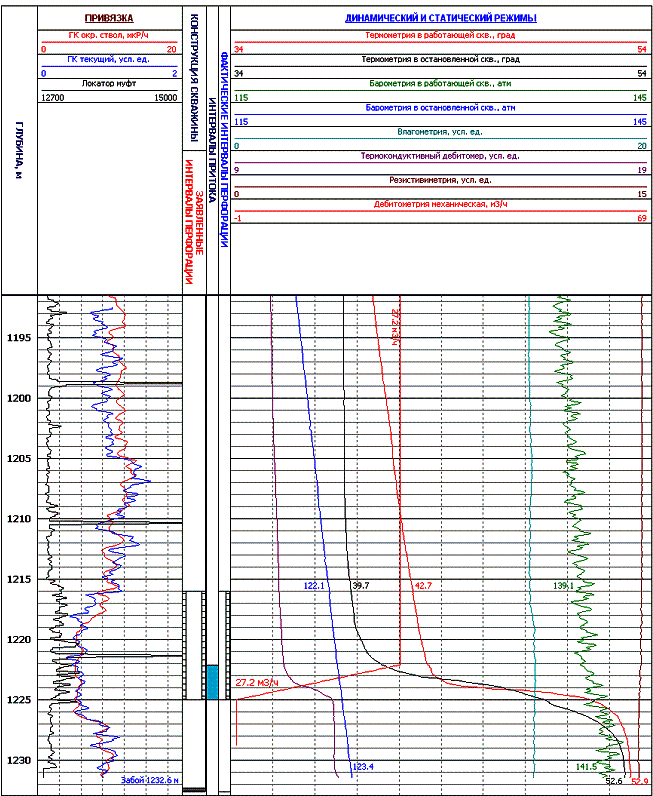
Figure 1 – Definition of acceleration performance profile and
behind-casing flows
By results of interpretation of the geophysical
researches conducted in the well No.60e it is possible to draw the following
conclusions:
1. The maximum depth of passing of borehole devices with account of a
dead zone made 1232,0 m. Perforation is confirmed in an interval
1216,0-1225,0m.
2. Measurements were carried out in two modes: static and dynamic. In a
static mode pressure and temperature in a perforation roof, respectively, 122,1
atm and 39,7 0С, down the hole, respectively,
123,4 atm and 52,6 0С. In a dynamic mode
pressure and temperature in a perforation roof, respectively, 139,1 atm and
42,7 0С, down the hole
respectively 141,5 atm and 52,9 0С.
3. By
the curves of a borehole thermoconductive flowmeter (BTI) and the highly
sensitive thermometer (HST) there allocated working intervals: 1222,1-1225,0 m.
4. In a
studied interval behind-casing flows aren't revealed. The bottom is leak-tight.
Literature
1. Geophysical researches and works in wells: в 7т. Т.3. Studies of acting wells/R.А. Valiullin, R.К. Yarullin, Ufa, Informreklama,
2010
2. Kuznetsov
G.S., Leontev Ye.I., Rezvanov R.А., Geophysical
control methods of development of oil and gas fields, М., Nedra, 1991