Engineering sciences
Кumykova Т., Kumykov V.
D. Serikbayev East
Kazakhstan State Technical University, Kazakhstan
Ways to stabilize the pressure of compressed air
in the shaft PNEUMATIC
NETWORK
Reasons for pressure falling in ore
mining pneumatic network and especially directly at the places of mining are
analyzed in the article. As a decision to this problem it is suggested to build
a compressed air accumulator (CAA) on the way of moving compressed air from the
compressor station to the consumer. It will allow smooth out peak-loads both on
ore mining pneumatic network and on energy system, increase productivity of
pneumatic-geared technological equipment, save electric power on generating
compressed air.
Transition to simulate mine lower horizons of the deposit
leads to an increase in the length of the pneumatic network and to removal of the
consumers of pneumatic energy from its source - the compressor station. The
effectiveness of the pneumatic network decreases with an increase in their
length due to growth in losses of energy of compressed air during
transportation to the consumer (Fig.1) [1].
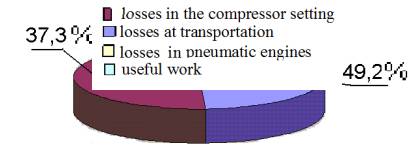
Fig.1 - Diagram of energy losses
in the shaft pneumatic setting
The object of
research is the process of generation, storage, distribution and consumption of
pneumatic energy with the use of hydro-pneumatic accumulator (HPA) of
compressed air in pneumatic energy complex of an underground mine.
Work of major processing equipment (drill rigs,
loaders, etc.), by its nature is probabilistic, while the most natural mode of
operation of compressor units is a continuous mode, due to the difficulties of
starting and stopping power installations. These circumstances, in practice,
lead to the continuous fluctuations of the basic parameters of compressed air
(the flow and pressure) virtually in all elements of the pneumatic network. Thus,
the elements of the pneumatic network, of
which there is a direct intake of compressed air, are most likely to suffer
from the energy point of view of the situation.
At the same time, the parameters of compressed air at
the technological equipment have a direct impact on the performance of this
equipment. Thus, with increasing air pressure for 0.1 MPa, drilling
productivity increases at an average of more than 20%, with simultaneous reduction
in specific consumption of compressed air to more than 1,5 times. At the same
time, reducing the pressure in the faces below the nominal, leads to a sharp
deterioration in the performance of some pneumatic mechanisms.
The investigation of pneumatic energy complex of Tishinsky
mine (Ridder, Kazakhstan) showed that the drop in air pressure at the
technological equipment during the work shift is 0.2 MPa (Fig.2) [1].
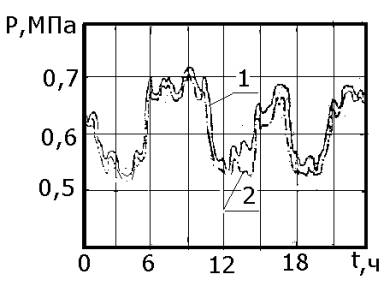
Fig.2
- Diagram of pressure in the main route of pneumatic gear (1) and in pneumatic
receiver (2)
The use of hydro-pneumatic accumulators of compressed
air (HPA) in the systems of pneumatic energy complex of mines allows upgrade
their work to a fundamentally new regime. One of the positive effects of
engaging the HPA pneumatic energy complex of a mine is that its presence allows
enclosing into specific characteristics of the compressor station and pneumatic
network into the specifications of HPA [2]. In first approximation,
specifications of GPA is a horizontal line РГПА= const.
But this option is valid only during active operation of HPA.
Engaging HPA in the pneumatic energy complex of a coal mine lets control the work of compressors,
regardless of the amount of intake of compressed air by coal mine pneumatic network
at each moment. This makes it possible to accumulate surpluses of compressed
air, available in the work of the compressor station in shift breaks, with its
subsequent applications using them for the shortfall in compressed air during a
working shift.
In addition, the presence of HPA in the pneumatic energy complex gives the possibility to manage the work of the
pneumatic system, not only by regulating the performance of compressor
stations, but also through the managing the regimes of accumulation of compressed
air in the HPA and harmonizing in timing its work with the work of a compressor
station.
To determine the parameters of compressed air, pressure
and temperature sensors were used, which had been installed at the exit from
the compressor station, the entrance to the mine’s pneumatic network, in pneumatic
camera of HPA and at points of mass air intake on the line from the compressor
station to the HPA.
During the HPA work the following was controlled: level of water in hydro camera of hydro-pneumatic accumulator;
air pressure in hydro camera of HPA;
air pressure in the pneumatic network.
In processing the results of measurements of compressed air in pneumatic energy complex without HPA the following was established.
Pressure of compressed air in the mine at idle pneumatic
receivers (rotary hammers, drills, etc.) varies between 0.5÷0.7 MPa.
Compressed air pressure in the working faces with pneumatic receivers working, varies
between 0.35 and 0.5 MPa, and air pressure equal to 0.4¸0.48 MPa is dominating. Duration of peak loads during the shift reaches 1.7÷3.4
hours, and dominated by yielding a peak period of 2.1
hours per shift.
Compressed air pressure at the compressor station in the period of
measurement fluctuates within 0.58÷0.8
MPa. Predominant pressure is equal to 0.6¸0,7 MPa. Fluctuation of compressed air pressure is equal to 0.22 MPa, predominant
air pressure ¾ 0.15 MPa. An average of 4 ÷ 5 compressors were running. Fluctuation
of compressed air pressure during a shift is 0.1÷0.3 MPa.
Processing of the data obtained with a running HPA showed that a most rational
mode of operation of the HPA allows use 3 compressors to during the work day. In this mode of
operation of compressor station air pressure in the working faces was equal to
0.56÷0.62 MPa, with a predominant
pressure 0,6 MPa. Fluctuation of pressure of compressed air was 0.04 ¸0.06 MPa, with a predominant pressure of 0.05 MPa.
Thus, the results of the investigations suggest that the presence of hydro-pneumatic accumulator in the system of coal mine pneumatic
energy complex leads the work of compressed
air network to a fundamentally new mode, in which the characteristics of both, the
compressor station and of the mine pneumatic
network, each separately, depend on the characteristics
of hydro-pneumatic accumulator [3].
Introducing HPA in the pneumatic system allows for the system of automatic
regulation of pneumatic
energy complex be carried out on
qualitatively new principles: by controlling the accumulation mode of compressed air in the HPA, and
harmonizing the work of the compressor station and HPA over time [4, 5].
Work of hydro
pneumatic accumulator in a mine pneumatic
energy complex permits increase the pressure
of compressed air in the working faces during a shift from 0.4 to 0.55 MPa.
The advantages of pneumatic systems with a HPA include:
compressed air is supplied to the process equipment with constant and
increased pressure, which increases its productivity;
a drier compressed air is supplied to pneumatic receivers, which
improves their work;
constant pressure benefits the work of compressors and pneumatic
receivers and increases their service life;
compressor stations can be designed not to "peak" loadings, but
taking into account the accumulation of air power in the HPA, which gives the
possibility to significantly reduce energy consumption in the systems and, in
some cases, reduce the number of operating compressors;
in the case of a short break in work of compressors,
pneumatic mining machines may be employed during some time receiving the
compressed air from the accumulator.
The most rational way of balancing peak loads, as in a
pneumatic system, the same as in the power system, is the use of underground
storage of compressed air in mines, which provide stabilizing and increasing
pressure of compressed air in the working faces, regardless of the number of
pneumatic receivers at work.
Using hydro
pneumatic accumulators of compressed air in the mines and quarries will provide
significant savings of electricity while developing compressed air and will
align the schedule of daily power consumption, allowing the processing
equipment work during the hours of peak loads on compressed air of the
pneumatic system, located in pneumatic camera of HPA.
References
1. Investigate the state of the coal mine pneumatic economy
of Zyryanovsk, Ridder, Irtysh plants and give data on its reconstruction / /
Inf. Map / VNIItsvetmet.-Ust-Kamenogorsk, 1995 .- 58 pp.
2.
Lisowski G.D., Kumykova T.M. Methods of stabilizing
work of shaft pneumatic network // Science and Education - a leading factor of
the strategy "Kazakhstan - 2030" / IY Proceedings of the
International Scientific Conference. - Karaganda: KarGTU, 2001. - S.
279-281.
3.
Kumykova T.M., Kumykov V.Kh. Energy conservation
in underground mines. Bdesheto problemite on svetovnata nauka. Material for a 4-and international scientific
practical conference. (17-25 December) Volume 23 Technology: ByalGRAD-BG Ltd. -
Sofia, 2008. - P.26-28
4.
Kumykova T.M., Kumykov V.Kh. Hydro
pneumatic accumulator of compressed
air. A provisional patent of the Republic of Kazakhstan for
the invention number 19314. Publ. 15.04.2008,
book. № 4
5. Kumykova T., Kumykov V. Hydro pneumatic accumulator of compressed air. A provisional
patent of the Republic of Kazakhstan for the invention number 25580. Publ. 15.03.2012, book. № 3