Levchenko
S. P., Ermolenko M. V., Stepanova O.A., Salkhanova A.N.
Shakarim
State University of Semey, Kazakhstan
HEAVY METALS IN MACROMYCETE’S FRUIT FORMS
OF EAST KAZAKHSTAN
Toxic
elements are the most common contaminants of foodstuff. They have an important
feature. Most of them belong to the scattered elements (microelements), which
are contained everywhere: in groundwater and surface water, rocks, soil, free
air, plants and animals. These substances ingested into human body with food,
water and air.
At the
same time during soil contamination with metals, their content in crops
increases, and then in the products of livestock. Consumption of products
containing increased amount of heavy metals is a risk to human health which may
appear as acute and chronic intoxication as well as mutagenic, carcinogenic and
embryo toxic effects.
To
prevent these effects, strict control of the hit compounds in food products
such as toxic elements from the environment, as well as a result of the
activities of the human being directed towards processes of intensification of
food is required [1].
Mushrooms
are one of the most important components of forest ecosystems. They fulfil wide
range of biosphere functions, including the most essential one, decomposition
of organic substances [2].
From
the point of view of biogeochemical studies mushrooms are of a particular
interest because of their ability to accumulate elements, particularly
hazardous to health. Tendency of edible mushrooms to accumulate heavy metals is
a risk.
This
ability is more strongly mainfested in them rather than in higher plants and
other organisms [3].
Despite
the fact that mushrooms are a valuable protein products, they are rich with
vitamins and micronutrients.
Everything
told above explains relevance of research of the content of heavy metals in
Eastern Kazakhstan mushrooms.
Purpose
is to determine the level of heavy metals contamination in mushrooms grown in
East Kazakhstan.
During
the work following tasks were posed and solved: determination of heavy metals
content in the examined samples, analysis and evaluation of results.
The
object of investigation was selected a mushroom (Boletus edulis), which grow in
the forests of Borodulikha district of East Kazakhstan. Mushrooms of various
forms and degree of ripeness were researched.
The
identification of samples was carried out according to generally accepted
criteria described in the professional literature [4]. As
indicators of safety, studies were conducted on the content of toxic elements
in mushrooms.
Fresh
mushrooms were studied in laboratory of chair «Technical Physics and
heat-and-power» and engineering regional testing laboratory «Radioecological
Investigation Laboratory» at Shakarim State University of Semey.
The
content of heavy metals was determined by liquid-plasma spectrometer VARIAN 820
ICP-MS. Research of content of toxic elements (lead, cadmium, mercury, and
arsenic) conducted by spectrometry method with a use of inductively coupled
plasma. Results are presented in Table 1 and in the figures 1, 2.
Table 1. The
elemental composition of boletus
|
Element |
Boletus (Boletus Edulis) |
MC, mg/kg |
|
|
pileus |
stipe |
||
|
Cadmium |
0,009 |
0,01 |
0,1 |
|
Arsenic |
- |
- |
0,5 |
|
Mercury |
- |
- |
0,05 |
|
Lead |
- |
- |
0,5 |
Table 1
shows that the test samples meet the safety requirements, as mushrooms do not
contain heavy metals such as arsenic, mercury and lead and cadmium
concentration of cadmium is insignificant and far to the marginal
concentration.
|
|
|
a) pileus |
|
|
|
b) stipe |
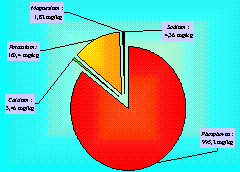
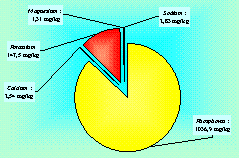
Figure 1.
Macronutrient content of mushrooms (Boletus edulis)
|
|
|
|
а) pileus |
б) stipe |
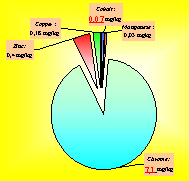
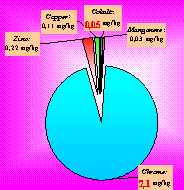
Figure 2.
Macronutrient content of mushrooms (Boletus edulis)
We can draw the following conclusions:
1.
Maximum concentration limit excess in the studied mushrooms wasn't revealed for
lead, neither arsenic, nor mercury, cadmium.
2.
Quite high content of chrome and the cobalt, observed in studied samples, is
characteristic for soils of the East Kazakhstan region (for chrome makes
(6,9÷10,1) of mg/kg, for cobalt – to 7,5 mg/kg).
3. The
maintenance of other elements (for which maximum concentration limits aren't
established), in one of cases doesn't exceed the top admissible level of daily
consumption, and some of them at all doesn't reach the accepted indicators of
an adequate consumption level.
4.
Contamination density of mushrooms by heavy metals in East Kazakhstan does not constitute a danger to human health.
1 Никифорова Т.Е. Безопасность продовольственного сырья и
продуктов питания: учебное пособие/ ГОУ ВПО «Иван. гос. хим. - технол. ун-т»,
Иваново, 2007, 132 с.
2 Одум Ю.
Основы экологии / Ю. Одум: пер. с англ. - М.: Мир, 1986. - 328 с.
3 Сибиркина А.Р. Аккумуляция хрома грибами соснового
бора Семипалатинского Прииртышья Республики Казахстан // Современные проблемы
науки и образования. – 2012. – № 2.
4
Клепинина 3. А., Клепинина Б. В. Справочник грибника. - М.: АСТ-ПРЕСС КНИГА,
2006. - 256 с, 24 л. ил.