Ecology/3. Radiation
safety and social-and-ecological problems
L. Skripnikova
State University after Shakarim Semey City, Republic of Kazakhstan
Propaganda,
prevention & education of the population in the field of emergency
situations of natural & technogenic nature
The article discusses the
importance of education and the propaganda of knowledge in the field of civil
defense. It’s presented a statistical database and analysis of natural and
technogenic disasters during the period 2013-2014 in the Republic of Kazakhstan
and the city of Semey in particular. It’s described the work of
"Propaganda, preparation and education of the population" department
at the Semey’s Committee of Emergency Situations of the Ministry of Internal
Affairs of the Republic of Kazakhstan.
One
of the most important tasks in the field of safety and
protection from emergency situations is the propaganda and public awareness in the field of civil defense and emergency situations of natural and
technogenic nature.
In
the Republic of Kazakhstan
for the first time about the need to prepare the entire population
to act in emergency situations has been said and reflected in the Resolution
of the Cabinet of Ministers of the Republic of Kazakhstan from 30.09.1993 №
969 "On measures to establish a system of public and professional
education on the prevention and action in emergency situations"[1].
On the basis of this Resolution is developed "The system of
education managers, groups of civil
defense and education for actions in emergency situations", which was
subsequently supplemented, improved
on the basis of the adopted legislation
in the field of emergency situations and
civil defense, as well as the Resolution of the Government of the Republic of
Kazakhstan № 50 from 07.01.2003 "On approval of Rules of public awareness, propaganda of knowledge,
public and professional education in the
field of emergency situations"[2].
In
the Address of the President of the Republic of Kazakhstan Strategy "Kazakhstan - 2050" N. Nazarbayev
said: "To be the developed competitive
state, we have to become a highly educated nation." The
statement applies to education of the
population in general and in the
field of civil defense in
particular [3].
11
April 2014 was adopted the Law "On
civil defense", which regulates public relations arising during the events for civil defense, and
is directed to the prevention and elimination emergency situations of natural
and technogenic nature and their
consequences.
Special
importance in the Law is given to education and propaganda of knowledge in the
field of civil defense: "... education of the population in the field of
civil defense is carried out in order to develop skills in action in emergency
situations, conducting rescue and emergency operations, knowledge of the basic
techniques and methods of self-rescue and mutual aid, the maximum reduction of
possible losses among the population and material damage "(Ch.9 Article
46) [4].
Based on the
Resolution [1,2] in Kazakhstan operates a three-stage system of education in
the field of safety and emergency situations. The State provides training and
education of the population on issues related to the provision of protection
for the individual, society and state from internal and external threats in a
variety of situations of social, natural and technogenic nature. In order to
form the individual citizen, responsibly related to personal safety and the
safety of others.
Education in the
field of civil defense is carried out in pre-school and school education, it
could be different sections "Young rescuer", summer camps, events,
competitions on the theme of "Basics of Life Safety", etc., in the
secondary educational and higher educational institutions which prepare
specialists by specialty 5B073100 "Life safety and environmental
protection", further education of citizens is conducted in organizations
in the workplace, which involves education and trainings in the system of civil
defense and emergency situations.
Life safety’s
provision supposes:
• identification
(recognition) hazards, i.e. determination of their type, probability, spatial
and temporary coordinates, the scale of possible damage, etc.;
• prophylaxis
(prevention) of identified hazard;
• actions in
emergency situations.
The experience of
recent years shows that at the present stage emergency situations became more
frequent, widespread and more dangerous.
According to
statistical data (Pic. 1) for the year 2014 on the territory of the Republic of
Kazakhstan were registered 11458 emergency situations and accidents of natural
and technogenic nature (by 12,1% more than during the same period in 2013). At
the same time were affected 2776 people (1,9% less than in the corresponding
period in 2013), 877 of them died (10,1% less than in the same period of 2013).
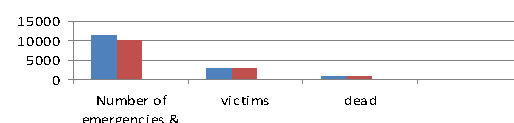
Picture 1 – Statistical data about emergency situations on the territory of the
RK
Emergency situations of technogenic nature
The
number of technogenic emergencies is 9416 cases (82,2% of total number of
emergencies), 96,3% of them (9069) make household and industrial fires.
Compared to the same period of 2013, the number of technogenic emergencies has
increased on 868 cases or 10,2%.
The
number of victims was 1184 people (12,5% less than at the same period of 2013),
444 people of them died (24,5% less than at the same period of 2013).
During
2014 there were 145 accidents and incidents in the workplace. As a result were
affected 187 people, 71 people of them died.
At
the enterprises and objects, controlled by the territorial authorities of the
authorized body in the field of industrial safety, in accidents on hazardous
production facilities died 8 people, 9 people were seriously injured. During
the same period in 2013 died 5 people, 6 people were seriously injured.
The
main cause of accidents is a violation of technological processes, shortcomings
in the organization and implementation of production control, low level of
employment, production discipline and organization of works, personal
imprudence of victims.
Emergency situations of natural nature
According
to preliminary data the number of natural emergencies is 2042 cases (17,8% of
the total number of emergencies). In comparison with the same period of 2013
the number of natural emergencies has increased on 367 cases or 21,9%.
The
number of victims amounted to 1592 people (7,8% more than in the same period of
2013), 433 people of them died (11,9% more than in the same period of 2013).
For
2014 there were 40 emergency hydro-meteorological situations, where 19 people
were injured, 9 people of them died. For the same period in 2013 were 30
hydro-meteorological emergencies, where 10 people were injured, 2 of them died.
During
2014 in the waters of the republic were injured 420 people. During the same
period in 2013 were 348 incidents, where 385 people were injured, 381 people of
them died. Personal imprudence of citizens is the main reason of death of
people on water.
On
the territory of the republic in 2014 were noted 1010 cases of dangerous
infectious diseases and poisonings, when 1141 people were injured. For the same
period in 2013 were noted 1019 cases of dangerous infectious diseases and
poisonings of people, when 1082 people were injured, 4 people of them died.
In
comparison with 2013 year decrease in the quantity of emergencies was noted in
Almaty of 4% (19 cases) and in the Atyrau region of 5,3% (17 cases).
Meanwhile, the
quantity of emergencies increased in the regions of (Pic. 2): Pavlodar by 59,9%
(385 cases), Akmola by 23,6% (124 cases), the East Kazakhstan by 18,8% (208
cases), Almaty by 15 % (169 cases), the North Kazakhstan by 13,8% (74 cases),
Zhambyl by 8,3% (45 cases), Karaganda by 7,7% (96 cases), Kyzylorda by 6,6% (30
cases), Kostanai by 5,9% (44 cases) and in Astana city by 10% (59 cases).
Considerably
was reduced the number of victims in the regions of: Zhambyl to 117 people, the
East Kazakhstan to 32 people, Almaty to 30 people, Kostanai to 19 people, the
North Kazakhstan to 12 people and in Almaty city to 59 people.
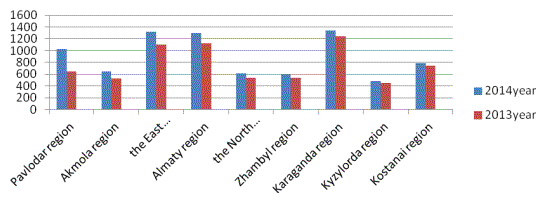
Picture 2 – Statistics
of natural and technogenic emergency situations by regions
From
the total number of victims the greatest number is the share of dangerous
infectious diseases and poisonings of people - 1141 persons (41,1%), industrial
and household fires - 616 people (22,2%), accidents on the water - 420 people
(15,1%), industrial accidents - 187 (6,7%), poisonings by carbon monoxide - 162
persons (5,8%), hydro-meteorological and geological hazards - 19 people (0,7%).
The
main cause of poisonings by carbon monoxide is breaking the rules of fire
safety in the maintenance of solid fuel furnaces.
The
number of dead has increased in the regions of: the South Kazakhstan by 31
people, Akmola by 13 people, Pavlodar by 9 people, Kyzylorda by 4 people and in
Astana city by 12 people.
The
decrease in the number of dead was noted in the regions of: Zhambyl by 53
people, Almaty by 43 people, Kostanai by 23 people, the East Kazakhstan by 13
people, Mangistau by 12 people, the North Kazakhstan by 8 people, the West
Kazakhstan by 7 people, Karaganda by 4 people and in Almaty city by 3 people.
The
greatest number of dead occurred in the accidents on the water - 420 people
(47,9%), industrial and household fires - 209 people (23,8%), industrial
accidents - 71 people (8,1%), poisonings by carbon monoxide - 60 people (6,8%),
hydro-meteorological and geological hazards -9 (1%).
Industrial and household fires
Since the
beginning of 2014 were 9069 industrial and household fires. In this case were
injured 616 people, 209 of them died (including 12
children).
Reduction in the
number of fires is noted in
the regions of: the South Kazakhstan to 26
cases, Atyrau to 18 cases.
The death of
people in fires has decreased in the regions of: the East Kazakhstan by 19
people, the North Kazakhstan by 11 people, Pavlodar by 7 people, Almaty by 6
persons, the South Kazakhstan and Kostanai by 5 persons, the West Kazakhstan by
3 people and in Almaty city by 6 people, Astana city by 3 people.
Growth in the
number of fires is noted in regions: Pavlodar by 347 cases, the East Kazakhstan
by 199 cases, Almaty by 176 cases, Akmola by 134 cases, Karaganda by 104 cases,
Zhambyl by 85 cases, the North Kazakhstan by 72 cases, Kostanai by 44 cases,
Kyzylorda by 32 cases, Aktobe by 27 cases and in Astana city by 65 cases.
The main cause of
the death of people in fires is death in a state of intoxication - 78 people
for the reporting period (37,3%).
During 2014 in
the Republic of Kazakhstan were registered 590 nature fires. Compared to last
year the number of fires has increased by 132,3%, therefore the material damage
was 73,7 million KZT (for the corresponding period in 2013 the material damage
was 14,7 million KZT).
For
8 months of 2014 on the territory of the State Forest Fund were registered 530
fires, 355 of them occurred in the territories under the jurisdiction of the
Ministry of Agriculture of the Republic of Kazakhstan and 175 - in the forests
under the jurisdiction of the regional executive officers and other public
forest owners.
The
main objects of the fires continue to be the residential sector, that’s 65% of
all fires, 14% comes from vehicles, 5,5% - forests, 3,2% - trade enterprises,
and 3% - other open areas (waste grounds, roadsides of rides, streets, etc.),
2,3% - buildings and industrial facilities.
Compared
to the same period in 2013 the occurrence of fires decreased in health care
facilities by 31%, sports and entertainment facilities by 17%, buildings and
industrial facilities by 10%, construction sites by 5%, trade enterprises by
2%, vehicles by 1%.
At
the same time the increase of fires is noted in children’s institutions by 67%,
warehouse buildings by 47%, cultural and entertainment facilities by 38%, bath
and laundry complexes by 23%, in the residential sector by 16%, on the other
open areas 13 %, in educational institutions by 10%, in administrative and
public buildings by 7% and in agricultural sites by 6%.
According
to the analysis the main causes of fires are careless handling of fire about
37%, breaking the rules of installation and operation of electrical equipment
about 22%, breaking the rules of fire safety in the maintenance of furnaces
about 12,6%, set burning about 11% [5].
Analysis
of statistical information shows the importance of knowledge’s propaganda in
the field of population’s and territories’ protection from emergency
situations.
Propaganda - it is a special kind of social activity, which main function is to extend knowledge, ideas and other
information in order to develop certain attitudes, beliefs and emotional
states, and through them more
effective influence on the living position of people and their behavior in
certain situations.
The work in this
direction is carried out by “Propaganda, preparation and education of the
population” department at the Semey’s Committee of Emergency Situations of the
Ministry of Internal Affairs of the Republic of Kazakhstan. The department is
intended for the organization of work on publicizing in the mass media
activities of Semey’s CEF, bringing to the public information about emergencies
and fires, promotion in the field of prevention of emergencies and fires, and
also in the field of civil defense and fire safety.
The main objectives of
"Propaganda, prevention and education of population"
department:
·
creating a correct public opinion
and public understanding of the social and economic importance of activities
for emergency situations’ prevention and elimination;
·
education at the population
conscious need of its participation in activities for the prevention and
skillful actions in case of accidents, catastrophes and natural disasters;
·
achieving conscious fulfillment of
every citizen responsibilities for safety.
In order to prevent the increase in the number
of emergency situations in the mass media on the subject of fire-prevention
took place 27656 performances, among them 1505 on television channels, 5096 in
the press and 21055 on the radio.
In the field of fire safety from the beginning
of the year was carried out purposeful work on fire- prevention at the
facilities of housekeeping and in the residential sector, thus were tested on a
fire-prevention state 12838 objects, including 365 industrial facilities and
critical infrastructure and 12473 of social and cultural purpose. There were
identified 57470 violations. For violations of the fire safety rules were
brought to administrative responsibility 11132 people, including 10438 officers
fined for the sum of 193 million 507 thousand KZT.
Social practice shows that the weakness of the
safety system turns around in huge troubles, leading to deaths, significant
material and moral costs that the state, society, the particular person, which
does not care about their safety, doomed to death.
The experience of recent years shows that at the
present stage emergencies became more frequent, widespread and more dangerous.
Unfortunately, further development of the productive forces leads to a deleting
of a side between the effects of industrial accidents, catastrophes, natural
disasters and the use of modern weapons of mass destruction. On this background
the role of civil defense is significantly growing, and its opposition to
emergencies has become the increasingly important component of the safety
system of the Republic of Kazakhstan. So the role of knowledge’s propaganda in
the field of population’s and territories’ protection from emergency
situations.
Propaganda of knowledge in the field of
protection of population from emergency situations – it is a
dissemination of knowledge in the field of protection of population from
emergency situations, implementation in social awareness of laws, government
regulations in the field of civil defense in interests of activization the mass practical activities of the
population to carry out their specific activities and tasks both in peacetime
and in wartime. Propaganda distributes its requirements and objectives
among the broad masses of the population, it enriches and complements the
special training.
Knowledge, abilities and skills in the field of
protection of the population from emergencies will become stronger than will be
correct people's understanding of its role and place in modern conditions, the
fuller and deeper regularities will be comprehended, which are disclosed by
propaganda.
Literature:
1 The Resolution of the Cabinet of Ministers of the
Republic of Kazakhstan from 30.09.1993 №
969 "On measures to establish a system of public and professional
education on the prevention and action in emergency situations"
2
The Resolution of the Government of the
Republic of Kazakhstan № 50 from
07.01.2003 "On approval of Rules
of public awareness, propaganda of
knowledge, public and professional education in the field of emergency situations"
3 The Address of the President of the Republic of
Kazakhstan Strategy "Kazakhstan
- 2050". – URL: http://online.zakon.kz [10.11.2014]
4
The Law "On civil defense" of the President of the Republic of Kazakhstan N.Nazarbayev
Astana, Akorda 11.04.2014 № 188-V LRK
5 The official internet page of the
Committee of Emergency Situations of the Ministry of Internal Affairs of the
Republic of Kazakhstan– URL: http://emer.gov.kz/ [10.11.2014].