Zabaznova T.A., Erohina
E.A. Sekacheva T.V.
FGBOU VPO "The Volgograd State University of
Architecture and Civil Engineering"
The Sebryakovsky branch
A method of building a portfolio of strategic alternatives for the
development of rural business in the Russian regions.
Annotation
The proposed method allows to coordinate the
interests of rural businessmen, public authorities and various areas in the
regions of Russia through the use of modern marketing and social technologies
(eg, crowdsourcing, Internet portals, a joint on-line discussion on the
development of agricultural entrepreneurship, focus groups, etc. ).
Keywords: agricultural enterprise, a portfolio of strategic alternatives, the
regions of Russia, profiling
Abstract
The
offered technique allows to coordinate interests of rural businessmen, the
authorities and the population of various territories in regions of Russia by
means of use of modern marketing and social technologies (for example,
crowdsourcing, the Internet portals, joint online discussion of problems of
development of agricultural business, focus group, etc.).
Keywords:
agricultural business, portfolio of strategic alternatives, regions of Russia,
profiling
Among the key objectives of the development of the
agricultural business in Russia must be highlighted: the reduction of
unemployment in rural areas; improving the lives of the general population, and
potential businessmen; ensuring the sustainability of the natural and
ecological environment in rural areas [1]. The set of alternatives to achieve
these objectives can be presented as a "portfolio of strategic
alternatives", describing the various ways in which business structure will
address the challenges it faces. [9]
If the management entity of agricultural businesses
represent as a unified methodical scheme, the development of strategic
alternatives will be the initial step in ensuring its strategic
competitiveness. (fig. 1).

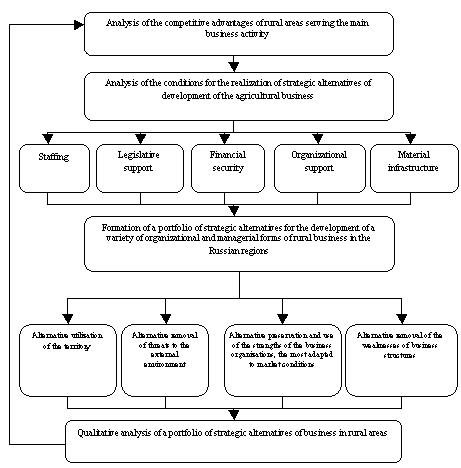

Fig. 1 A method of
formation of a portfolio of the strategic alternatives
development of
agricultural business.
Source: compiled by the
author.
A method of building a
portfolio of strategic alternatives for the development of a variety of
organizational and managerial forms of rural entrepreneurship in the Russian
regions, includes the following steps [11]:
1)an analysis of the
competitive advantages of rural areas serving the main business activities,
alternative opportunities territory;
2) an alternative
addressing threats of the external environment;
3) an alternative
conservation and use of the strengths of the different business organizations,
more adapted to the prevailing market conditions at the meso level;
4)an alternative for
eliminating weaknesses for different branches of the business structures;
5)a qualitative analysis
of the portfolio of strategic alternatives for all organizational and managerial
forms of rural entrepreneurship.
The proposed method
allows to align the interests of rural businessmen, public authorities and
various areas in the regions of Russia through the use of a modern marketing
and a social technologies (eg, crowdsourcing, Internet portals, a joint on-line
discussion on the development of agricultural business, focus groups, etc. )
[4].
The result of the
development phase of strategic alternatives must be completely formed and meets
the requirements portfolio, allowing visualize possible ways to achieve its
business structure problems [5].
A qualitative analysis
of a portfolio of strategic alternatives proposed to be based on the mechanism
of profiling. Profiling is a purposeful change of the branch structure of the
rural areas in the direction of increasing the proportion of business according
to local factors of production, has a beneficial effect on the integral
characteristics of the economic condition of the rural area. [12]
The profile of the rural
area is a structure of economic complex of the countryside, reflecting its
functional specialization. It is necessary to distinguish between the
established, the actual profile, which may reflect outdated or inefficient
initially specialized rural areas and scientifically based perspective profile
formed taking into account objective factors of competitiveness of the rural
area. [7]
In other words,
profiling increasing the share of specialized industries and areas of
agricultural business, what is happening as a result of implementation of the
strategic plan for sustainable development of the territory [2].
The specialized areas of
business are selected on the basis of the consolidated appeal of assessments
and survival.
Attractiveness is based
on identifying the impact that this line of business has or will have on
sustainable development criteria indicators site [3]. Since the effect may be
the most diverse and contradictory evaluation conducted on individual
components - a factor of attraction. The assessment is based on a comparison of
the actual value criteria indicators with the regulatory limit values, given a
partition of all the possible range of values criteria indicators
into five sections. If you get the index value of the criteria for a certain
period of the scale defined by the boundary values of the
standard ratio, direction of business is accordingly one of the groups receives
the appeal and typical for this group of notional value of scoring the
attractiveness of this factor.
Thus obtained partial
assessment of the attractiveness of factors are important in the set {-2, -1,
0, 1, 2}, and uniquely relate to the allocation of business structures in the
group unappealing, unattractive, neutral, of a highly attractive and this
factor.
An assessment of
survival based on the simulation of siting by matching specific, significant
for the industry and the areas of entrepreneurial activity characteristics of
the local environment of production and life with the parameters of the medium
possible alternative locations for [10]. The analysis leads to the construction
of a series ranked as first in the list of business activity areas listed,
which are more likely to benefit from placement in the area, and in the end
those who receive from it the smallest benefit.
On the basis of
comparison of the sensitivity of vectors (the importance of) the factors
placing the vector of estimates of competitiveness of a rural area on the
factor structure of each enterprise receives a set of partial survival
estimates and summary evaluation of survival in the city.
Based on the final
grouping of specialized index combining assessment of the attractiveness and
survival, the following groups of strategic alternatives of development of
agricultural business: high profile (CAP); potential profile (PP); Neutral (N)
and non-core (NP). The priority alternatives in strategic planning of
development of enterprise structures in rural areas are high profile and
potentially profile. Non-core alternative should be excluded, and the neutral
do not require the attention of the business entity. [8]
Regular assessment of
the profile makes it possible to monitor the competitiveness of rural areas is
reflected in the three indicators [6]:
1) the share of
high-profile areas of entrepreneurship development in the structure of the
economy;
2) the number of
industries that have fallen for the analyzed period of the PP group in the EP
group;
3) the share of
industries with positive exponents survival in the total number of industries
with positive evaluations appeal.
Analysis Group of
attractive industries and areas of business development, with low scores
survival (PP group) allows you to identify the key factors for the placement,
which were hindering the development of rural areas.
Literature
1. Zabaznova T.A.,
Erohina, E.A., Sekacheva T.V. "Patterns and foundations of an effective
system of motivation" - Socio-economic and technological challenges of
building complex of the region. The science. Practice. Education .: Materials
of II Russian Scientific-Practical Conference SF VolgGASU "" //
Volgograd -town Mikhailovka 18-19 December 2008 / Volgogr. state.
arhit.-building. Univ Volgograd: VolgGASU 2009 Part 2 with. 101-110
2. Zabaznova T.A.,
Erohina E.A. Environmental management in business - Socio-economic and
technological challenges of building complex of the region. The science.
Practice. Education .: Materials of II Russian Scientific-Practical Conference
SF VolgGASU // Volgograd - Mikhaylovka town on December 18-19, 2008, at 3
parts. / Volgogr. state. arhit.-building. Univ Volgograd: VolgGASU 2009 Part 2
with. 119-122
3. Zabaznova T.A.,
Erohina E.A. Support and development of small business in a small town (on an
example of Mikhaylovka Volgograd Region) - Socio-economic and technological
challenges of building complex of the region. The science. Practice. Education
.: Materials of II Russian Scientific-Practical Conference SF VolgGASU //
Volgograd – Mikhaylovka town on December 18-19, 2008, at 3 parts. / Volgogr.
state. arhit.-building. Univ Volgograd: VolgGASU 2009 Part 2 with. 223-225
4. Zabaznova T.A,
Erohina E.A., Sekacheva T.V. Diversification of business in rural territoriy-
Socio-economic and technological challenges of building complex of the region.
The science. Practice. Education .: Proceedings of the III All-Russian
scientific-practical conference // SF VolgGASU Volgograd - town Mikhailovka
22-23 October 2009 ../ Volgogr. state. arhit.-building. Univ Volgograd:
VolgGASU 2009 s. 425-429
5. Zabaznova T.A,
Erohina E.A.The direction of the state policy in the field of sustainable
business development in rural areas - Socio-economic and technological
challenges of building complex of the region. The science. Practice. Education
.: Proceedings of the III All-Russian scientific-practical conference // SF
VolgGASU Volgograd – town Mikhailovka
22-23 October 2009 ../ Volgogr. state. arhit.-building. Univ Volgograd:
VolgGASU 2009 s. 431-433
6. Zabaznova T.A,
Erohina E.A., Selection of the most important strategic objectives of business
development in rural areas - Socio-economic and technological challenges of
building complex of the region. The science. Practice. Education .: Proceedings
of the III All-Russian scientific-practical conference // SF VolgGASU Volgograd
-town Mikhailovka 22-23 October 2009 ../ Volgogr. state. arhit.-building. Univ
Volgograd: VolgGASU 2009 s.433-436
7. Zabaznova T.A,
Erohina E.A., The process of finding strategic alternatives of development of
entrepreneurship in rural areas - Socio-economic and technological challenges
of building complex of the region. The science. Practice. Education .:
Proceedings of the III All-Russian scientific-practical conference // SF
VolgGASU Volgograd - town Mikhailovka 22-23 October 2009 ../ Volgogr. state.
arhit.-building. Univ Volgograd: VolgGASU 2009 s. 422-425
8. Zabaznova T.A,
Erohina E.A., The state's role in the
implementation of the national strategy for sustainable development of rural
areas - Socio-economic and technological challenges of building complex of the
region. The science. Practice. Education .: Proceedings of the III All-Russian
scientific-practical conference // SF VolgGASU Volgograd - town Mikhailovka
22-23 October 2009 ../ Volgogr. state. arhit.-building. Univ Volgograd:
VolgGASU, 2009, p. 429-431
9. Zabaznova T.A.,
Erohina E.A., Gornostaeva, J.V., Kundrat
I.V. On the question of enhancing the effectiveness of rural development
- Economic Science in 2009, №8 p.67
10. Zabaznova, TA,
Erokhin, EA General The socio-ecological-economic evaluation of the
effectiveness of environmental management - Socio-economic and technological
challenges of building complex of the region. The science. Practice. Education
.: Materials of II Russian Scientific-Practical Conference SF VolgGASU //
Volgograd - Mikhaylovka town on December 18-19, 2008, in 3 parts. / Volgogr.
state. arhit.-building. Univ Volgograd: VolgGASU 2009 Part2 with. 110-119
11. Zabaznova T.A. As
the preferred form of micro enterprise development in rural areas -
NaukaPark.2013 number 2 (12). 87-92
12. Erohina E.A.
Improvement of the state policy in the sphere of small business - Materials of
II Russian Scientific and Technical Internet-conference dedicated to the 10th
anniversary of Sebryakovsky VolgGASU branch and the 60th anniversary VolgGASU
March 12, 2012., was Mikhailovka with. 280-285