The honored science and education member of the RANS,
corresponding-member of the IAS of HS, Dr.S. (eng.). Professor, Pil E.A. Russia, Saint-Petersburg,
Saint-Petersburg State Marine Technical University
Variants of economic shell expansion and retraction
The
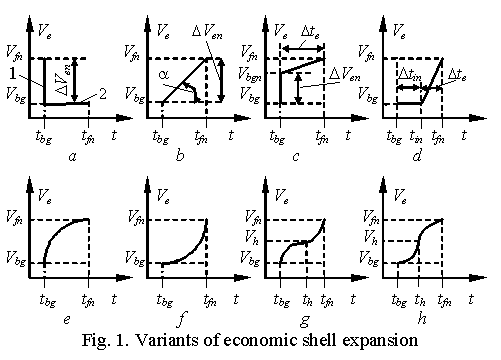
next diagram in figure 1b shows a linear dependence where an economic
shell expands rectilinearly at angle a to the
horizontal axis. Angle a is
situated within the following limits: 0 £ a £ 90°. This
variant is desirable while an economic shell expands (retracts), as knowing the
values of angle a and
time Dte we can
easily calculate both the final and intermediate volumes of the economic shell
using the equation Ve = t + с.
Fig. 1с and 1d show variants of more complex development
of economic shell expansion that are a group of two lines. So, Fig. 1с depicts a case
where after influence of internal forces an economic shell reacted to it
instantly and expanded by the value DVen
whereupon its volume changes according to the linear law.
Figures 1d and 6e show slow reaction of an economic shell
after internal forces affect it. Slow response of an economic shell is
characterized by the time Dtin during
which the volume of the economic shell does not change despite external
(internal) forces affecting it (1)
Dtin = tin
- tbg, (1)
where: tin
is the end time of slow response of an economic shell.
In the
case in question the bigger the value Dtin the
more intensely the volume of an economic shell will change in future.
Slow
response of an economic shell after it is affected by forces shows that the
market (companies) evaluates the situation change and solves the issue of how
to react to it.
Thus,
here we can draw the following description for slow response of an economic
shell.
Slow response of an economic shell is understood as
its state where after forces PV affect it its volume Ve
does not change during time Dtin
due to the market (companies) comprehending possible outcomes of these forces’
influence.
The
next class of change of economic shell volume is presented in Fig. 1e, 1f, 1g, and 1h
in the form of curves which can be described by a general polynomial equation
(2)

So,
Fig. 1e shows a variant where after internal forces affect an economic
shell its volume starts to increase quickly, and then it comes smoothly to its
top value. Figure 1f shows a similar dependence but at the beginning
after internal forces affect an economic shell its volume changes slowly due to
slow response of the system, and then changes are ascending.
Fig. 1g
and 1h show almost
identical complex dependences of volume change of an economic shell. These
diagrams have an inflexion point with coordinates Vh and th
where one type of mathematical dependence of volume change of an economic shell
changes to another.
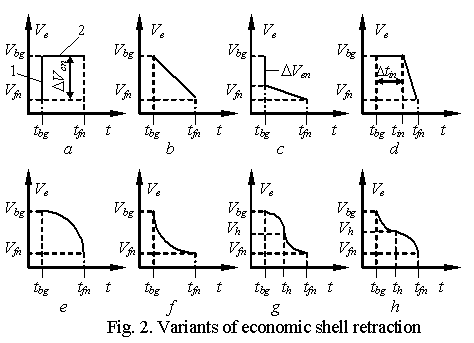
Fig. 2 shows possible variants of economic shells
retraction after being affected by external forces drawn similarly to Fig. 1,
and here similar conclusions are acceptable.