PhD, Ableeva A.M.
Bashkir State Agrarian University, Russia
Analysis of the indices dynamics of GDP and agriculture in comparable
prices
The research of trends of
economic growth in Russia's economy implies prolonged analysis of the dynamics
of major macroeconomic indicators to study the transformations in the structure
of indicators, ratios and proportions between them.
Economic growth is
characterized by increasing the scale of aggregate production and consumption,
defined as gross domestic product. GDP reflects the
market value of all goods and services in all economic sectors for consumption,
export and accumulation. GDP is an indicator
of public welfare of the nation: the higher the production, the higher the
welfare of the state population. Therefore, this
indicator is the major macroeconomic indicator that reflects the results of the
functioning of the economy. At the present stage of economic development of
Russian society there is the task of ensuring sustainable economic growth
through the accelerated renewal of fixed capital of the state. Therefore,
the most important long-term factor of economic growth is investments.
The investment policy of
the state is aimed at creating a favorable investment climate, allowing for all
sources of funding to develop key areas of the economy.
Socio-economic
development and the dynamics of economic growth are defined by the volume and
nature of investments. Growth in gross domestic product and the wealth of
society are ultimately determined by investments. Declining
investment is a key indicator of an economy in a state of crisis, and the
investment recovery activity is the essential ingredient to achieve a
sustainable path of economic growth. Falling investment
in fixed assets completely contradicts the nature of the market economy, which
is based on the laws of capital accumulation, and it does not meet the goals
and objectives of economic reform.
Analysis of the main
macroeconomic indicators of Russia's economy in current prices from 1990 - 2014
reveals a trend of exponential growth in virtually all areas. However,
these processes cannot attest to economic growth. This confirms that the
reproduction process is nominally extended character, because of the increase
value of the studied parameters as a result of inflation.
Therefore, a realistic
assessment of the Russian economy’s dynamics, which directly characterizes
trends by their growth or decline, should be carried out by calculating their
volume indices at constant prices (Figures 1 and 2). Indices of changes in
macroeconomic indicators in comparable prices show that the transition to a
market economy has been accompanied by a critical decrease of all of the
analyzed indicators. Thus, the GDP in 1998 amounted only 57.5% compared to
1990, but by 2007-2014 from the previous level in 1990. However, thanks to the
competent economic policy, by 2014, the GDP amounted to 118,5% of the level
1990.
|
|
|
|
Figure 1. Volume indices of Russia's GDP (blue line) and agricultural (red line) in 1990 -
2014 years in comparable prices of 1990,% |
Figure 2. Volume indices of Russia's
investment in fixed assets (blue line) and agricultural (red line) in 1990 -
2014 years in comparable prices of 1990,% |

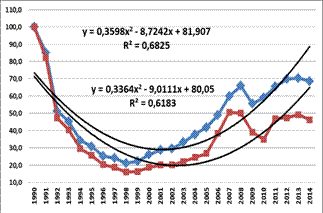
Economic crises in 1998
and 2008 had a negative impact on the volume of investment in fixed assets. At
the end of 2014, investments in fixed assets amounted to only 68.5% from 1990
levels. To identify the main trends of the index change in GDP and investment
in fixed assets, an analytical alignment was made which shows a clear tendency
of decrease and growth in the analyzed parameters, which are described by a
polynomial trend (Table 1).
Table 1 – Comparative analysis of the trend of
volume indices of GDP and investment in fixed capital in comparable prices, %
|
Indicators |
Trend |
Equation |
|
|
Volume indices of GDP in % of 1990 |
Polynomial |
|
0,797 |
|
Volume indices of agricultural
GDP in % of 1990 |
Polynomial |
|
0,729 |
|
Volume indices of investment in fixed assets in % of 1990 |
Polynomial |
|
0,682 |
|
Volume indices of investment in agricultural fixed assets in % of 1990 |
Polynomial |
|
0,618 |



Analysis of the
identified trends showed that the characters have a common trend direction of
development, but at the same time they are inherent differences expressed in
the descending and ascending branches aligned trends, accelerating and decelerating
growth levels. Studying the dynamics of the index change of the main
macroeconomic indicators of Russia's economy that characterize economic growth
allows the conclusion of serious structural changes over the last 25 years.
Calculated indices of GDP and investment in fixed assets allow carrying out
comparable analysis of real growth or decline in these indicators, allowing us
to estimate the real change in the dynamics of long-term and on par with those
at the level of different countries.
References
1. Лубова
Т.Н., Исламгулов Д.Р., Исламгулова И.Р. Основа реализации федерального
государственного образовательного стандарта – компетентностный подход // Бъдещите
изследвания Материали за 12-а международна научна практична конференция. 2016.
С. 3-11.
2. Salimova
G.A. Comprehensive study of the level of wages// Наука и образование: сохраняя прошлое, создаем
будущее//Сборник статей II Международной научно-практической конференции. Под общей редакцией
Г.Ю. Гуляева. 2016. С. 37-43.
3. Zalilova Z.A., Sultanova E.A., Mikhailovskaya I.M.
Information base and its use in apiculture //Информационные технологии. Проблемы и решения. 2016. С.173-176.
4. Federal State Statistics Service - http //:
www.gks.ru