Bukhovets A.G. Dr. Sc. (Eng.), Biryuchinskaya
T.Y. Cand.
Sc. (Phys.-Math.)
Department of Applied Mathematics, Voronezh State Agrarian University
named after Emperor Peter I, Michurina str., 1, Voronezh, 394087, Russia
Tel.: +7 473-253-73-69; fax: +7 473 253-86-51
E-mail address: abuhovets@mail.ru,
bir_tat@mail.ru
PROPERTIES OF SETS
GENERATED BY RANDOM ITERATED FUNCTION SYSTEMS
Abstract: Fractal properties of attractors for the
randomized systems of iterated functions are considered in the work. The
special attention is given to characteristic lines of these sets connected with
algorithms generating them
Keywords: Fractal
analysis, random iterated function systems, simulating fractal sets.
Highlights:
·
Constructions fractal
sets by means of as random iterated function systems, and an alternative
method by construction of the matrix which lines represent the sums of in a random
way taken members of absolutely converging number are considered.
·
The basic
properties received fractal sets such as powers, perfection, resolvability,
convergence are considered.
1. Introduction
Random
iterated function systems (RIFS) represent one of the most significant
achievements in the theory of fractals being at the same time a component in
the theory of dynamic systems [1]. Mathematical aspects of this concept have
been first developed by Hutchinson and directly used in the theory of fractals
[2]. However, the performed investigations were as a rule executed within the
frameworks of classical approach, i.e. without the study of the properties of passage
to the limit and intermediate results of RIFS performing. In this work it was
proposed to consider the results RIFS execution from the two different points
of view – classical one and constructive one. So, for example, during the study
of problems of the convergence for a
certain RIFS it shall be specially stipulated each time if we deal with an
actual infinity meaning the finalized and realized one or the infinity is
considered as a potential one, otherwise as a possibility to continue the
calculations in principle for an arbitrary long time. In other words the result
of the study is to some extent determined by the fact how the analysis will be made
– either constructive
approach is applied or consideration is performed within the frameworks of the
classical analysis – for example, from the viewpoint of the naive set theory. An approach proposed in the present work when
both different points of view were taken into account, describes behaviour of a
system in that special cases that seem to be very important in the practical
conditions when a solution does not depend on the details of the initial and
boundary conditions but the system is still far from the limiting states. In
fact, the sets obtained as a result of RIFS represent some
intermediate-asymptotic solution.
Moreover, in our work a special
attention was tended to notice the alternative way of constructing fractal sets
based on the generalization of approach for summation of series with random
signs of terms [4]. The use of such approach which
is to some extent dual (alternative) relative to the routine way of
constructing fractal sets makes it possible to perform the evaluation of RIFS
parameters when solving some practical problems.
2.
Realization of the random iterated function systems
Let’s first introduce the following definitions:
1. Proto-fractal means a set Z – discrete or continuous one
generating fractal set during RIFS execution. To realize this procedure it is
necessary to preliminarily specify some probability measure P(Z) and determine the value of
parameter µ.
2. Pre-fractal X is a countable set of points which
appears as a result of RIFS realization.
3. Fractal is a limiting set composed of all
the possible points that can appear (potentially) during RIFS execution.
To realize certain RIFS it is proposed to apply the following procedure [3].
Let’s assume that a certain value of some parameter µ is specified and some set of points  is determined in RP
Euclidean space that we further name a proto-fractal as agreed above; let a
probability distribution is determined upon this proto-fractal. Initial point
is determined in RP
Euclidean space that we further name a proto-fractal as agreed above; let a
probability distribution is determined upon this proto-fractal. Initial point  is determined in a random order. In order to
obtain the points of simulated set the following procedures are successively
executed:
is determined in a random order. In order to
obtain the points of simulated set the following procedures are successively
executed:
1. According to the
predetermined distribution measure the point of proto-fractal  is chosen;
2. Coordinates of  point are calculated by the formula

Next, the obtained point  is taken as an initial one and items 1-2 are
repeated as many times as many points of the generated set are required. As a
result of execution of this procedure a set of points
is taken as an initial one and items 1-2 are
repeated as many times as many points of the generated set are required. As a
result of execution of this procedure a set of points is obtained and named pre-fractal as it was
agreed above, just similar to the determination of precompact. Fractal
term should be used to designate a limiting set. The iterated procedure
described above will be specified as F1.
is obtained and named pre-fractal as it was
agreed above, just similar to the determination of precompact. Fractal
term should be used to designate a limiting set. The iterated procedure
described above will be specified as F1.
Computation of
pre-fractal points can be also organized in another way. Without limiting of
generality and for convenience let’s consider the execution of this procedure
in one-dimensional case. Let  is an initial point of the procedure that can
be taken randomly. Then a successive execution of the iterated procedure can be
represented as follows:
is an initial point of the procedure that can
be taken randomly. Then a successive execution of the iterated procedure can be
represented as follows:

 (2.2)
(2.2)

…………………………………………………………………………….  ��(…ξ(ξ(ξ
The obtained expression
represents notation of Homer's method for the n-the polynomial of �� variable without a free term with the coefficients  which
were obtained by selection according to the predetermined measure (Р) from an aggregate of points of the proto-fractal
which
were obtained by selection according to the predetermined measure (Р) from an aggregate of points of the proto-fractal  at each iteration
step multiplied by the coefficient µ. Removing the brackets we obtain
the following equality
at each iteration
step multiplied by the coefficient µ. Removing the brackets we obtain
the following equality

Then rewrite equation (1), changing the order of summation and make an
upper estimate of the sum

where  for µ
≥ 1.
for µ
≥ 1.
For  value one can
obtain more accurate estimate by rearranging of series terms and collecting
terms relative to Zj
value one can
obtain more accurate estimate by rearranging of series terms and collecting
terms relative to Zj
 ,
,
or

where

and  while
summation in some certain terms is performed over the number of proto-fractal
points chosen according to the algorithm represented in item 2.
while
summation in some certain terms is performed over the number of proto-fractal
points chosen according to the algorithm represented in item 2.
Note that from (2.5) follows – each point of the
obtained pre-fractal is a linear combination of proto-fractal points.
Thus, constructing of pre-fractal for a predetermined
set of 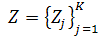 ,
distribution of the probability values
,
distribution of the probability values  and the value of
  in fact means the execution of the following
operations:
in fact means the execution of the following
operations:
1. According to the distribution of  К values of totals are calculated formed from the
elements of absolutely convergent series of the type
К values of totals are calculated formed from the
elements of absolutely convergent series of the type

The obtained К values are recorded in line as the elements of 
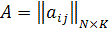 matrix, where N is the number of the
required pre-fractal points, К is the number pre-fractal points. The rule of assignment for i-th term of series to some of the summands
matrix, where N is the number of the
required pre-fractal points, К is the number pre-fractal points. The rule of assignment for i-th term of series to some of the summands  can be an arbitrary one. In our numerical
experiments it was usually assumed that all of the series terms could be
equiprobably included into the sum of any summand. However, it is not difficult
to provide any other relation of the probabilities.
can be an arbitrary one. In our numerical
experiments it was usually assumed that all of the series terms could be
equiprobably included into the sum of any summand. However, it is not difficult
to provide any other relation of the probabilities.
2. Matrix A obtained as a result
of the calculations is multiplied by  matrix, composed of pre-fractal points. Result
of the product – matrix
matrix, composed of pre-fractal points. Result
of the product – matrix  will be a list of coordinates of
the points for pre-fractal X in the
specified space.
will be a list of coordinates of
the points for pre-fractal X in the
specified space.
Thus, if 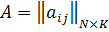 is obtained then construction of pre-fractal
means simply multiplication of the matrices. Such way of constructing of the
pre-fractal set that is to some extent reciprocal to that one described above
will be further noted as F2.
is obtained then construction of pre-fractal
means simply multiplication of the matrices. Such way of constructing of the
pre-fractal set that is to some extent reciprocal to that one described above
will be further noted as F2.
Multiplicative representation
fractal sets X=A×Z allows to
receive further statistical estimations of a proto-fractal using this parity.
Let's notice, that procedure F1 represents some generalisation of procedure of
M. Barnsley known under the name «chaos game» [4],
and procedure F2 somewhat it is possible to consider as
analogue of the
Bak–Tang–Wiesenfeld sandpile
model that allows to use further
it in modelling the process self-organized
criticality.
Equivalence of
these two proposed procedures for construction of the fractal sets F1 and F2 is
supported by the graphical results obtained under their execution for the same
input parameters.
3. The power of sets generated by RIFS
Let’s consider an issue related to the power of sets
obtained during execution of RIFS. Cantor discontinuum (С-set) is known to be a classical and universally recognized example of
the fractal set [1]. Among a lot of the equivalent determinations for C-set
let’s choose the one that seems to be the most convenient one in this situation
meaning that it corresponds to our purpose to the highest extent. Usually C-set
is determined algorithmically, i.e. geometrical (or, more exactly, mechanical)
way for constructing of this set is proposed. It is based on a successive
elimination of the central third for the unit segment and
next the study of its properties is performed. Examples
for construction of the fractal sets with different dimensions according to
this principle are given in [1].
However,
there is another approach. For example, in [4] one can see: «Cantor discontinuum can be determined as a set of all numbers
involved between zero and one, that can be written in ternary notation using
only ''0'' and ''2''». There are also alternatives where C-set is written
directly with the help of «0» and «1» digits; this allows to make a direct
conclusion that this set has a power of continuum, since this record represents
binary notation of any number involved within the unit interval starting from
zero.
Let’s show that a set of
points obtained as a result of F1 procedure execution, can be homeomorphically mapped
to C-set. In this case it is convenient to use symbol dynamics method [5], based on the coding of each path of a dynamic system
by a sequence of symbols.
Let 
 is a predetermined pre-fractal including K points
and so we have K different digits, respectively. Let’s agree that if Zm
point was chosen at the k-th step of F1 procedure execution then in the numeral
of the number Yk = 0,y1 y2…yk m
digit will be logged at k-th position, i.e. we suppose that yk = m. Obviously,
0< Yk <1. Then each set
is a predetermined pre-fractal including K points
and so we have K different digits, respectively. Let’s agree that if Zm
point was chosen at the k-th step of F1 procedure execution then in the numeral
of the number Yk = 0,y1 y2…yk m
digit will be logged at k-th position, i.e. we suppose that yk = m. Obviously,
0< Yk <1. Then each set  obtained as a result of F1 procedure
execution can be aligned in biunique correspondence with a number Yk
obtained as a result of F1 procedure
execution can be aligned in biunique correspondence with a number Yk
 Ek, recorded in
the numerical system with the base number K but without the use of 0 digit in
the numerals. Such a set
corresponds to Cantor
set [1]. Note, that here
an assumption is made that each number in the chosen numerical system has a
single notation.
Ek, recorded in
the numerical system with the base number K but without the use of 0 digit in
the numerals. Such a set
corresponds to Cantor
set [1]. Note, that here
an assumption is made that each number in the chosen numerical system has a
single notation.
The presented construction means that the obtained
sets Ek are enumerative,
i.e. if one knows a sequence of digits in the number Yk = 0,y1
y2…ym it is
always possible to construct sequence Ek
and vice versa. With this presentation of the sets of points for pre-fractal it
is easy to show using Cantor’s diagonal method, that in case of accepting the
idea of actual infinity the limiting set – fractal has a power of continuum.
Really, assuming the
contrary idea, i.e. that the limiting set is a countable one let’s set down successively
all the numerical sequences corresponding to the obtained sets at each step of
the procedure. Due to the countability this procedure can be really made. After
that let’s make a new number W = 0,w1w2… wk…
basing on the known principle: w1 can be any of the chosen digits of
numerical system except the first digit of the number Y1, i.e. w1
≠ y1. The second digit w2 can be any of the
chosen digits of numerical system except the second digit of the number Y2
and so on. Obviously, the obtained number W differs from Y1 by the first digit,
from Y2 – by the second one and so on. In other words, the number W will
not coincide with no one of the numbers presented in the enumeration. In turn,
it means that the assumption on the countability of the set of points for the
fractal as in the limiting set is not true; it means that this assumption is
false.
In a certain sense, if
to draw analogy with the numbers arranged within the unit segment, the points
obtained with the use of the procedure F1 can be compared with the presentation
of rational numbers of the segment while the rest ones that can be potentially
obtained – compared with irrational numbers. In this case both situations are
very similar: rational numbers are sufficient for the practical applications
(results of the procedures F1), while theoretical reasoning require the use of
irrational numbers and, hence the points that can be obtained in principle. By
the matter, note that this theoretical construct, for example, to explain why
Serpinsky’s triangle obtained with the use of F1 procedure for µ=1 provides the
fractal dimension equal to 1,58 [7], and it is in a good correspondence with
theoretical value of dimensionality equal to  .
.
Thus, there is a pre-fractal – the sets of  , obtained during the
execution of the procedure F1 are countable and the limiting set
, obtained during the
execution of the procedure F1 are countable and the limiting set 
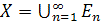 has the power of continuum.
4. Solvability and
enumarability of sets obtained by RIFS
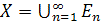
Let’s consider the problem of solvability of the
fractal set of points. In other words, the problem implies the possibility to
answer the question – if the given point  is a member of a set Х, i.e. to determine if
the set
is a member of a set Х, i.e. to determine if
the set 
 is a decidable one.
In order to determine the membership of  point to a set Х it
is convenient to consider that
point to a set Х it
is convenient to consider that  was obtained during execution of the procedure F2.
In this case the following representation occurs, according to (2.5)
was obtained during execution of the procedure F2.
In this case the following representation occurs, according to (2.5)

where  .
.
Statement 1. In order the set 
 would be a set obtained by F2 procedure it is
necessary and sufficient that among its elements there was a dominating element
[9], i.e. the element
would be a set obtained by F2 procedure it is
necessary and sufficient that among its elements there was a dominating element
[9], i.e. the element  , with the value exceeding the sum of values for all the rest elements.
◄ Necessity.
Let  and the following equality occurs

Then the first term of this series is equal to  , while the sum of all the rest series terms
is
, while the sum of all the rest series terms
is

For the given value of  the following inequality is obvious

Sufficiency. Let elements 
 be the totals of randomly selected elements of
the series (4.2) and the value of
be the totals of randomly selected elements of
the series (4.2) and the value of  is a dominating one

Below one can see that in this case the value of parameter  can be determined in such a way that the
corresponding procedure F2 results in the execution of the relation (4.5).
can be determined in such a way that the
corresponding procedure F2 results in the execution of the relation (4.5).
In fact, from the condition of dominance and relation of 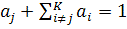 it follows that
  , and
, and  , respectively. In this
case, if a set of
, respectively. In this
case, if a set of 
 was obtained using procedure F2,
  must involve the first term of series (4.1). To
check if it is true let us consider the value of the first term in this series
as a function of parameter µ
must involve the first term of series (4.1). To
check if it is true let us consider the value of the first term in this series
as a function of parameter µ

Obviously f(1)=1/2,  , and, hence, for
  the value of the first term in this series is no
less than 1/2, so, condition (4.5) is always satisfied. ►
the value of the first term in this series is no
less than 1/2, so, condition (4.5) is always satisfied. ►
Thus, in order to obtain all points of the pre-fractal
related to Zm, it is sufficient to determine the dominance component
 and arbitrarily generate the rest of the
components from the terms of series (4.2). Obviously, in this case all of the
rearrangements for the elements
and arbitrarily generate the rest of the
components from the terms of series (4.2). Obviously, in this case all of the
rearrangements for the elements  form a group of transformations.
5. On the perfection of
fractal sets
If one considers En from the viewpoint of the
countable axiomatics and relies on the finite conclusions then the set of  obtained for a finite number of steps can be
represented as a sum of the countable number of one-point sets and each one of
them has null Lebesgue measure. Due to the countable additivity of the measure
obtained for a finite number of steps can be
represented as a sum of the countable number of one-point sets and each one of
them has null Lebesgue measure. Due to the countable additivity of the measure  set has a null measure as well, and topological
dimension of such set will be equal zero. However, considering of the limiting
set – fractal, as it was mentioned above, allows to come to some other
conclusion: namely, the limiting set can have the measure different from zero [9].
set has a null measure as well, and topological
dimension of such set will be equal zero. However, considering of the limiting
set – fractal, as it was mentioned above, allows to come to some other
conclusion: namely, the limiting set can have the measure different from zero [9].
In order to
investigate the limiting properties of the obtained sets they were considered
as the actually infinite ones; it means that an infinitely great amount of
pre-fractal points has been already obtained. In other words, at least one
point with the required properties among a set of the points obtained with the
use of F1 or F2 procedures can always be found. Let’s show that within the
frameworks of this assumption the following statement is true
Statement 2.
The obtained limiting set is a closed one.
◄ To prove this let’s show that within any ε-vicinity
of the arbitrary point Х, being a member of the limiting set there is at least one point Х*≠Х, that is also a member of this limiting set. In other words, a set of
fractal points involves all of its limiting points, i.e. it is a closed one
set. Let’s consider the points obtained with the use of F2 procedure. According to (2.5)
we have

For convenience let us confine our consideration by
the case  ,
,  . Then, in order that Х
and Х* were both within the ε-vicinity, the following ratio must be satisfied
. Then, in order that Х
and Х* were both within the ε-vicinity, the following ratio must be satisfied

where ε is an arbitrary positive number. Consider 
 as a vector with the coordinates obtained with
the use of F2 procedure keeping in mind that the order separation in (2.5) is
known. Next, find the first element
as a vector with the coordinates obtained with
the use of F2 procedure keeping in mind that the order separation in (2.5) is
known. Next, find the first element  among the terms of series (4.2) that obeys
inequality
among the terms of series (4.2) that obeys
inequality

where 
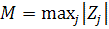 and also set the coordinate
  , related with
  . Let
. Let  is chosen as the vector determined according to
the following rule
is chosen as the vector determined according to
the following rule

i.e.  differs from а
only by the fact that the element
differs from а
only by the fact that the element  is transferred from the cell with number i
to the cell with number i-1. Then
is transferred from the cell with number i
to the cell with number i-1. Then

Thus, knowing the order of constructing of arbitrary
point for fractal Х
using F2 procedure it is possible determine at least one point
of the same fractal for any ε-vicinity.►
It is obvious that in
the presented proof an actual infinity of the points of fractal set has been
essentially applied.
As it is seen from the
proof, any point of the fractal set Х is a
limiting point. And this means that a set Х is a
perfect one [10].
6. Study of the convergence for RIFS procedures
Let’s consider the
problem concerning convergence of the procedure for constructing of pre-fractal
 . The ways for
specifying of the finite and infinite mathematical objects are known to be
different. To determine finite sets it is sufficient a simple enumeration of
the elements in a set, while in case of the infinite sets this way seems to be
unreasonable. In the latter case an algorithm for the computation of the terms
in this set is usually provided, as, for example, in case of numerical
sequences
. The ways for
specifying of the finite and infinite mathematical objects are known to be
different. To determine finite sets it is sufficient a simple enumeration of
the elements in a set, while in case of the infinite sets this way seems to be
unreasonable. In the latter case an algorithm for the computation of the terms
in this set is usually provided, as, for example, in case of numerical
sequences  , or the property characterizing the relation of the objects to the set,
for example, continuity of the function. While considering infinity of a set
, or the property characterizing the relation of the objects to the set,
for example, continuity of the function. While considering infinity of a set  , potential infinity is
meant i.e. a possibility to infinitely continue the process while in the second
case an actual (realized) infinity is usually meant.
, potential infinity is
meant i.e. a possibility to infinitely continue the process while in the second
case an actual (realized) infinity is usually meant.
Obviously,
F1 should be considered as a potentially unlimited constructive process. In
this case it is important to divert from the principal incompleteness of this
process but at the same time just the possibility of constructive obtaining of
the investigated mathematical objects makes them very convenient for the
application of finite-dimensional methods of analysis.
Thus,
consideration of the results of the F1 procedure’s execution ca be represented
in the following form
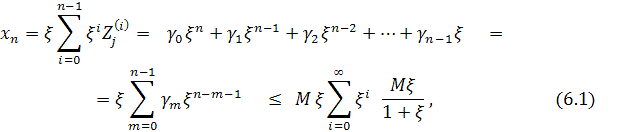
where 
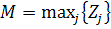 ,
, 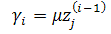 ,
, 

 , and without the loss
of generality it is reasonable to consider all Zj to be positive. Considering of
, and without the loss
of generality it is reasonable to consider all Zj to be positive. Considering of  as a particular sum of an absolutely convergent
series allows to state as if the series
as a particular sum of an absolutely convergent
series allows to state as if the series  , considered as actually
infinite mathematical object in case it is a majorized one converges as well. However,
this statement is not true – that is clearly seen from the geometrical
presentation of the results of numerical experiments. The matter is that
sequence
, considered as actually
infinite mathematical object in case it is a majorized one converges as well. However,
this statement is not true – that is clearly seen from the geometrical
presentation of the results of numerical experiments. The matter is that
sequence  is not a fundamental one due to the randomness of
choice of the elements
is not a fundamental one due to the randomness of
choice of the elements .
.
In fact, as it was shown
above the generated fractal set is a perfect one. In particular, it means that
each point if this set is a limiting one. Thus, it is impossible to fix a
single limit of the generated sequence (6.1).
The situation here is approximately the same as in the
case of Specker sequence. Specker [11], as it is known, gave an example which
showed that a theorem on the convergence of monotonously varying sequence
within the frames of the constructive interpretation is false.
The sequence obtained as a result of F1 procedure can
be related to the sequences of Specker type. It is limited and without the loss
of generality it may be considered as non-negative one. Homeomorphism with Cantor discontinuum – and classical Specker sequence in
the process of its realization represents just the points of Cantor
discontinuum – emphasizes the topological commonality of these
sequences. In fact, Specker sequence can be represented as a result of RIFS
execution with proto-fractal  and arbitrary values of
  as well as the value of µ=2. Results of the
execution of F1 and F2 procedures with the given parameters illustrate well
this fact. With such approach Specker sequence enumerates Cantor’s set, or,
more exactly, its fractal limit. However, in the obtained sequence of
as well as the value of µ=2. Results of the
execution of F1 and F2 procedures with the given parameters illustrate well
this fact. With such approach Specker sequence enumerates Cantor’s set, or,
more exactly, its fractal limit. However, in the obtained sequence of , unlike of the Specker
one, there exist
, unlike of the Specker
one, there exist  subsequences converging
to separate proto-fractal points – for example, at the constant choice of the
point
subsequences converging
to separate proto-fractal points – for example, at the constant choice of the
point  in F1 procedure.
Conclusion
Practical application of RIFS results to a high extent depends on the
main properties of sets obtained during the execution of the corresponding
procedure. However, certain properties characteristic for the results are
considerably determined by the interpretation of the computational experiment.
In case when the resulting set is considered from the viewpoint of constructive
approach, a set obtained as a result of numerical RIFS realization is
· A countable set of a null Lebesgue measure;
· Sequence of Specker type arranged inside the linear shell for the
proto-fractal points.
At the same time the limiting set – fractal is
· A set with a power of continuum;
· Countable set, i.e. compact and closed one,
· In general, having Lebesgue measure different from null.
The final choice of the properties is determined by appropriateness of
the use of results. For example, the use of F1 and F2 procedures for the
approximation problems of the point sets assumes consideration of the
pre-fractals properties. At the same time comparison of these two different
fractal sets requires the knowledge of just the limiting properties of these
objects.
References
1.
Crownover R.M. Introduction to Fractals and Chaos. Boston: Jones & Bartlett •
1995.
2. Hutcthinson J.E.
Fractals and Self Similararity. Indiana University Mathematics Journal, vol.
30, #5, 1981, pp. 713-747.
3. Barnsley M. Fractals Everywhere. Academic
Press, 1988.
4.
Morozov A.D. Introduction to fractals theory.
– Moscow-Izhevsk, 2002, 160 p.
5.
Bowen R. Methods of symbolic dynamics. – M.: Mir,
1979, 244 p
6.
Bukhovets A.G. Modeling of fractal structures of the data / Bukhovets
A.G., Bukhovets E.A. // - Management systems and information technologies, №
3(33), 2008, P. 4-7.
7.
Bukhovets A.G. Semenov M.E. Determination of fractal data dimensions in the classification tasks. Review of applied and industrial mathematics – M.;
2006, v. 13, iss. 1, p.
86.
8.
Bukhovets A.G., Biryuchinskaya T.Ya., Bukhovets E.A. The use of fractal
models in classification problems. Management systems and information
technologies, 2009б 3.1(37), P.
117-121.
9.
Bukhovets A.G., Biryuchinskaya T. Ya., Korablina N.A. Dominate factors
in modeling a fractal structure. Economical prognosis: models and methods.
Proceedings of VI International theoretical and practical conference on 6 of
April 2010 – Voronezh: VGU, 2010.- v.1., p. 61-66.
10.
Gelbaum B.R., Olmsted J. M. H. Counterexamples in Analysis. 1964.
11.
Specker E. Nicht konstruktiv beweisbare Satze der Analysis, Symbolic
Logic, 14 A949, 145—158.