Korotov N.A
IV year student of the Institute of
Metallurgy and Chemical Technology S.B. Leonova of Irkutsk State Technical
University
UNCONVENTIONAL USE OF PETROLEUM COKE
Delayed coking process increases the
production of motor fuels and increase the depth of oil refining. Planned
construction of new delayed coking unit in Russia will reduce the deficit
electrode coke and increase the depth of oil processing in refineries. At the
same time there is a question about the directions of qualified use of sulfur
coke.
Widespread delayed coking
process in schemes overseas
refineries caused not by a desire
to increase production of petroleum coke
for the aluminum industry and the electrode, and the need to obtain maximum distillates for the production of motor fuels and, consequently, the deepening of oil refining. According to [1], due to the widespread
adoption of delayed coking unit at the refinery schemes and
management of US distillates
obtained saves up
to 250 million tons per year of
primary oil processing.
The development plans of Russian oil
refining industry is also planned to increase the capacity of the delayed coking
process, as there is a deficit of
low-sulfur petroleum coke(pic.1)
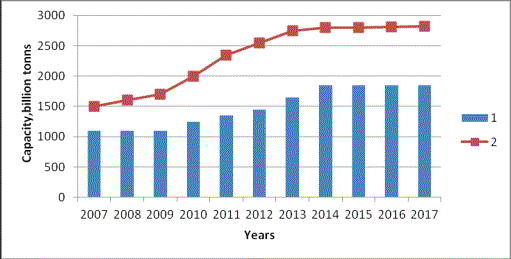
Pic.1. Forecast of production of petroleum coke in Russia (1) and the
need "RUSAL" company for it (2)[3]
Since 2009, commissioned a delayed coking
capacity of 1.2 million tons per year
in the PLC "Ufaneftekhim", there is a building
Delayed Coking Komsomolsk - on the Amur, Achinsk,
Volgograd (there will be low-sulfur coke) to be
built Ufa (PLC «Ufa Oil
Refinery»), Tuapse, Ryazan, Orsk, Samara, Perm. Construction of a
large number of new plants will
significantly reduce the deficit of
low-sulfur petroleum coke for the
aluminum industry, as well as to increase the depth
of oil refining at specific refineries. Qualified use of distillates
coking in the PLC
"Ufaneftekhim" allowed to bring refining depth
to 95-96%[2].
Now Russian refineries operated 9
Delayed Coking, which in 2010 produced about 1,3 million
tons of petroleum coke. Only at
three refineries produced
petroleum coke with a sulfur content
of about 1.5% (in accordance with
regulatory requirements) on the
other plants the sulfur content
of 3% or more.
In considering the question of
expanding uses of petroleum coke
having difficulty due to the mismatch
of its physical and chemical
characteristics of the requirements of consumers. in particular, the content of volatile matter, ash, sulfur, grain composition and mechanical strength.
Details pertaining to the use of petroleum coke and justification of the regulatory requirements of consumers
for its quality are given in the literature [3,4]
As shown in [5],
almost half of the foreign coke fuel is used as fuel in
cement industry where high sulfur content is desirable because
it allows the gypsum to replace partially introduced
to the clinker for lengthening the setting time of portland cement [6]. But this trend of using
sulfur coke in Russia
is not yet widely available due
to the relatively low cost of
natural gas used as fuel.
One of the alternative use of
fines of coke is
coke industry, where petroleum coke is introduced into the coking coal charge
upon receipt of metallurgical coke
for non-ferrous metallurgy and
blast furnace production. Analysis of
the literature shows [7,8] that the quality
of metallurgical coke is mainly
determined by the quality of the
original coal charge, and to a lesser extent - the
terms of coking. Therefore,
in solving the problem of improving
the quality of metallurgical coke
at coke plants focuses on optimizing the composition of the coal charge.
For this purpose, as well as to search
for ways to control the directional physicochemical and mechanical properties of metallurgical coke,
numerous studies were conducted on batches of coal
coking hydrocarbon with various additives, including petroleum coke breeze [9].
Petroleum coke breeze in the coal charge serves
as emaciated supplements and acts positively in the case of coal fat charge. No
currently in charge coal Russian coking plants there is a deficit (up to 7
million tons per year) of coking coal with a high degree of metamorphism and
low volatile substances that determine the formation of lumpy structure and
mechanical strength of coke [8].
The big advantage of "coking
additive" is a low ash content and a wide temperature range of plasticity,
plasticity interval exceeding any of coking coal, which ensures continuity of
plastics and ideal conditions of sintering coal charge.
Testing of "petroleumcoal"
metallurgical coke in blast furnaces and non-ferrous metals led to the
conclusion that "coking additive" can be
effectively used in the manufacture of:
- Coke with improved strength and reactivity;
- Coke for coal injection technology;
- Lumpy foundry for shaft furnaces;
- For the production of non-ferrous metals.
Thus, the developed technology for producing
"coking additive" enables volumetric market
and qualified use of petroleum coke with a sulfur content of 3% or more, and
also helps to improve the resource base of coking industry for the production
of metallurgical coke.
Bibliography
1)
The
current state of scientific and clinical achievements in the development of
global refining technology of coking residual oil for deeper processing of oil
and increase the production of motor fuels and petroleum coke: analytical
review. – M.: PC Central Research Institute Of Information And
Technical-Economic Research Refining And Petrochemical Industries, 2005. – 48
p.
2)
Rudnev
I. Refining pace with the times. Not only produce high-quality gasoline – it’s
required to reduce the production of oil // newspaper "Izvestia". -
2010, April 9
3)
Glagoleva
O.F. Petroleum coke // World of petrochemicals. Messenger of the oil companies.
- 2009. №№3,4,5,6
4)
Sunyaev
Z.I. Production, refinement and applying of petroleum coke. - M.: Chemistry,
1973. - 295 p.
5)
5)
Predel H., Nielsen M. Petroleum coke - Development and trends // Petroleum and
coal, 2005. - №10. - p.348, 350-352
6)
Ufimtsev
V.M., Kapustin F.L., Pyachev V.A. Petroleum coke in the production of cementing
materials // Dry construction mixes. - 2009. - №5,6 (13-14). - p. 24-26
7)
Unterberger
O.G., Koksharov V.Y., Strakhov V.M et al. Getting foundry coke from the batch using petroleum coke breeze
// Coke and Chemistry. - 1995. - №12. - p. 13-17
8)
Egorov V.N., Tarasov N.A., Melnykov I.I. et al. About air conditioning
coal charge for coking // Coke and Chemistry. - 2006. - №12 - p.11-17
9)
Saltanov A.V., Pavlovich L.B., Pyanov B.F et al. recycle carbon waste
during high-temperature pyrolysis of coal: sintering and oiling additives //
Coke and chemistry. – 2002. - №4. – р.17-25