PhD, Associate Professor Kuzenko Tatiana B., PhD, Associate
Professor Ignatenko Larisa A., Postgraduate Plakhotnaya
Nataliia V.
Simon Kuznets Kharkiv National University of Economics, Ukraine
Classification
of the threats to financial security of a business entity in current economic
conditions
In
current economic conditions a lot of business
entities are very vulnerable to inner and external adverse events, which can harm their financial security or even lead to insolvency. The risk of realization of such events
is especially real in conditions of instability or crisis in a country. However, even in
relatively stable periods in the
economy, some companies become
insolvent exclusively due to shortcomings in the system of financial security ensuring that is carried out by the management of a business entity. So the
issue of planning of such system
appears extremely important for successful and safe operation of business entities.
We
believe that the most complete and informative definition of financial security
is suggested by I.A. Blank.
Financial security a business entity
is quantitatively and qualitatively determined level of its financial state, which provides stable protection
of its priority and balanced
financial interests from the identified real and
potential threats of internal and external nature, parameters of which are determined
on the basis of its financial philosophy and create the
necessary conditions for sustainable financial support of its growth in the current and
prospective period [1, p. 32].
Some authors believe that financial
security is a financial state that is characterized, firstly,
by balance and quality of the set of financial tools,
technologies and services which are used by a business entity, secondly, by
resistance to internal and external threats, thirdly, by
the ability of financial system of a business
entity to ensure the realization of its financial interests, missions and tasks with sufficient financial resources, fourthly, to ensure the development
of the financial system [4,
p. 65-67].
According
to some researchers, the essence of financial security is a
business entity’s ability to design and conduct the financial
strategy in accordance with the objectives
of the corporate strategy in an uncertain and competitive
environment. Consequently, financial
security is a state of a business entity that:
1) allows ensuring financial balance, stability, solvency and liquidity of a
business entity in the long run;
2) meets the needs of enterprise
of financial resources for sustainable
expanded reproduction of a business
entity;
3) provides sufficient financial
independence of a business
entity;
4) is able to deal with existing and emerging
threats that seek
to inflict financial damage to a business entity or change desired capital structure, or forcibly liquidate a business entity;
5)
ensures sufficient flexibility in making financial decisions;
6) protects the financial interests of
the owners of a business entity [5,
p. 101].
Thus, one of the key points of financial security ensuring of a business entity is to identify internal and
external threats and to create
effective mechanisms to counteract them. Let us consider the broad classification of threats that may affect
financial security.
1) All the threats can be divided
into external and internal by the source of occurrence. The external
threats include, for example, industrial espionage,
illegal actions of competitors, the instability of the economy etc. Internal - low
qualification of specialists who
develop contractual documents, inefficient
work of financial or economic security service etc. The greatest danger,
as a rule, is external threats. The
detailed classification of the threats to financial
security of a business entity by the source of occurrence will be considered
further.
2) By the level of the severity of consequences all the threats can be
divided into threats of high, large, medium or low severity of consequences.
High severity means that these threats can lead to a sharp deterioration of the
financial performance of a business entity that causes immediate termination of
its activities or cause irreparable harm that will result in such consequences
later. In this case, the liquidation of a business
entity can happen. A
significant level of severity of the impact of threats suggests the possibility
of applying such financial losses to a business
entity that negatively affect the main
financial indicators of a business
entity and its activities in the
future. Average severity means that overcoming the effects of these threats
requires spending (causes a loss), comparable to the current expenditures of a business entity and doesn’t require considerable time. The
consequences of threats of low severity have not any significant effect either
on the strategic position of a business
entity, or even on its current
activity.
3) By the level of probability threats can be unlikely and highly likely.
4) Threats may differ by manifestation at particular stage of activity.
There are threats which are most likely and dangerous in the construction phase
of a business entity, and threats which are typical for its operation.
In the first case, it may be illegal actions by corrupt officials who prevent the
organization of a business entity. At the stage of operation threats may arise in
the preparatory phase (prevent normal supply of raw materials, equipment), the
production stage (destruction or damage to property, equipment, theft of
"know-how"), the final stage (interference to sales, restriction of
competition, illegal advertising restrictions).
5) The threats may differ by the object attacked. The object attacked is, especially, resources: labor (staff), physical, financial, informational. Staff threats
are blackmail to obtain confidential information, theft of employees,
extortion etc. Material
resources threats are damage to buildings,
facilities, communications systems, equipment
stealing. Financial resources threats are fraud, falsification of financial documents, currency, theft
of cash. Information resources threats are unauthorized connection to the information network of the company, removal of
confidential documents etc.
6)
By the subjects of threats:
threats from criminal organizations;
threats from unfair competition; threats from contractors; threat by employees.
7) By the mode of the damage - threats, implementation of which has a direct damage and
threats, the implementation of which
will result in loss of profits [6, p. 121-122].
Many
authors emphasize the threat
classification by the source of occurrence, that is, division
of threats to internal and external. It
makes sense, since such
classification covers the most
common and therefore the most
important threats to financial
security. So let's consider in
details what threats relate to external, and what
threats relate to internal (Fig. 1).
Thus, analyzing the threats to the
financial security of a business
entity, let’s list the tasks that
need to be resolved for financial
security ensuring:
1) the identification of hazards and threats
to a business entity;
2) identifying indicators of a business
entity’s financial security;
3) development of financial security monitoring
system;
4) developing measures to ensure a business entity’s financial security (both in the
short and in the long run);
5) monitoring the implementation of the
activities taking place in a business
entity;
6) analysis of the performance of measures and their assessment and adjustment;
7) identification of hazards and
threats to a business entity and
updating of indicators based on changes in the state of the environment, the goals and objectives
of a business entity [2, p. 116-117].
The
most suitable methods of analysis
for identification and evaluation
of threats to the financial
security of a business entity are:
SWOT-analysis, PEST-analysis,
SNW-analysis, method of development
of scenarios [2, p. 119]. Features of these
methods can be used as material
for further research of threats
to financial security of a business
entity.
Thus, the article summarizes the definitions of financial
security and
proves that one of the key points for ensuring financial
security of a business entity is to identify internal and external threats and effective
mechanisms for resistance to them. The article defines tasks
which need to be resolved to
ensure financial security of a business
entity. The article shows a
classification of threats as well as detailed threats classification by
source of occurrence.
Threats that could
threaten the financial security of a business entity

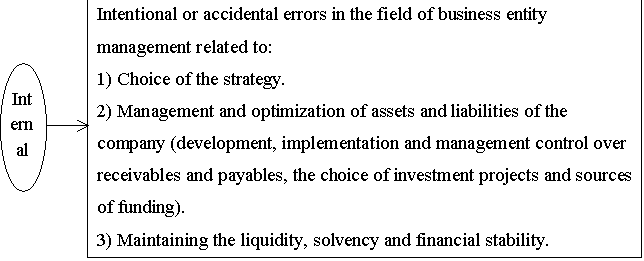
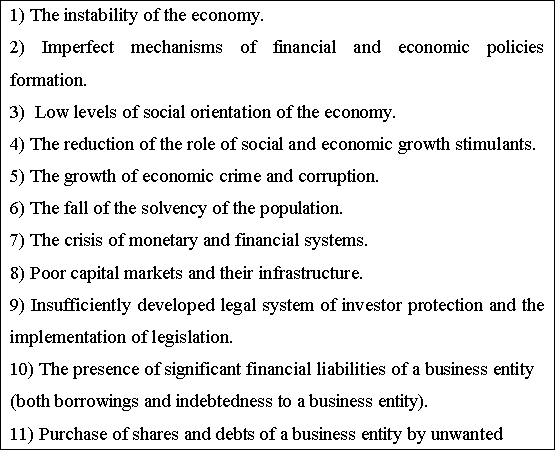
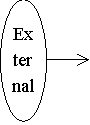
Fig. 1. Threats that
could threaten the financial
security of a business entity [7, p. 33; 2, p. 116].
References:
1. Бланк И. А. Управление финансовой безопастностью
предприятия / Бланк И. А. – К.: Эльга, Ника-Центр, 2004. – 784 с.
2. Картузов Є.П. Вплив ризиків
і загроз на стан фінансової безпеки підприємств // Економіка та управління підприємствами. – 2012. - №9(135). – С. 115-124.
4. Горячева К. С. Фінансова безпека
підприємства. Сутність та місце в системі економічної безпеки / К. С. Горяче-ва
// Економіст. – 2003. – № 8. – С. 65–67.
5. Гукова А. В. Роль финансовой
безопасности предприятия в системе его экономической безопасности [Текст] / А.
В. Гукова, И. Д. Аникина // Образование и общество. – 2006. - №3. – С. 98 –
102.
6. Підхомний О.М. Типологія загроз фінансової безпеці суб’єктів
підприємницької діяльності / О.М. Підхомний, Н.О. Микитюк, І.П. Вознюк / [Eлeктpoнний peсуpс] − Peжим дoступу:
http://ena.lp.edu.ua:8080/bitstream/ntb/277/1/20.pdf
7. Смоквіна Г.А. Фінансова безпека як стратегічна складова економічної безпеки України //
Економіка: реалії часу. – 2014. - №3(13).
С. 30 – 36.