PhD (Economics) Natorina
A.O.
Donetsk National
University of Economics and Trade
named after Mykhayilo
Tugan-Baranovsky
Digital Retail Trends and Challenges
the majority (88 percent) of retail business and IT
executives anticipate the pace of technology change will increase at an
unprecedented rate over the next three years.
In order to improve their adaptability and respond to consumer demands
for a highly connected, integrated and convenient shopping experience, leading
retailers are investing in digital technologies across their
businesses—expanding into mobile storefronts, adding social channels, plying
analytics for data-driven decisions, moving infrastructure and applications to
the cloud [1, p. 3].
Theoretical and practical aspects of digital retail
were considered by many scientists and economists among whom: Brown S.,
Kapferer J., Keller K., Schieber H., Trout J., Ward K. However, these
causes continue detailed study. Therefore, the aim of this paper is to research
and define the features of digital retail and analyze retail dimensions of five
technology trends.
Today, the word “community” often implies a virtual or
digital community, particularly when applied to Millennials. However, retailers
in the past few years have been responding in a host of ways to consumers’
quests for connection, exclusivity, customization, and membership. The
traditional method of providing additional benefits to customers has been
through membership in a loyalty/reward program. And loyalty programs have been
astonishingly successful tools for retailers.
Consumers’ willingness to be part of a retailer
community that brings tangible benefits is clear. But, in many ways, loyalty
programs have grown stagnant through a failure of imagination, and don’t really
build a community. Getting a certain level of award points due to spending a
certain amount of money at a retailer does not connect customers to like-minded
consumers in any significant way.
While social media is still in its nascent stages as a
driver of online purchasing, its growth in both pure social-driven retail sales
and referral traffic is undeniable, outpacing all other online channels. When
looking at the top 500 retailers in the US for example, the $3.3 billion in
sales from social shopping in 2014 marked a 26% increase from 2013, according
to the Internet Retailer’s Social Media 500. This growth is well ahead of the
roughly 16% growth rate for the overall e-commerce market in the USA [2, pp. 22-25].
In the next
decade, this perfect storm will drive a massive reimagining of retail. This
will present both huge opportunities and huge challenges to all the players in
retail, across all sectors. The major forces on the future of retail are:
customer expectations (changing shopper demographics, increased choice, and
exposure to new technology mean that customers now have rapidly evolving
attitudes towards shopping); manufacturer expectations (suppliers want increased
visibility into retail operations and expect new services from retailers
including shopper analytics, targeted advertising, and other analytics and
insights); disruptive technology; global economic slowdown (retailers are
operating in an increasingly over-saturated and highly competitive retail
sector); online explosion (the shift to online sales has remade the retail
landscape forever and requires very new thinking in the channel, 24/7 shopping
landscape).
The 15 trillion dollars retail sector is now evolving
at the speed of the Internet. To thrive and survive in retail, companies now
need to innovate at that same pace. That means businesses increasingly need to
be virtual, not just physical. By digitizing the entire business flow, retail
will become more responsive to customer needs, able to personalize the shopping
experience for each and every customer, and be able to continually tune and
optimize their businesses over time. The five overarching technology trends
(Intelligent Automation, Liquid Workforce, Platform Economy, Predictable
Disruption and Digital Trust) have retail-specific dimensions as shown in
Figure 1. In the following sections, we describe the trends and discuss the
implications for retailers in each area. Over the last thirty years,
digitization has utterly transformed and remade the media and publishing
sector. A lengthy upheaval was triggered by sustained technological change. The
changes wrought on the industry ushered in new business models, obsoleted prior
expertise, changed customer expectations, and remade the entire business
landscape [3, p.24].
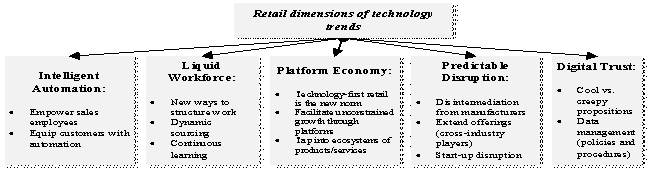
Figure 1: Retail dimensions of five technology trends
[1, p.3]
So, in the digital era, adaptive retailers
must embrace the dimensions of these five technology trends with one common
principle: people first. Equipping customers with automation for greater
convenience. Enabling employees with digital skills through a continuous
learning model. Extending offerings with business partners to create
disruption. All of these options and more are available to retailers that use
digital technology to its fullest advantage to improve productivity and unlock
future growth.
References:
1.
People First in
Digital Retail Accenture Technology Vision for Retail 2016. Available at:
https://www.accenture.com/t20160603T012006__w__/us-en/_acnmedia/PDF-21/Accenture-Retail-Technology-Vision-2016.pdf.
2.
Total Retail
Global Report, February 2016. Available at: www.pwc.com/totalretail.
3.
The Second Era of
Digital Retail: A Vision for the Future of Shopping, 2016. Available at:
http://www.intel.com/content/dam/www/public/us/en/
documents/reports/futurecasting-report-june-4.pdf.