ENERGY PRINCIPLES OF
STABLE BIO-STRUCTURE FORMATION
G.А. Korablev*, V.I. Kodolov**, G.E. Zaikov***
*Izhevsk State Agricultural Academy
**Basic Research-Educational Center of Chemical Physics and Mesoscopy,
UdSC, UrD, RAS
**Institute of Biochemical Physics, RAS
ABSTRACT
The notion of spatial-energy
parameter (P-parameter), which is a complex characteristic of important atomic
values, is used to evaluate energy criteria of stable bio-structure formation.
The rationality of applying such methodology when investigating the formation
process of some nanosystems, conformation of polypeptide chains and fragments
of DNA molecules is demonstrated. The principles of biosystem formation and
stabilization have definite analogy with the conditions of wave processes. The
results obtained do not contradict the experimental data.
Keywords: spatial-energy parameter, nanosystems, conformation, biosystems, DNA
molecules.
Introduction
To
obtain the dependence between energy parameters of free atoms and dynamics of
structural formations in simple and complex systems is one of strategic tasks
in physical chemistry. Classical
physics and quantum mechanics widely use Coulomb interactions and their
varieties for this.
Thus
in [6] Van der Waals, orientation and charge-dipole interactions are referred
to electron-conformation interactions in biosystems. And as a particular case –
exchange-resonance transfer of energy. But biological and many cluster systems
are electroneutral in structural basis. And non-Coulomb equilibrium-exchange
spatial-energy interactions, i.e. non-charge electrostatic processes, are
mainly important for them.
The structural interactions of summed electron
densities of valence orbitals of corresponding conformation centers take place
– processes of equilibrium flow of electron densities due to overlapping of
their wave functions.
Heisenberg and Dirac
[10] proposed the exchange Hamiltonian derived in the assumption on direct
overlapping of wave functions of interacting centers. In this model
electrostatic interactions are modeled by effective exchange Hamiltonian acting
in the space of spin functions.
In
particular, such approach is applied to the analysis of structural interactions
in cluster systems [7]. It is demonstrated in Anderson’s works [9] that in
compounds of transition elements when the distance between paramagnetic ions
considerably exceeds the total of their covalent radii, “superexchange”
processes of overlapping cation orbitals take place through the anion between
them.
In
this work similar equilibrium-exchange processes are evaluated through the
notion of spatial-energy parameter – Р-parameter.
1.
Initial criteria
In the systems in
which the interaction proceeds along the potential gradient (positive work),
the resultant potential energy is found based on the principle of adding
reciprocals of corresponding energies of subsystems [2].
Thus
the energy of atom valence orbitals (responsible for interatomic interactions)
can be calculated by the principle of adding reciprocals of some initial energy
components based on the following equations:
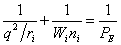 or
or 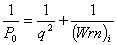 ;
;  (1),(2),(3)
Here: Wi – electron orbital energy [14]; ri – orbital radius of i–orbital [13];
q=Z*/n* [11,12], ni –
number of electrons of the given orbital, Z*
and n* – nucleus effective charge
and effective main quantum number, r – bond dimensional characteristics.
Р0 is called a spatial-energy parameter (SEP), and РE – effective Р–parameter (effective SEP). Effective SEP has a physical sense of some
averaged energy of valence electrons in the atom and is measured in energy
units, e.g. electron-volts (eV).
Calculation results by the equations (1,2,3) are given in Table 1.
Table 1
Р-parameters of atoms calculated via the electron bond
energy
|
Atom |
Valence
electrons |
W (eV) |
ri (Å) |
q2 0 (eVÅ) |
Р0 (eVÅ) |
R (Å) |
Р0/R (eV) |
|
H |
1S1 |
13.595 |
0.5292 |
14.394 |
4.7969 |
0.5292 0.375 0.28 |
9.0644 12.792 17.132 |
|
С |
2P1 2P2 2P3г 2S1 2S2 2S1+2P3г 2S1+2P1г 2S2+2P2 |
11.792 11.792 19.201 |
0.596 0.596 0.620 |
35.395 35.395 37.240 |
5.8680 10.061 13.213 9.0209 14.524 22.234 13.425 24.585 24.585 |
0.77 0.67 0.60 0.77 0.67 0.60 0.77 0.77 0.77 0.77 0.77 0.77 0.67 0.60 |
7.6208 8.7582 9.780 13.066 15.016 16.769 17.160 11.715 18.862 28.875 17.435 31.929 36.694 40.975 |
|
N |
2P1 2P2 2P3 2S2 2S2+2P3 |
15.445 25.724 |
0.4875 0.521 |
52.912 53.283 |
6.5916 11.723 15.830 17.833 33.663 |
0.70 0.55 0.70 0.63 0.70 0.55 0.70 0.70 |
9.4166 11.985 16.747 18.608 22.614 28.782 25.476 48.090 |
|
O |
2P1 2P1 2P2 2P4 2S2 2S2+2P4 |
17.195 17.195 17.195 33.859 |
0.4135 0.4135 0.4135 0.450 |
71.383 71.383 71.383 72.620 |
6.4663 11.858 20.338 21.466 41.804 |
0.66 0.55 0.66 0.59 0.66 0.59 0.66 0.66 0.59 |
9.7979 11.757 17.967 20.048 30.815 34.471 32.524 63.339 70.854 |
In
the systems in which the interactions proceed against the potential gradient
(negative performance) the algebraic addition of their masses as well as the
corresponding energies of subsystems is performed [2]. Thus, for the
interaction of similarly charged (homogeneous) subsystems the principle of
algebraic addition of their P-parameters is performed:
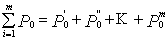 (4)
(4)  (5)
(5)
where
R – dimensional characteristic of atom (or chemical bond).
Modifying the rules of adding the reciprocals of the
energy magnitudes of sub-systems as applicable to complex structures, we can
obtain the equations to calculate a РС-parameter
of a complex structure:
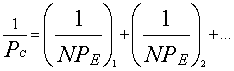 (6)
(6)
where N1 and N2
– number of homogeneous atoms in sub-systems.
The calculation results in
this equation for some atoms and radicals of biosystems are given in Table 2.
The
value of the relative difference of P-parameters of interacting
atoms-components – the structural interaction coefficient α is used as the
main numerical characteristic of structural interactions in condensed media:
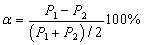 (7)
(7)
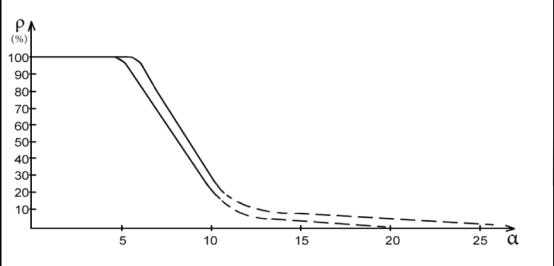 Applying the reliable experimental data we obtain the nomogram of
structural interaction degree dependence (ρ) on coefficient α, the
same for a wide range of structures (Fig.1). This approach gives the
possibility to evaluate the degree and direction of the structural interactions
of phase formation, isomorphism and solubility processes in multiple systems,
including molecular ones.
Applying the reliable experimental data we obtain the nomogram of
structural interaction degree dependence (ρ) on coefficient α, the
same for a wide range of structures (Fig.1). This approach gives the
possibility to evaluate the degree and direction of the structural interactions
of phase formation, isomorphism and solubility processes in multiple systems,
including molecular ones.
Fig. 1
Nomogram of structural interaction degree dependence (ρ) on
coefficient α
Table
2
Structural
РС-parameters calculated via electron bond energy
|
Radicals, molecule fragments |
|
|
|
Orbitals |
|
ОН |
9.7979 30.815 17.967 |
9.0644 17.132 17.132 |
4.7084 11.011 8.7710 |
O
(2P1) O
(2P4) O
(2P2) |
|
Н2О |
2·9.0644 2·17.132 |
17.967 17.967 |
9.0237 11.786 |
O
(2P2) O
(2P2) |
|
СН2 |
17.160 31.929 36.694 |
2·9.0644 2·17.132 2·9.0644 |
8.8156 16.528 12.134 |
С (2S12P3г) С (2S22P2) С (2S12P3г) |
|
СН3 |
31.929 15.016 |
3·17.132 3·9.0644 |
19.694 9.6740 |
С (2S22P2) С (2P2) |
|
СН |
36.694 17.435 |
17.132 17.132 |
11.679 8.6423 |
С (2S22P2) С (2S22P2) |
|
NH |
16.747 19.538 48.090 |
17.132 17.132 17.132 |
8.4687 9.1281 12.632 |
N(2P2) N(2P2) N(2S22P3) |
|
NH2 |
19.538 16.747 28.782 |
2·9.0644 2·17.132 2·17.132 |
9.4036 12.631 18.450 |
N(2P2) N(2P2) N(2P3) |
|
С2Н5 |
2·31.929 |
5·17.132 |
36.585 |
С (2S22P2) |
|
NO |
19.538 28.782 |
17.967 20.048 |
9.3598 11.817 |
N(2P2) N(2P3) |
|
СН2 |
31.929 |
2·9.0644 |
11.563 |
С (2S22P2) |
|
СН3 |
16.769 |
3·17.132 |
12.640 |
С (2P2) |
|
СН3 |
17.160 |
3·17.132 |
12.865 |
С (2P3г) |
|
СО–ОН |
8.4405 |
8.7710 |
4.3013 |
С (2P2) |
|
СО |
31.929 |
20.048 |
12.315 |
С (2S22P2) |
|
С=О |
15.016 |
20.048 |
8.4405 |
С (2P2) |
|
С=О |
31.929 |
34.471 |
16.576 |
О (2P4) |
|
СО=О |
36.694 |
34.471 |
17.775 |
О (2P4) |
|
С–СН3 |
31.929 |
19.694 |
12.181 |
С (2S22P2) |
|
С–СН3 |
17.435 |
19.694 |
9.2479 |
С (2S12P1) |
|
С–NH2 |
31.929 |
18.450 |
11.693 |
С (2S22P2) |
|
С–NH2 |
17.435 |
18.450 |
8.8844 |
С (2S12P1) |
|
С–ОН |
8.7572 |
8.7710 |
4.3821 |
|


2. Formation of carbon
nanostructures
After different
allotropic modifications of carbon nanostructures (fullerenes, tubules) have
been discovered, a lot of papers dedicated to the investigations of such
materials, for instance were published, determined by the perspectives of their
vast application in different fields of material science.
The main
conditions of stability of these structures formulated based on modeling the
compositions of over thirty carbon clusters are given [8]:
1) Stable carbon
clusters look like polyhedrons where each carbon atom is three-coordinated.
2) More stable
carbopolyhedrons containing only 5- and 6-term cycles.
3) 5-term cycles
in polyhedrons – isolated.
Let us
demonstrate some possible explanations of such experimental data based on the
application of spatial-energy concepts. The approximate equality of effective
energies of interacting subsystems is the main condition for the formation of
stable structure in this model [4] based on the following equation:
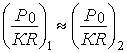 ;
;  (8)
(8)
where К – coordination number, R – bond dimensional characteristic.
At the same time,
the phase-formation stability criterion (coefficient α) is the relative difference of parameters Р1 and Р2 that is calculated following the equation (1) and is αST<(20-25)% (according to the nomogram).
During the interactions of similar
orbitals of homogeneous atoms  we have
 (8а)
(8а)
Let us consider
these initial notions as applicable to certain allotropic carbon modifications:
1. Diamond.
Modification of structure where К1=4, К2=4;  , R1=R2, Р1=Р2 and α=0. This is absolute
bond stability.
, R1=R2, Р1=Р2 and α=0. This is absolute
bond stability.
2. Non-diamond
carbon modification for which  , К1=1; R1=0,77Å; К2=4;
  , α=3,82%.
Absolute stability due to ionic-covalent bond.
, α=3,82%.
Absolute stability due to ionic-covalent bond.
3. Graphite.  , К1=К2=3, R1=R2, α=0 – absolute
bond stability.
, К1=К2=3, R1=R2, α=0 – absolute
bond stability.
4. Chains of
hydrocarbon atoms consisting of the series of homogeneous fragments with
similar values of P-parameters.
5. Cyclic organic
compounds as a basic variant of carbon nanostructures. Apparently, not only
inner-atom hybridization of valence orbitals of carbon atom takes place in
cyclic structures, but also total hybridization of all cycle atoms.
But not only the
distance between the nearest similar atoms by bond length (d) is the basic
dimensional characteristic, but also the distance to geometric center of cycle
interacting atoms (D) as the geometric center of total electron density of all
hybridized cycle atoms.
Then the basic
stabilization equation for each cycle atom will take into account the average
energy of hybridized cycle atoms:
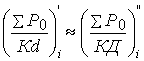 ;
;  (9) (9а)
where ΣР0=Р0N; N – number of homogeneous atoms, Р0 – parameter of one cycle atom, К – coordination number relatively to geometric center of cycle atoms.
Since in these cases К =K
=K and N
and N =N
=N , К=N, the following simple correlation for paired bond appears:
 ;
;  (10)
(10)
During the
interactions of similar orbitals of homogeneous atoms  , and then:
 (11)
(11)
Equation (10)
reflects a simple regularity of stabilization of cyclic structures:
The
main condition of formation and stability of structures is an approximate
equality of effective interaction energies of atoms along all directions of
interatomic bond.
The corresponding
geometric comparison of cyclic structures consisting of 3, 4, 5 and 6 atoms
results in the conclusion that only in 6-term cycle (hexagon) the bond length
(d) equals the length to geometric center of atoms (D): d=D.
Such calculation
of α following the equation (7), gives for hexagon α=0 and absolute
bond stability. And for pentagon d≈1.17D and the value of α=16%,
i.e. this is the relative stability of the structure being formed. For the
other cases α>25%, therefore many biosystems such as, for example,
nucleic acids, contain only 5- and 6-term cyclic fragments.
The calculations
and comparisons performed based on spatial-energy concepts allow explaining
some formation peculiarities of hexagonal structures in biosystems.
3. Formation of polypeptide chain
Main
components of organic compounds constituting 98 % of cell element composition:
carbon, oxygen, hydrogen and nitrogen. The polypeptide bond formed by COOH and
NH2 groups of amino acid CONH is the binding base of protein
biopolymers of a cell. At the same time, carbon atoms are more frequently found
in polypeptide chain nodes, and sometimes – nitrogen atoms.
Fragments of polypeptide chain
nodes are formed of CH, OH, CO, NH, NH2, CO-OH atom groups and some
radicals. In accordance with conformation energy criteria of such chain, the
approximate equality of their РE-parameters needs
to be followed, both separately for all fragments and chain atomic nodes. The
calculations of possible variants are given in Table 2. Its analysis results in
the conclusion of the existence possibility of three series of such relations.
Their summarized data are given in Table 3. Such cyclicity of functional
correlations can be evaluated from the point of quantum-wave properties of
P-parameter [5].
The
interference minimum, oscillation weakening
(in anti-phase) takes place if the difference in wave move (∆) equals the
odd number of semi-waves:
∆ = (2n +1) = l(n
+
= l(n
+  ), where n = 0, 1, 2,
3, … (12)
), where n = 0, 1, 2,
3, … (12)
It means that the minimum of interactions take place
if P-parameters of interacting structures are also “in anti-phase” – either
oppositely charged systems or heterogeneous atoms are interacting (e.g. during
the formation of valence-active radicals CH, CH2, CH3, NO2
…, etc.).
In
this case, P-parameters are summed up based on the principle of adding the
reciprocals of P-parameters – equations (1-3).
The difference in wave move (∆) for Р-parameters can be evaluated
via their relative value (g= ) or via
relative difference of Р-parameters (coefficient a), which give an odd number at minimum of
interactions:
) or via
relative difference of Р-parameters (coefficient a), which give an odd number at minimum of
interactions:
g=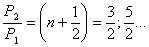 … At n=0
(basic state)
… At n=0
(basic state)  (12а)
(12а)
Interference maximum,
oscillation enhancing (in phase) takes place if the difference in wave move equals
an even number of semi-waves:
∆=2n =ln
or ∆=l(n+1) (13)
=ln
or ∆=l(n+1) (13)
As applicable to P-parameters, the maximum enhance of
interaction in the phase corresponds to the interactions of similarly charged
systems or systems homogeneous by their properties and functions (e.g. between
the fragments or blocks of complex organic structures, such as CH2
and NNO2).
Then: g= =(n+1) (13а)
By this model, the maximum of
interactions corresponds to the principle of algebraic addition of P-parameters
– equations (4,5). When n=0 (basic state), we have Р2=Р1, or: the maximum
of structure interaction occurs if their P-parameters are equal. This postulate
and equation (13а) are used as basic conditions
for the formation of stable structures [4].


