PhD in Economics Lymar V.V.
Nizhyn Agro-technical Institute, National University of Life and
Environmental Sciences of Ukraine, Ukraine
Germany bioeconomy strategy vision
Global
food security, renewable raw materials and energy from biomass, the
conservation of biological diversity, climate- and environmental protection,
and Germany’s competitiveness are some of the major challenges facing this
country at the beginning of this century. Meeting these challenges will require
not only great social, economic and political effort, but also intense research
efforts and new approaches to research and innovation.
This
is the endeavor of the Federal Government’s new research strategy, which has
been created to expand the groundwork for the further development of a
knowledge-based and internationally competitive bioeconomy. The National
Research Strategy BioEconomy 2030 is a component of the High-Tech Strategy and
provides vital impetus for the demand areas energy/climate and health/
nutrition, among others.
With
the National Research Strategy BioEconomy 2030, the Federal Government is
establishing the conditions for the vision of a sustainable bio-based economy
by 2030. This carries the promise of global food supplies that are both
sufficient and healthy, and of high quality products from renewable raw
materials. This vision derives from the development of a free, dynamic, and
innovative knowledge-based society. Therein, results from the life- and technological
sciences will be accommodated with open-mindedness and curiosity, and (bio)
technological progress and globalisation regarded as decisive opportunities.
The central objective is the optimal utilisation of the chances created by the
knowledge-based bioeconomy, and to translate these into enduring economic
growth.
The
concept of the bioeconomy covers the agricultural economy and all manufacturing
sectors and associated service areas that develop, produce, process, handle, or
utilise any form of biological resources, such as plants, animals, and
microorganisms. This spans numerous sectors, such as agriculture, forestry,
horticulture, fisheries and aquaculture, plant and animal breeding, the food
and beverage industries, as well as the wood, paper, leather, textile,
chemicals and pharmaceutical industries, and aspects of the energy sector.
Bio-based innovations also provide growth impetus for other traditional
sectors, such as in the commodity and food trade, the IT sector, machinery and
plant engineering, the automotive industry, environ-mental technology,
construction, and many service industries.
The
research strategy lays out five priority fields of action for further
development towards a knowledge-based, internationally competitive bioeconomy.
These are: global food security, sustainable agricultural production, healthy
and safe foods, the industrial application of renewable resources, and the
development of biomass-based energy carriers. Thereby, food security always
takes the highest priority. Holistic approaches are essential to resolve
conflicting aims between these fields of action, to give equal consideration to
environmental, economic and social issues, and for these to be integrated in
terms of sustainable solutions.
Serving
as guidelines in the implementation of the research strategy are thus the
sustainable provision of foods, renewable raw materials, products and energy,
the identification of all biomass-based paths of application, as well as the
consideration of entire value creation chains.
The
National Research Strategy BioEconomy 2030 identifies the measures that are
required for each of these fields of action. These measures also serve to build
on current strengths in science and industry, and to compensate for weaknesses
and remove obstacles to innovation. Here, it will be crucial to attain
interdisciplinary competencies, to accelerate the transfer of technology, to
expand international cooperation, and to intensify the dialogue with the
public. The National Research Strategy BioEconomy 2030 (Fig. 1) relies on
scientists’ ingenuity, innovation, and individual initiative, and aims to
provide support to these ends with targeted funding. The research strategy
defines priority areas for the coming years, and adaptations to current developments,
in the sense of a learning programme, will also be incorporated over the
duration of the strategy.
Cross-section activities: Developing interdisciplinary competencies,
exploiting international cooperation, transferring transfer into practice
and intensifying dialog with society
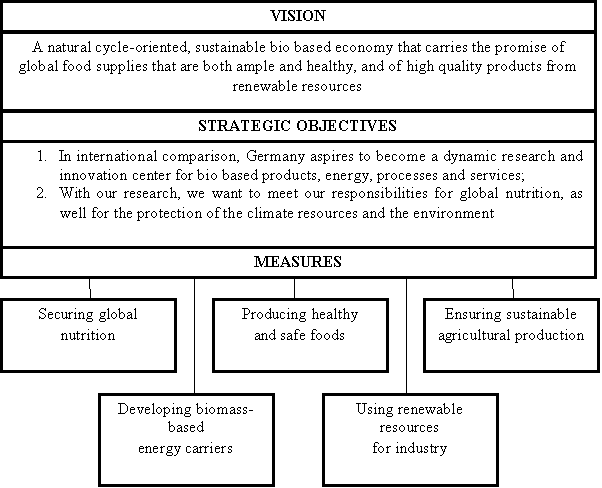
Fig. 1. The vision of the National Research Strategy
Bioeconomy 2030*
*made by the
author
The National
Research Strategy BioEconomy 2030 lays the groundwork for the development of a
knowledge-based and internationally competitive bioeconomy. On the basis of
this vision, priority fields of action will be determined to promote research
and innovation, and corresponding objectives and measures derived.
Adaptations to
current developments, in the terms of a learning programme, will also be
incorporated over the duration of the strategy. As a
result of the long-term lead character of research and innovation, the National
Research Strategy BioEconomy 2030 represents the first and necessary step for a
broad establishment of the bioeconomy in Germany. The opening up of future
markets and the opportunities for society of a bioeconomy are the duties of all
policy areas that help shape the conditions for the innovation behaviour of the
economy and society. In accordance with the High-Tech Strategy, research
promotion in the area of the bioeconomy calls for innovation-friendly framework
conditions.
References:
1. EC, (2012). Communication on Innovating for Sustainable Growth: A Bioeconomy for Europe. COM (2012) 60 final. Brussels, Belgium, European Commission.
2. Hall T. European Bioeconomy: strategy and action plan, 2015, European Commission,
Brussels.
3. EC (2015). Boosting the EU
Bioeconomy. Brussels, Belgium,
European Commission.
4. Systems Analysis Tools Framework for the EU Bio-Based Economy Strategy: Report on the overview of the systems analysis of the bio-based economy (D1.4), 14 (November 2013). Retrieved June 4, 2015, from http://www.wageningenur.nl/.
5. En Route to the Knowledge-Based Bio-Economy (2007). Retrieved September
10, 2015, from http://www.bio-economy.net/reports/files/koln_paper.pdf.