Mathematics /4. Applied Mathematics
Dr. Sci. (Phys.-Math), Prof. Alekhina M.A.,
Cand. Sci. (Phys.-Math), Docent Moiseev A.V.
Penza State Technological University,
The recurrent
formula for unreliability of circuits
in the Rosser-Turkett
basis (in  )
)
Let  ,
,  , and let
  be the set of all k-valued logic functions, i.e. functions
of the type
be the set of all k-valued logic functions, i.e. functions
of the type  . Consider the realization of functions of the set
  by circuits of unreliable
functional elements in the basis Rosser-Turkett
by circuits of unreliable
functional elements in the basis Rosser-Turkett
 (also denote
  and
and  by
by  and Ú respectively [1]).
We assume,
that the circuit of unreliable elements realizes the function  , if in the absence of faults in it for each input set
  the output value is equal
  .
.
Let the
circuit  realizes the function
  , and let
  be an arbitrary input set of
the circuit
be an arbitrary input set of
the circuit  , and
, and  . Denote by
  the probability of the value
 at the output of the circuit
 on the input set
  , and denote by
  the fault probability at the
output of the circuit
the fault probability at the
output of the circuit  on the input set
  . Obviously,
  . (In expressions
  ,
,  ,...,
,...,  the addition is performed
  .)
.)
For example,
if the input set  of the circuit
  is such that
 , then the fault probability on
this set is
, then the fault probability on
this set is


The unreliability of the circuit  , realizing the function
  , is called a number
  equal to the maximum fault
probability at the output of the circuit
equal to the maximum fault
probability at the output of the circuit  . The reliability of the
circuit
. The reliability of the
circuit  is
is  .
.
Elements
of the circuit are supposed to be prone independently of each other inverse
faults at the outputs with a probability
 , i.e. each basic element with his assigned function
 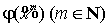 on any input set
  such, that
  , gives a value
  ,
, 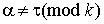 with a probability
  . That’s why the fault probability at the output of every basic element
is
. That’s why the fault probability at the output of every basic element
is  . Obviously, the unreliability of any basic element is also equal
  , and his reliability is
  .
.
Let  be a function of
  , and let
  be an arbitrary circuit, realizing
the function
be an arbitrary circuit, realizing
the function  . Using
  we construct a new circuit, which
will be used to improve the reliability of
the original circuit
we construct a new circuit, which
will be used to improve the reliability of
the original circuit  . For this we take two copies of the circuit
  and connect their outputs
with inputs of the basic element, realizing
and connect their outputs
with inputs of the basic element, realizing  . The resulting circuit will
be called a circuit
. The resulting circuit will
be called a circuit  . Further we take two copies of the circuit
  and connect their outputs with inputs of the
basic element, realizing Ú. Denote the
resulting circuit by
and connect their outputs with inputs of the
basic element, realizing Ú. Denote the
resulting circuit by  . It’s easy to check, that the circuit
 realizes the same function
  .
.
A recurrence relation for the unreliability
of circuits  and
and  is found in Theorem 1.
Theorem 1. Let  be an arbitrary function of
  ,
,  be any circuit, realizing
  , and
, and  be the unreliability of the
circuit
be the unreliability of the
circuit  . Then the circuit
  realizes the function
  with the unreliability
  , satisfying the inequality:
 .
.
Proof. Let  be an arbitrary function. Without loss of generality we can assume that the
function
be an arbitrary function. Without loss of generality we can assume that the
function  depends on
variables
depends on
variables  . Let
. Let  be any circuit, realizing
  , and
, and  be an arbitrary set,
  . Denote by
  a fault probability
  at the output of the circuit
 (i.e.
(i.e. 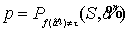 ) and define a fault probability at the output of the circuit
  on the same set, given that the unreliability of the subcircuit of three elements (two conjunctors
and one disjunctor) no more than
on the same set, given that the unreliability of the subcircuit of three elements (two conjunctors
and one disjunctor) no more than  ,
,

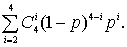
Previously [2], it was proved inequality: 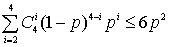 .
.
Then  . Hence,

Theorem 1 is proved.
Thus, the
recurrent formula for the unreliability of original and constructed circuits is
found in the Rosser-Turkett basis for all  . Earlier, similar formulas
are known
only for k equal 3 [3] and 4 [2]. In
the case
. Earlier, similar formulas
are known
only for k equal 3 [3] and 4 [2]. In
the case  this formula is precisely
proposed formula, but the proof of the
corresponding theorem is more
cumbersome.
this formula is precisely
proposed formula, but the proof of the
corresponding theorem is more
cumbersome.
This work was supported by the Russian
Foundation for Basic Research (project number 14-01-00273).
References
[1]
S. V. Jablonski: Introduction to Discrete Mathematics, A textbook for higher
education, ed. V. A.
Sadovnichii, Moscow (in Russia), 2001.
[2]
M. A. Alekhina, S. P. Kargin: Asymptotically optimal reliable circuits
in the Rosser-Turkett basis in P4,
University
proceedings. Volga region. Physical and mathematical sciences. 2015. N 1. P. 38–54.
[3]
M. A. Alekhina, O. Yu. Barsukova: Estimates of
unreliability of circuits in the Rosser-Turkett basis, University proceedings. Volga region.
Physical and mathematical sciences. 2014. N 1. P. 5–19.