Филологические науки/
4.Синтаксис: структура, семантика, функция
Shumovska Roksolana
Lviv National Polytechnic University, Ukraine
Zoomorphic metaphors in Galicia journalistic texts of the first half of XXth
century
The topicality of the theme is determined by the
necessity of Ukrainian-language sources of the twentieth century, published in
Galicia, linguistic study, which has not become the subject of linguists’
attention yet, as well as the need to describe metaphorical way of reality
apprehension in the early XXth century.
The object of research are lexical metaphors used in journalistic texts of the Young Life newspaper (1922-1958). [5]
The subject of research are metaphors semantics.
Metaphor is the most
productive creative means of enriching the language, the expression of language
economy, semiotic pattern that appears to use the same conceptual sphere of
signs to indicate the other that is often likened to it in some ways. [6]
A metaphor is described as having two parts:
the tenor and the vehicle in The Philosophy of Rhetoric by I. A.
Richards. The tenor is the subject to
which attributes are ascribed and the vehicle is the object whose attributes
are borrowed. [3]
From Aristotle through speech act theories, metaphor
had been viewed as a secondary type of language, built on literal speech which is,
in turn, the true nature of language. Aristotle has described the metaphor as a
figure of speech, stylistic device based on comparison and transfer of meaning
that led to its identification with hyperbole and metonymy. Only logical and
clear metaphor that correctly identifies the conceptual complexes was nice for
the philosopher. However, since the 1970s, cognitive scientists have become
increasingly convinced that metaphor is not only central to thought, but that
it is also a central aspect of language, and no less priveleged than literal
language.
Cognitive linguists emphasize that metaphors serve to facilitate the understanding of
one conceptual domain. Lakoff and Johnson greatly contributed to establishing
the importance of conceptual metaphor as a framework for thinking in language.
In recent years many scholars have investigated the original ways in which
writers use novel metaphors and question the fundamental frameworks of thinking
implicit in conceptual metaphors.
In cognitive linguistics, conceptual metaphor, or cognitive metaphor, refers to the
understanding of one idea, or conceptual domain,
in terms of another.
Conceptual metaphors are seen in language in our
everyday lives. Conceptual metaphors shape not just our communication, but also
shape the way we think and act. In George Lakoff and Mark Johnson’s work, Metaphors
We Live By, [1] it is visible how everyday language is filled with
metaphors we may not always notice.
A conceptual metaphor uses one idea and links it to
another to better understand something. For example, the conceptual metaphor of
viewing communication as a conduit is one large theory explained with a metaphor.
Lakoff's work, Women, Fire, and Dangerous Things, explores the effects of cognitive
metaphors (both culturally specific and human-universal) on the grammar per se
of several languages, and the evidence of the limitations of the classical
logical-positivist or Anglo-American School philosophical concept of the category usually used to explain or
describe the scientific method. [2]
During our research all metaphors, 4,223 units
totally, were selected from the created newspaper corpus and analyzed by such
metaphorization directions as anthropomorphic, zoomorphic, mythomorphic,
subjectomorphic, naturemorphic, floromorphic and objectomorphic. Here is the
result of analysis:
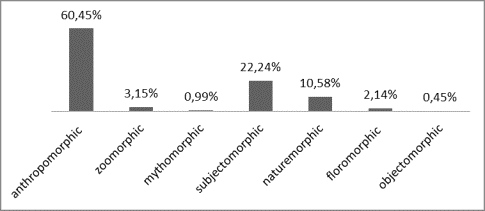
Diagram 1. Metaphorization directions in the
journalistic texts
All metaphors that have zoomorphic direction of
metaphorization have been classified by such donor areas as Physical actions;
Physiological status, processes and animals actions; Parts of
animals’ body and Group of animals. The following results were
received:
Table 1
The most frequent donor areas
|
Donor areas |
|
|
Physical actions |
57,02% |
|
Physiological status,
processes and animals actions |
17,54% |
|
Parts of animals’ body |
19,30% |
|
Group of animals |
6,14% |
Frame Physical actions includes such metaphors
as летять і крутяться метелики снігу, діти на крилах
любови й віри злітають високо, реве дивна музика вихру. The examples of Physiological status, processes and animals actions are: зір стане соколиним, скажену спеку, шкідники ідеї. Such metaphors as мати львине серце в
грудях, попадатись у "лапи" червоних, в хвості Европи belong to Parts of animals’ body. And
the Group of animals donor area consists of the metaphors like: рій новаків, роєм кружляють вони в моїй голові.
Then the metaphors of zoomorphic direction were
classified by such recipient areas as Person, Inanimate
Nature, Item. After the
classification we received the following results:
Table 2
The most frequent recipient areas
|
Recipient areas |
|
|
Person |
47,32% |
|
21,43% |
|
|
Item |
31,25% |
Frame Person: летів на білому коні якийсь казковий лицар, рій новачок, дивимось очима
сов, попадатись у "лапи" червоних, мати львине серце в грудях,
злітаються берегівці, мукачівці, пражани, прилинула мені гадка, влітаю слідом.
Frame Inanimate nature: дерево в порох розлітається, ріка завзято скакала на твердий беріг та з
ревом відскакувала назад, гадюкою вється плай, ніч розпостерла свої чорні крила, заревли раптом громи, пісок летить, табун
хмар.
Frame Item: куля сама летить, літали томагавки, клекотіли стріли, ревіли гармати,
книжки кружляють, ґранати падали довкола з несамовитим ревом, в хвості Европи, дзьоб корабля.
As we can see the most
frequent recipient area is Person and it was decided to divide this area into
four groups: Child, Man, Woman and Person in general for checking the gender
aspect among zoomorphic metaphors. The following results were received:
Table 3
Groups of the Person recipient
area
|
Group |
|
|
Child |
2% |
|
Man |
28% |
|
Woman |
6% |
|
Person in general |
64% |
Frame Child includes just one metaphor: діти на крилах любови й віри злітають високо. There are such metaphors that
are related to the frame Man: рій новаків, попадатись
у "лапи" червоних, вовком глядів, летів на білому коні якийсь
казковий лицар. The examples of metaphors that are related to frame
Woman are рій новачок роєм кружляють вони в моїй голові,
стягнула по котячому широкий хребет, полохливої клячі. And the most frequent frame
Person has such metaphors as летіли ми, думки, які
мов жуки, лізли до лоба, летючі скавти, мати львине серце в грудях.
To sum up, within this work it was found that a
significant portion of all selected from the journalistic texts metaphors
belong to the zoomorphic direction of metaphoriztion. The most frequent donor
area is Physical actions of animals and the most frequent recipient area is
Person. This result indicates that anthropocentrism prevails, i.e. human beings are the central or most significant species on
the planet. Metaphors related to the group Person are the most frequent and it
shows us that the person in general, without paying attention on gender aspect,
takes center stage for the Plast national organization that published Young Life newspaper in the first
half of the XXth century.
References:
1. Lakoff G. Metaphors we live by /
Lakoff G,. Johnson M. — Chicago: University of Chicago Press,
1980.
2. Lakoff G. Women, Fire and Dangerous Things. – Chicago: University of
Chicago Press, 1987.
3. Richards I.A. The Philosophy of
Rhetoric. – Oxford: Oxford University Press, 1936.
4. Арутюнова Н.Д. Метафора и дискурс /
Н.Д. Арутюнова // Теория метафоры. — М., 1990. — С. 5–18.
5. Журнал українського Пласту "Молоде життя"
за 1922–1958 рр. [Електронний ресурс] — Режим доступу: http://avr.org.ua
6. Селіванова О. О. Лінгвістична енциклопедія / О.О. Селіванова. —Полтава: Довкілля-К, 2010. — 844 с.