Student
Myshko V., Ph.D. Kovalenko M.
National Technical University of Ukraine «Kyiv
Polytechnic Institute», Ukraine
MATHEMATICAL MODELING OF ELECTROMAGNETIG FIELDS OF THE ELECTRICAL
MACHINES
There are several ways
to compute electromagnetic forces. In the most general case, the calculation of
electromagnetic forces involves the computation of volume forces acting on a
body, and of surface forces originating from jumps in the electromagnetic fields
on the boundaries. The volume and surface forces are derived from a general
stress tensor that includes electromagnetic terms.
Calculating forces in moving objects is important,
especially for electric motors and other moving electromagnetic devices. When
performing the computations in a coordinate system that moves with the object,
the electromagnetic fields are transformed. The most well-known relation for
moving objects is the one for the electric field. The transformed quantity of
the electric field is called the electromotive intensity.
Assume that the object modeled is moving with a
constant velocity,  . The equations now take on a slightly different form that
includes the Galilei invariant versions of the electromagnetic fields. The term
Galilei invariant is used due to the fact that they remain unchanged after a
coordinate transformation of the type:
. The equations now take on a slightly different form that
includes the Galilei invariant versions of the electromagnetic fields. The term
Galilei invariant is used due to the fact that they remain unchanged after a
coordinate transformation of the type:
 (1)
(1)
In continuum mechanics, this transformation is
commonly referred to as a Galilei transformation.
The Galilei invariant fields of interest are [1]:
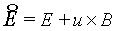 (Electromotive
intensity)
(2)
(Electromotive
intensity)
(2)
 (Free conduction
current density) (3)
(Free conduction
current density) (3)
 (Lorentz
magnetization) (4)
(Lorentz
magnetization) (4)
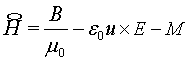 (Magnetomotive
intensity) (5)
(Magnetomotive
intensity) (5)
The electromotive intensity is the most important of
these invariants. The Lorentz magnetization is significant only in materials
for which neither the magnetization M nor the polarization P is negligible.
Such materials are rare in practical applications. The same holds for the
magnetization term of the magnetomotive intensity. Notice that the term  is very small compared to
  except for cases when
 and E are both very
large. Thus in many practical cases this term can be neglected.
and E are both very
large. Thus in many practical cases this term can be neglected.
The stress tensor in the surrounding air or vacuum on
the outside of a moving object is [2]:
 (6)
(6)
There is an additional term in this expression
compared to the stationary case.
The stress tensor in a moving elastic pure conductor
is:
 ,
,
where  and
and  . (7)
. (7)
To get the equation for the balance of forces the
divergence of this expression needs to be computed. This requires an
introduction of an extra term in Cauchy’s equation corresponding to an
additional electromagnetic contribution to the linear momentum. Cauchy’s
equation with this extra term is [2]:
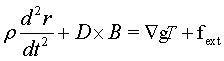 (8)
(8)
The extra term is canceled out by the additional term
in the stress tensor, and the final result is:
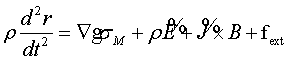 (9)
(9)
For the case of no acceleration, with the explicit
appearance of the transformed quantities:
 (10)
(10)
The terms containing  cancel out, which yields the following equation:
 (11)
(11)
which is the same expression as for the stationary case.
The stress tensor for a moving general elastic
material is [3]:

 (12)
(12)
The magnetization M and the polarization P occur
explicitly in this expression. To instantiate the stress tensor for the general
elastic case a material model explicitly including the magnetization and
polarization effects is needed.
Thus, this method allows to сalculating forces in
moving objects, especially in electric motors and other moving electromagnetic
devices.
References:
1. A. Kovetz, The Principles of Electromagnetic
Theory, Cambridge University Press, 1990.
2. O. Wilson, Introduction to Theory and Design of
Sonar Transducers, Peninsula Publishing, 1988.
3. D.K. Cheng, Field and Wave Electromagnetics, 2nd
ed., Addison-Wesley, 1991.