Student
Nechay V., Ph.D. Kovalenko M.
National Technical University of Ukraine «Kyiv
Polytechnic Institute», Ukraine
CALCULATION
OF THE ELECTROMAGNETIC ENERGY
Electromagnetic energy is a form of energy
contained in an electromagnetic field. Also included are special cases of a
pure electric field and the net magnetic field. In many cases, the electric and
magnetic energy are closely related to each other, each of them can be
considered as "downside" of another one. This energy is the
mechanical work done by moving charges and conductors in electrical and
magnetic fields.
The electric and magnetic energies are
defined as [1]:
 (1)
(1)
 (2)
(2)
Electrical
energy is one of the most important form of energy. Electricity in its final
form can be transmitted over a long distances to the consumer.
The time derivatives of these expressions are the
electric and magnetic power [1]:
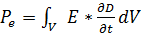 (3)
(3)
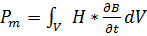 (4)
(4)
These quantities are related to the resistive and radiative energy, or energy
losses, through Poynting’s theorem:
 (5)
(5)
where V is the computation domain and S is
the closed boundary of V. Poynting theorem - a theorem
describing the law of an electromagnetic field energy conservation . The
theorem was proved in 1884 by John Henry Poynting. It comes down to the
following formula [2]:
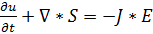 (6)
(6)
The first term on the right-hand side represents
the resistive losses:
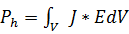 (7)
(7)
which result in heat dissipation in the material. (The
current density J in this
expression is the one appearing in Maxwell-Ampère’s law.)
The second term on the right-hand
side of Poynting’s theorem represents
the radiactive losses [2]:
 (8)
(8)
The quantity is called the Poynting vector.
Under the assumption the material is linear and
isotropic, it holds that:
 (9)
(9)
 (10)
(10)
By interchanging the order of
differentiation and integration (justified by the fact that the volume is
constant and the assumption that the fields are continuous in time), the result
is [1]:
 (11)
(11)
The integrand of the left-hand side is the total
electromagnetic energy density:
 (12)
(12)
For electric and
magnetic fields energy is proportional to the square of the field strength.
Strictly speaking, the term "electromagnetic energy" is not quite
correct.
The calculation of the
total energy of the electric field, even one electron leads to a value equal to
infinity, as the corresponding integral diverges. The infinite energy of the
field is quite the end of the electron is one of the theoretical problems of
classical electrodynamics. Instead, the physics is usually used the concept of
the energy density of the electromagnetic field (to a certain point in space).
The total energy of the field is equal to the integral of the energy density
over the entire space. The energy
density of the electromagnetic field is the sum of the energy densities of
electric and magnetic fields.
References:
1. J. Jin, The Finite Element Method in
Electromagnetics, John Wiley & Sons, NewYork,1993.
2. B.D. Popovic, Introductory Engineering Electromagnetics,
Addison-Wesley,
Reading, Massachusetts, 1971.