Student Pavlovska K., Ph.D.
Kovalenko
M.
National Technical University of Ukraine «Kyiv
Polytechnic Institute», Ukraine
OVERVIEW OF FORCES IN CONTINUUM
MECHANICS
All variety of
naturally occurring interactions is reduced to only four types. This
gravitational electromagnetic, nuclear and weak interactions. In Newtonian
mechanics can be considered only gravitational and electromagnetic
interactions. In contrast to the short-range nuclear and weak interactions, the
gravitational and electromagnetic interaction - the long-range: their actions
are manifested at very large distances.
The main
provisions of continuum mechanics, playing a role of axioms, or the most
important theorems:
1. Euclidean space. The space in which the motion of the body -
three-dimensional Euclidean point space.
2. Absolute time t. The passage of time does not depend on the choice of
the reference system.
3. The hypothesis of continuity. Material body - continuous medium.
4. The law of conservation of mass. Any material body V has a scalar
non-negative characteristic - mass M, which: a) is not changed by any movements
of the body, if the body is composed of the same material points, b) an
additive value.
5. The law of conservation of momentum (change in momentum).
6. The law of conservation of angular momentum (change of angular momentum).
7. The law of conservation of energy (first law of thermodynamics).
8. The existence of absolute temperature (zero law of thermodynamics).
9. The law of entropy balance (the second law of thermodynamics).
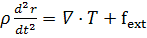
Cauchy’s equation
of continuum mechanics reads
 (1)
(1)
where  is the density,
  denotes the coordinates of a
material point,
denotes the coordinates of a
material point,  is the stress tensor, and
 is an external volume force
such as gravity (
is an external volume force
such as gravity ( ). This is the equation solved
in the structural mechanics physics interfaces for the special case of a linear elastic material, neglecting the
electromagnetic contributions.
). This is the equation solved
in the structural mechanics physics interfaces for the special case of a linear elastic material, neglecting the
electromagnetic contributions.
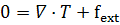
In the stationary
case there is no acceleration, and the equation representing the force balance is
 (2)
(2)
The stress tensor
must be continuous across a stationary boundary between two materials. This
corresponds to the equation
 (3)
(3)
where  and
and  represent the stress tensor in
materials 1 and 2, respectively, and
represent the stress tensor in
materials 1 and 2, respectively, and  is the normal pointing out from
the domain containing material 1. This relation gives rise to a surface force
acting on the boundary between material 1 and 2.
is the normal pointing out from
the domain containing material 1. This relation gives rise to a surface force
acting on the boundary between material 1 and 2.
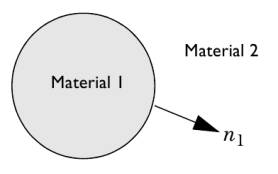
Fig.1 The stress tensor in materials 1 and 2
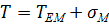
In certain cases,
the stress tensor T can be divided into one part that depends on the
electromagnetic field quantities and one part that is the mechanical stress
tensor,
 (4)
(4)
For the special
case of an elastic body, the mechanical stress tensor is proportional only to
the strain and the temperature gradient. The exact nature of this split of the
stress tensor into an electromagnetic and a mechanical part depends on the
material model, if it can be made at all.
It is sometimes
convenient to use a volume force instead of the stress tensor. This force is
obtained from the relation
 (5)
(5)
This changes the
force balance equation to
 (6)
(6)
or, as stated in the structural
mechanics physics interfaces,
 where
where 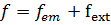 (7)
(7)
In continuum mechanics techniques developed mechanical problems to the
attention of mathematics, that is, to the problem of finding some numbers or
numeric functions using various mathematical operations. In addition, an
important goal of continuum mechanics is to establish the general properties
and laws of motion of deformable bodies and force interactions in these bodies.
Under the influence of continuum mechanics received a large number of
developing branches of mathematics - for example, some sections of the theory
of functions of complex variable boundary value problems for partial
differential equations, integral equations, and others.
References:
1. B.D. Popovic, Introductory Engineering Electromagnetics, Addison-Wesley,
Reading, Massachusetts, 1971
2. R.K. Wangsness, Electromagnetic Fields, 2nd ed., John Wiley & Sons,
1986
3. A. Kovetz, The Principles of Electromagnetic Theory, Cambridge
University Press, 1990