Karachun V.V.
National Technical
University of Ukraine “KPI”
ANALYTICAL STUDY OF
RESONANCE PHENOMENA
IN THE DIFFRACTION OF SOUND WAVES
In the case when
the wave size of the ДУСУ body is much greater than the unit, i.e.
 ,
,
where  – is a wave number;
  – a radius of the
body shell, in a liquid-and-stable component, under certain circumstances, can
be formed disturbance zones, which
are referred to as caustic zones. Caustic surfaces are
confocal to the inner cylindrical surface of the shell. They are formed as a
by-pass of acoustic rays that are transmitted from the same point of the inner
cavity of the device as a result of its circular (along the formers) and
transversal (bending) oscillations. As
a result there occurs a great concentration of sound waves energy in a
liquid-and-stable component.
– a radius of the
body shell, in a liquid-and-stable component, under certain circumstances, can
be formed disturbance zones, which
are referred to as caustic zones. Caustic surfaces are
confocal to the inner cylindrical surface of the shell. They are formed as a
by-pass of acoustic rays that are transmitted from the same point of the inner
cavity of the device as a result of its circular (along the formers) and
transversal (bending) oscillations. As
a result there occurs a great concentration of sound waves energy in a
liquid-and-stable component.

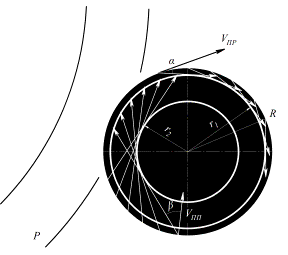 Energy focusing
energy of an ultrasonic beam. Surfaces of caustic. We will show some original
aspects of arising energy focusing of penetrating acoustic radiation. Let’s
consider an average former (Fig. 1).
Energy focusing
energy of an ultrasonic beam. Surfaces of caustic. We will show some original
aspects of arising energy focusing of penetrating acoustic radiation. Let’s
consider an average former (Fig. 1).
Suppose that the float is missing. A sound wave Р, which is falling from outside on the ДУСУ body, generates in the
material circular (along the former
circle) oscillations

 , which extend in a parallel direction with velocity
  , i.e, along the lateral surface of the shell, and also Fig. 1. Energy focusing of
acoustic radiation bending (radial) oscillations
, i.e, along the lateral surface of the shell, and also Fig. 1. Energy focusing of
acoustic radiation bending (radial) oscillations
 in the plane of the
former at velocity
in the plane of the
former at velocity  .
.
First
of all, let us find out the mechanism of circular waves. Taking the lateral
surface of the ДУСУ body as a shell of a sufficiently large wave size, let’s
consider any separate element of the inner surface of the former as a plate of
zero curvature, where the velocity of longitudinal waves coincides with the
circular velocity  of the shell.
If the
velocity of longitudinal waves  is greater than the
sound speed
is greater than the
sound speed  in liquid, i.e.,
  , then the wave traveling along the parallel will radiate a
sound wave in liquid, and the direction of its propagation together with the
vector velocity
, then the wave traveling along the parallel will radiate a
sound wave in liquid, and the direction of its propagation together with the
vector velocity  will constitute the
angle
will constitute the
angle  , which is calculated by the formula (Fig. 1):
 .
.
As a
result, much of the sound wave energy will be focused around a circle of radius
 (Fig. 1)
 .
.
For
example, if we take the radius of the inner cavity of the ARS body as  , take aluminum alloy as material (
 ,
,  ) a liquid-and-static gimbal - of glycerol (
 ), and the frequency of the ultrasonic beam f=42 kHz, then the wave size will be 3,43.
It is
not difficult to calculate the radius of the caustic surface (Fig. 1) –
 .
.
It is clear that if
 , the angle
  and the wave
travelling along the parallel will radiate a sound wave (that crosses the axis
of the device here) in liquid. Thus, aberration will disappear and the caustic
surface turned to the geometric locus of points of energy concentration that
are located on the ДУСУ axis. Similarly, if
and the wave
travelling along the parallel will radiate a sound wave (that crosses the axis
of the device here) in liquid. Thus, aberration will disappear and the caustic
surface turned to the geometric locus of points of energy concentration that
are located on the ДУСУ axis. Similarly, if  , then
  and the caustic
surface is not formed by a bending wave.
and the caustic
surface is not formed by a bending wave.