PhD.: Aubakirova Z.Y.
Master of Academy:
Altynbekova G.A.
Al-Farabi Kazakh
National University, Kazakhstan
Social policy as
a factor in sustainable economic development and economic security
Social
protection and social policy is always pressing issue of economic policy and
economic efficiency. This is even more important for Kazakhstan, ascertaining
the welfare state itself. Socially oriented market economy involves a
significant activity of the state in solving social problems. This is due to
the fact that the market economy does not guarantee workers the right to work,
the standard of well-being, education, and does not provide social protection
of the disabled people, the poor and pensioners. Therefore there is a need for
government intervention in the distribution of income by the scope of social
policies. In the end everything depends for the solution of this problem: the
power and independence of the state, welfare of the people, the stability of
the political atmosphere in the society [1].
Among
the main tasks undertaken in the field of social policy and its important areas
- social protection should include: the reform of the housing sector; revision
of the principles of functioning of insurance institutes general and the
pension system, in particular [2].
The
formation of modern forms and models of the state social policy occurred in the
second half of the XIX century in Western Europe and was conditioned by the
needs of industrialization of their economies and the regulation of social
order. [3]
To
date, there are following main types of welfare states: a model of Bismarck,
Beveridge model and the Swedish model.
Model
of Bismarck. By its basic characteristics should include the following: the
size of pensions and benefits dependent on salary.
This
model is characterized by the management of democracy and transparency of
financial flows. To the states relating to the model (Germany, France, Greece)
the main political objective of putting income protection while laying
responsibility for the opportunity of having a job on the worker.
Beveridge
model. Its general characteristics are as follows.
Three-level
type of social protection, which assigned to the state obligation to provide
basic guarantees of social protection to the entire population, for an employer
- social (professional) employees insurance (in which the employee takes
partial participation), the employee - an additional private insurance. W.
Beveridge believed that family allowances and the national health service
should be financed from the state budget, and other measures of social
protection - by contributions of employees and employers themselves, as well as
state subsidies. Beveridge system, common in the UK and Ireland, based on the
principles: every citizen should be covered by social insurance benefits or
social assistance in an emergency (illness, retirement age, death, birth,
etc.).
Next
model is a Swedish. Highlights: the financing of social expenditure due to the
revenue side of the budget; a high level of accessibility and measures of
social support of the population [4].
The
Scandinavian model, which exists in Sweden, Norway, Finland, Denmark, adheres
to the principles of: all living in the country have the right to social
security; all work shall be entitled to benefits depending on earnings. State
as its main political task puts full employment and assumes responsibility for
it.
If
we consider the transformation of the social security systems in the CIS
countries, it can be said that they are moving from the Nordic model to the
Beveridge model.
The
term "Scandinavian model" refers to a greater extent to the social
sphere, as the Nordic countries are very close to the area of
social policy. Social and economic leader in the region in favor
Sweden and therefore equivalent to the term "Scandinavian model" was
the term "Swedish model." A specific feature of the Swedish model is
that economic policy is actively pursued two goals: maximum employment and
income equality. To solve them, the state intervenes in the labor market and
contains an exceptionally large public sector engaged in the redistribution of
income for these purposes [5].
The
uniformity of the distribution of income among all the inhabitants of the
country is the foundation of social stability. The Gini coefficient is a
statistical measure of the degree of separation for a particular feature of
society. Income inequality is one of the social problems of modern society. [6]
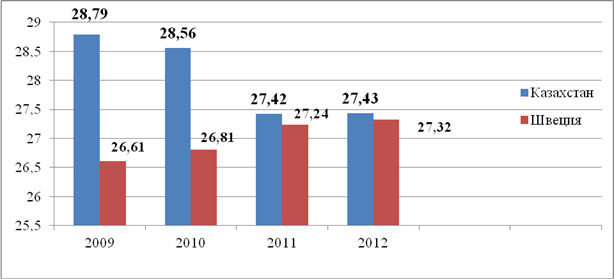
Image
1. Gini indices in Kazakhstan and Sweden
[Note:
Compiled by the author on the basis of the Republic of Kazakhstan Statistics
Agency [7]. * 2012 year the most recent available.
For
several decades, the most widely used indicator to measure inequality in
society is the indicator of the concentration of household income - Gini
coefficient. But whether it is authentic? It might seems that within the same
country, and it is such, but not on a global scale. Each country has its own characteristics
and strategies for optimization of inequality, its parameters and depth, there
is no universal and equal for all countries equal the best indicator of
concentration of income - Gini coefficient [6].
As
you can see from the performance difference between the developed social
Switzerland and Kazakhstan is insignificant, thus showing discrepancies of Gini
index.
Incomes
of the population formed by receiving wages, pensions, scholarships, grants,
revenues from the sale of goods produced on their own farm, as payment for
services rendered, revenues from the sale of personal property, renting it.
Table
1. Statistical data on pensions and pensioners in Kazakhstan
|
|
2010 |
2011 |
2012 |
2013 |
2014 |
2015 |
|
The
number of pension recipients, people |
1695301 |
1732412 |
1759321 |
1863615 |
1918516 |
1980847 |
|
The
average amount of the granted pension, to KZT |
21238 |
27388 |
29644 |
31918 |
36068 |
38933 |
|
The
number of recipients of state social benefits, people |
767239 |
778504 |
768747 |
791631 |
774149 |
767458 |
|
The
average size of a designated state social benefits, to KZT |
14037 |
15520 |
16384 |
17738 |
19918 |
21674 |
|
The
minimum pension, to KZT |
12344 |
16047 |
17941 |
19066 |
21736 |
23692 |
[Note: The table is
compiled by the author on the basis of the Republic of Kazakhstan Statistics
Agency data http://www.stat.kz [8]].
The
number of recipients of pensions in the Republic of Kazakhstan in 2015 amounted
to 1980.8 thousand people, while the average monthly pension was assigned to
21674 tenge, and the minimum pension was 23692 tenge.
Table
2. Statistical data on pensions and pensioners in Sweden
|
|
2013 |
2014 |
2015 |
|
all pensions |
2
056 739 |
2
102 171 |
2
141 269 |
|
the number of pension recipients, people |
2
070 113 |
2
116 486 |
2
156 924 |
|
guaranteed pension |
761 602 |
786 859 |
770 189 |
|
retirement income |
1
224 700 |
1
333 519 |
1
434 426 |
|
supplementary pension |
1
945 739 |
1
997 403 |
2
033 232 |
|
premium pension |
1
111 513 |
1
217 035 |
1
314 551 |
|
property Extras |
274 270 |
284 640 |
290 663 |
|
in particular, additional
retirement |
977 |
918 |
850 |
[Note: Compiled by the author
based on the Swedish Pensions Agency https://secure.pensionsmyndigheten.se/FAQEnglish.html
data [9]].
As
part of the social policy of the Republic of Kazakhstan, one of the strategic
priorities of the government announced provision of decent employment as its
main type of social security. Providing employment is an essential condition
for the development and implementation of human resources, the main means of
social wealth growth and quality of life. Raising living standards in
Kazakhstan with the 2000s is a stable trend, which is confirmed by the positive
dynamics of income and other indicators, traditionally used for this feature.
[10]
In
the twentieth century happened in Sweden, which is often called the
"economic miracle". This welfare state has attracted great attention
from experts in the social sciences and policy makers around the world, and its
experience to some degree was acceptable for other countries. The economic
success of Sweden and a high growth rate in the last ten years show that the
direction of reform in Swedish was chosen correctly. Therefore, the study of
Swedish experience in this regard, it is important for economic science, and for
the post-Soviet practices
[8].
Experience
in other countries shows that the success of the social state is possible only
on the basis of a highly developed economy, which must be effective, socially
oriented, serving the interests of all strata of society. Kazakhstan needs to
take into account the positive experience of developed countries in the
construction of legal, democratic and social state, especially in the formation
of state policy in the field of education, health and social assistance, as the
most important areas of social policy to achieve this level.
References
1. Z.S.
Muhambetova, J.C. Bulanov, T. J. Talap, Social Policy of the Republic of
Kazakhstan at the present stage. Collectors conferences SIC sociosphere - 2013.
№ 57. p.82-84.
2. Orazgalieva
A.K. Prospects and the development of an integrated social protection system in
the Republic of Kazakhstan. Siberian financial school: AVAL. - 2009. - N 3. -
p. 34-36.
3. E.I.
Holostova, prof. G.I. Klimantova, Social Policy: A guidebook for undergraduate
/ M: Yurayt, 2011, p. 367.
4. Sochneva
E.N. Analysis of the current model of Russia's social policy. Problems of
Modern Economics, N 3 (27), 2008
5. A.Volkov
Scandinavian model. World and national economy. MGIMO Russian Edition. - 2013.
№ 1 (24).
6. A.D.
Kosmin, V.A. Siryak Factor Jinny as an indicator of population appeasement.
Bulletin of Omsk University. "Economy" series.2011. № 1. p. 57-63.
7. Internet
resource. [Access]: http://knoema.ru/atlas. World Data Atlas.